
If you are a CEO or CFO in an AI company, here is the hard truth:
You do not have an FP&A problem. You have a system design problem.
Because in AI, the question is not, “Do we have a forecast?”
It is, “Can we understand change fast enough to act on it?”
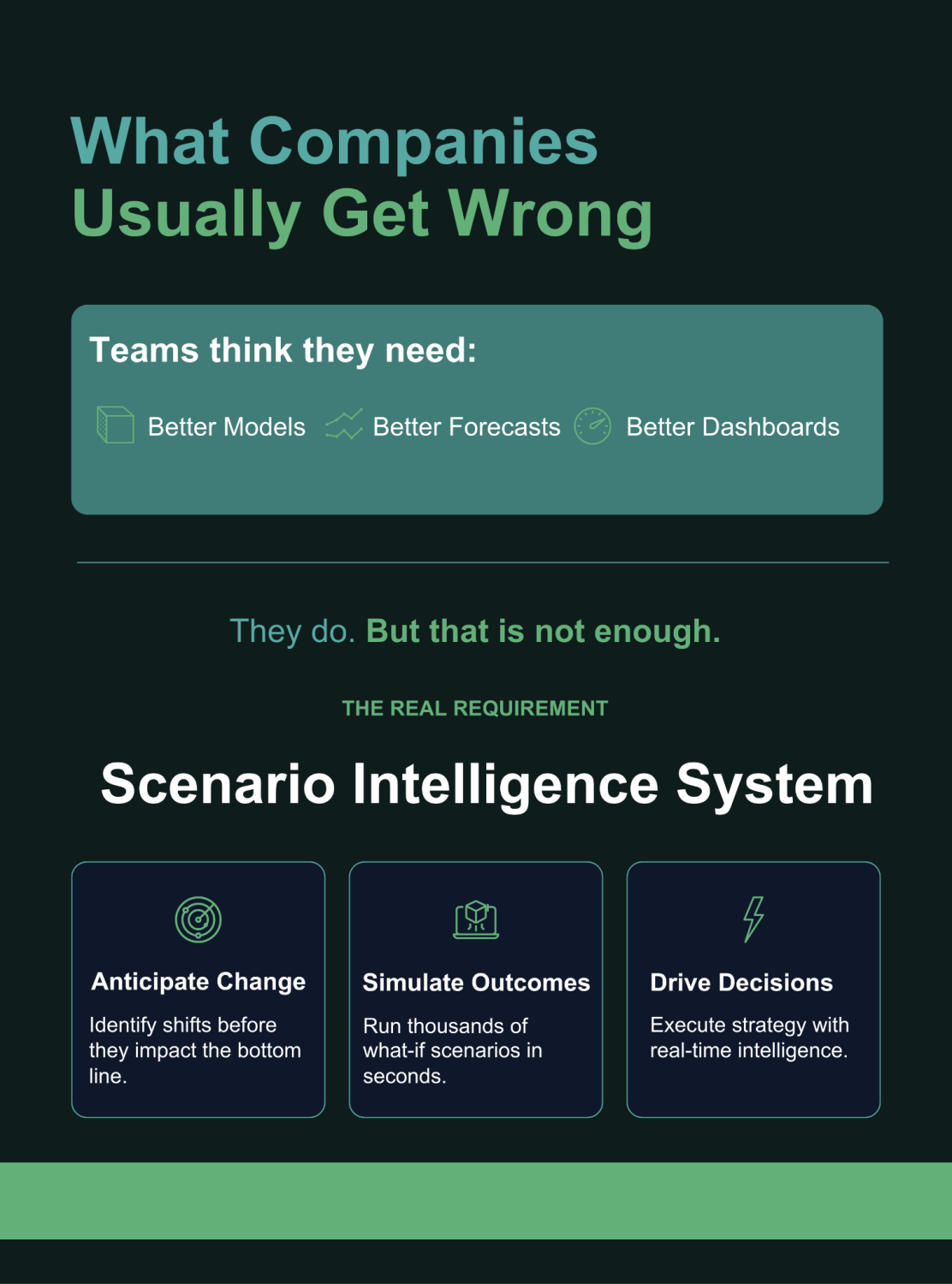
What Companies Usually Get Wrong
Most teams think they need:
-
Better models.
-
Better forecasts.
-
Better dashboards.
They do.
But that is not enough.
What they really need is a scenario intelligence system.
A system built to:
-
Anticipate change.
-
Simulate outcomes.
-
Drive decisions in real time.
Why This Matters
As a CEO, you need clarity under uncertainty.
As a CFO, you need a system that keeps up with the business — not one that lags behind it.
If your team is always reacting, it is usually not a people problem.
It is a design problem.
The Three Layers
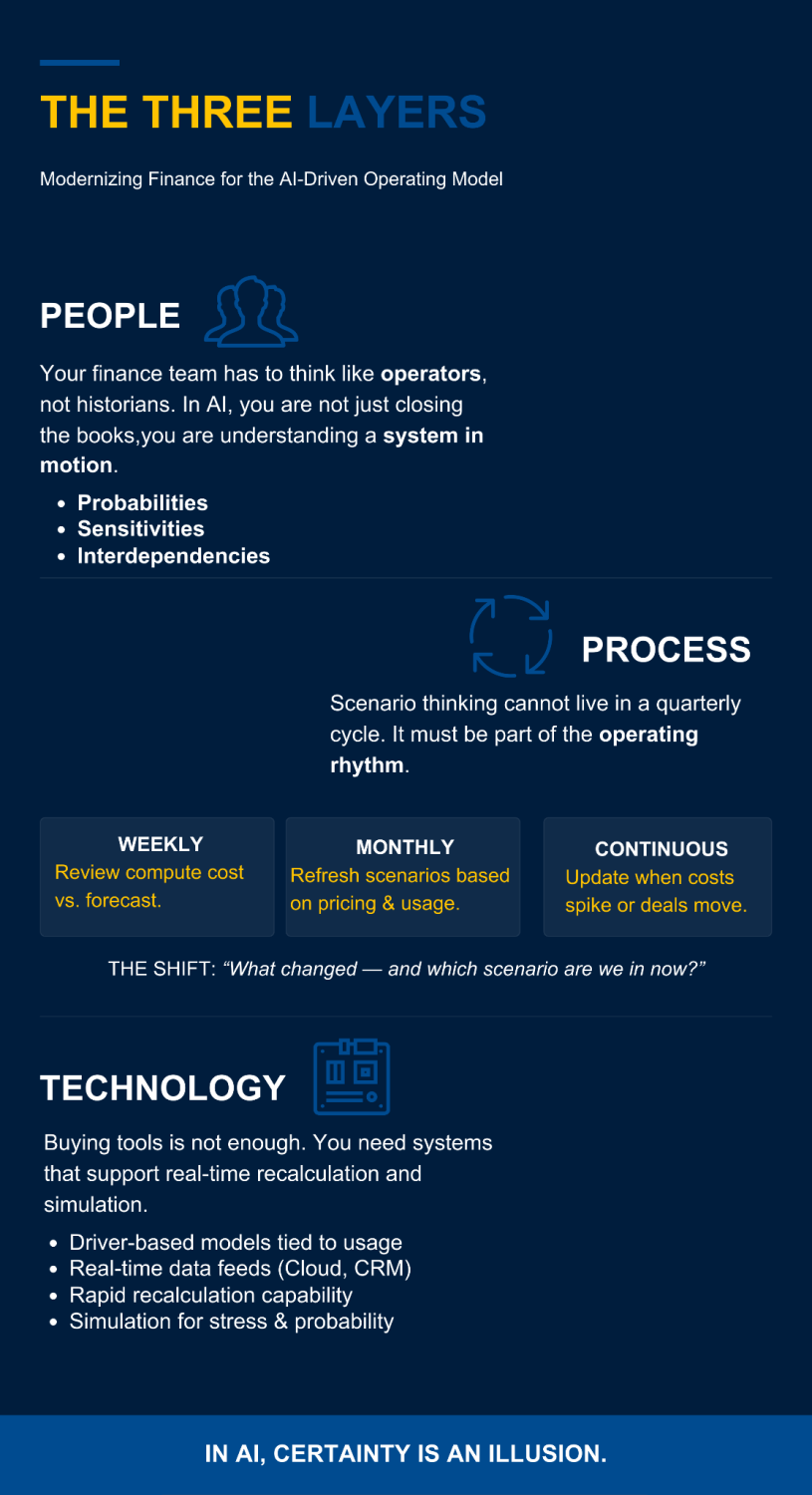
1. People Your finance team has to think like operators, not historians.
That means thinking in:
-
Probabilities.
-
Sensitivities.
-
Interdependencies.
In AI, you are not just closing the books. You are trying to understand a system in motion.
2. Process Scenario thinking cannot live in a quarterly planning cycle.
It has to be part of the operating rhythm:
-
Weekly: review compute cost vs. forecast.
-
Monthly: refresh scenarios based on pricing, usage, and pipeline changes.
-
Continuous: update when costs spike, usage shifts, or deals move.
The shift is simple: From, “Let’s revisit the forecast,” To, “What changed — and which scenario are we in now?”
3. Technology Most companies buy tools and stop there.
That is not enough.
You need systems that support:
-
Driver-based models tied to usage, pricing, and unit cost.
-
Real-time data feeds from cloud billing, product usage, and CRM.
-
Rapid recalculation when assumptions change.
-
Simulation capability for range, stress, and probability-weighted outcomes.
In AI, certainty is an illusion.
Your system should reflect that.
1. MongoDB: “Usage vs. monetization” and scenario intelligence
MongoDB is a strong example of a consumption‑based AI‑era model where the CFO simply cannot afford a lagging FP&A system.
Its Atlas cloud database is consumption‑priced; AI workloads naturally increase data volume and queries, which directly drive revenue.
If usage spikes but the underlying mix leans toward low‑margin trials or dev‑style workloads, gross margin and margin expansion can decouple from revenue growth.
In your article, you can frame MongoDB as a company that needs a scenario intelligence system:
“MongoDB’s Atlas usage patterns mean the CFO must know instantly whether a surge will be profitable, not just whether the model can recalculate in a week.”
2. HubSpot: people, process, and AI‑driven workflows
HubSpot is a good example of blending AI, people, and operating rhythm without being a pure‑play AI‑chip or hyperscaler.
It has embedded AI agents inside sales, marketing, and service workflows, and recently emphasized “hybrid human‑AI teams” and workflow‑triggered AI across its CRM.
For a CFO, that means sales cycles, win rates, and customer‑lifetime‑value can shift as AI agents change lead scoring, quoting, and support speed.
You can use it to show how scenario thinking must live in the operating cadence, not just in quarterly planning:
“HubSpot’s AI‑driven workflows force finance to think in probabilities and sensitivities, not just bookings and ARR.”
3. ServiceNow: “AI control tower” and real‑time decision‑making
ServiceNow is a clean example of a system‑of‑record turning into a scenario intelligence layer.
It markets itself as an “AI control tower for business reinvention,” tying AI‑powered workflows directly to IT, operations, and finance‑adjacent metrics.
The company talks about AI‑driven cost savings and margin expansion, which depend on quickly seeing how AI adoption changes cost structures and throughput.
You can use ServiceNow to show what a real‑time decision engine looks like:
“ServiceNow’s AI control‑tower framing is exactly the kind of system design the CFO needs: a layer where what‑changed, what‑it‑means, and what‑we‑do are wired together.”
What Good Looks Like
A real scenario intelligence system does more than report.
It tells you:
-
What changed.
-
What it means.
-
What action follows.
If compute costs move, the model updates.
If usage outpaces revenue, the scenario shifts.
If pipeline slips, the runway impact shows up immediately.
That is the difference between reporting and operating.
A Simple Test
Ask yourself:
If one key variable changes today, how long does it take to see the impact?
-
Hours.
-
Days.
-
Weeks.
That answer tells you how well your system is built.
Final Thought
If your FP&A system cannot recalculate your future in minutes, it is not built for an AI business.
The winners in AI will not be the ones with the best forecasts.
They will be the ones with the best systems for adapting to change.
Go deeper: Guide 02, FP&A, Budgeting & Board Reporting, part of the CFO Guide Series: 24 one-page guides for CEOs and founders.
