
The Nimble CFO in AI (Part 3): From Scenarios to Action — Building a Real-Time Decision Engine
It is Monday morning.
Usage is up. Your cloud bill is higher than expected. Sales says a key enterprise deal may slip.
Now the only question that matters is:
What do we do right now?
Where Most Teams Get Stuck
Most companies are not short on scenarios.
They have:
-
A model.
-
A planning deck.
-
A set of what-if cases.
But when conditions change, decisions still happen in real time — with uncertainty.
Why?
Because the scenarios were built for discussion, not execution.
The Shift: Scenario Planning to Scenario Execution
High-performing teams treat scenarios as operating infrastructure, not analysis.
The shift is simple:
-
“We will evaluate when something happens.”
-
Becomes: “If X happens, we already know what we are doing.”
That is where speed comes from.
Introducing Scenario-Triggered Actions
Instead of static plans, you define:
-
Clear triggers tied to real metrics.
-
Predefined actions tied to each trigger.
Think of it as building decision rules into the business.
Not reactions. Responses.
What This Looks Like in Practice
These are not edge cases. This is day-to-day reality in AI companies.
Scenario: Compute Costs Spike Signal: cloud dashboard + cost alerts
Typical response:
-
“Let’s monitor it.”
-
“We will review at month-end.”
Nimble response:
-
Throttle or limit low-margin usage.
-
Adjust pricing tiers, caps, or overages.
-
Shift workloads, optimize models, or reallocate compute.
No escalation cycle. Action is already defined.
Scenario: Enterprise Pipeline Slows Signal: CRM shows deal slippage and longer sales cycles
Typical response:
-
Assume deals will close next month.
-
Maintain current spend.
Nimble response:
-
Slow or reprioritize hiring.
-
Extend runway assumptions immediately.
-
Shift GTM toward faster-converting segments.
You are not reacting late. You are adjusting in stride.
Scenario: Usage Surges, Monetization Lags Signal: usage up 2x, revenue not keeping pace
Typical response:
-
Celebrate growth.
-
Worry about margins later.
Nimble response:
-
Prioritize high-value or paying customers.
-
Introduce usage controls or pricing guardrails.
-
Renegotiate cloud/vendor terms proactively.
-
Selectively accelerate infrastructure where ROI is clear.
Growth is managed, not just absorbed.
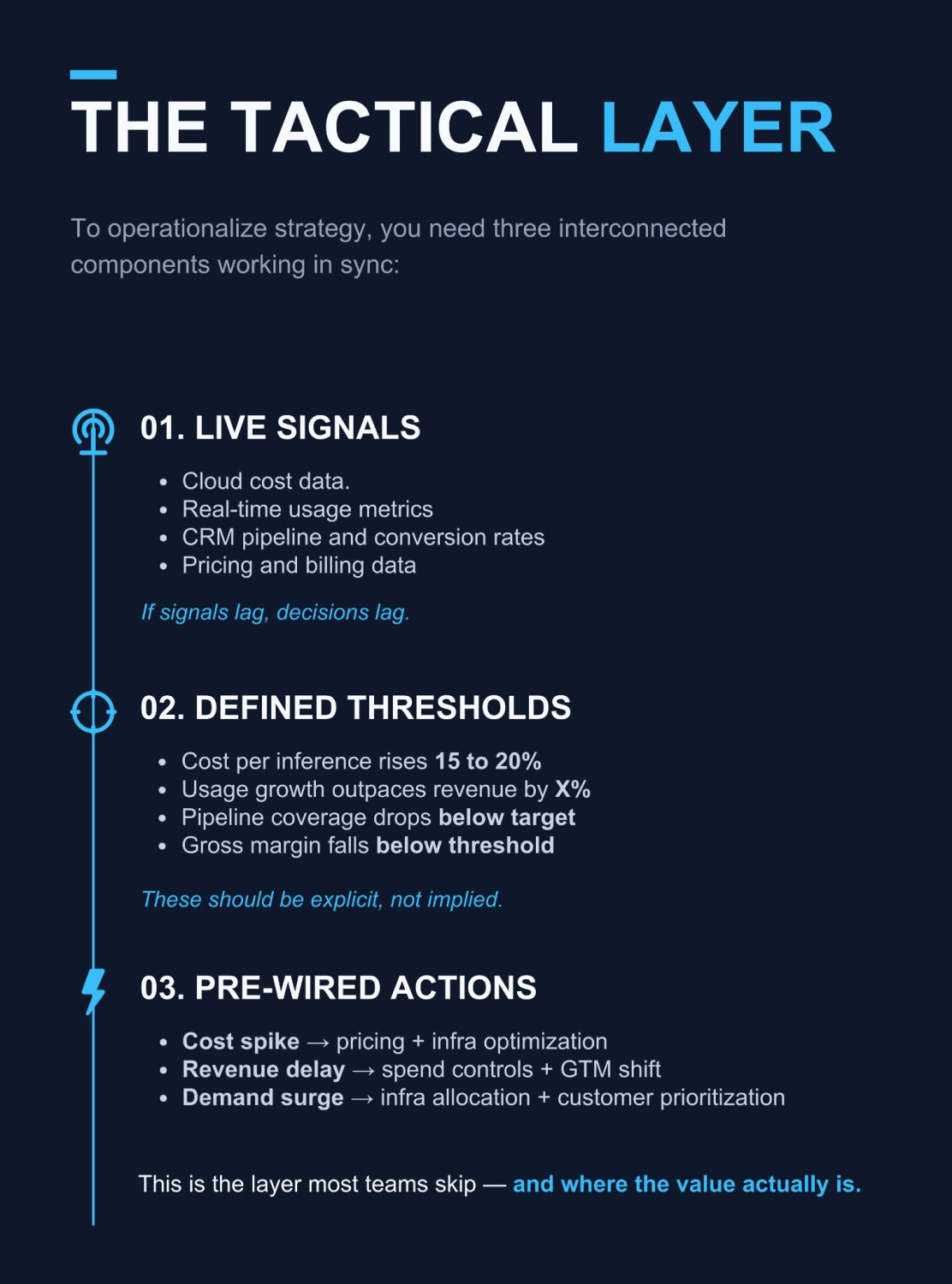
The Tactical Layer
To operationalize this, you need three things working together:
1. Live Signals
-
Cloud cost data.
-
Usage metrics.
-
CRM pipeline and conversion rates.
-
Pricing and billing data.
If signals lag, decisions lag.
2. Defined Thresholds
-
Cost per inference rises 15 to 20%.
-
Usage growth outpaces revenue by X%.
-
Pipeline coverage drops below target.
-
Gross margin falls below threshold.
These should be explicit, not implied.
3. Pre-Wired Actions For every trigger: “If X, we do Y.”
-
Cost spike → pricing + infra optimization.
-
Revenue delay → spend controls + GTM shift.
-
Demand surge → infra allocation + customer prioritization.
This is the layer most teams skip — and where the value actually is.
Where Software Fits
Modern systems now make this feasible:
-
Real-time cloud cost monitoring.
-
Usage-level analytics.
-
CRM plus financial model integration.
They enable immediate visibility and continuous updates.
But they do not decide.
They surface signals. The response still depends on how well the business is pre-wired.
Example: Microsoft / Meta / AWS–style hyperscalers
Microsoft and Meta have repeatedly raised AI‑related capex and cloud-cost guidance as component prices and GPU demand moved sharply.
In both cases, usage and AI workloads grew faster than expected, but CFOs had to decide quickly whether to:
throttle lower‑margin or experimental workloads,
renegotiate chip/cloud terms, or
shift spend toward higher‑ROI infrastructure.
That is exactly the “cost spike → pre‑wired action” scenario: no ad‑hoc debate, just a calibrated response already baked into the operating model.
1.Trigger: Enterprise pipeline slows
Example: Palantir
Palantir’s commercial AI business is heavily dependent on enterprise deal timing and ramp‑up. When large platform deals push out or adoption lags, revenue and margin timelines shift even if usage is strong.
A nimble FP&A layer here would define triggers such as:
“If pipeline coverage drops below 1.5x target, slow new headcount in non‑core AI units.”
“If net retention on new AI products falls below X, shift GTM spend toward higher‑ACV verticals.”
That turns a pipeline‑slowdown scenario into a predefined set of capital and resource actions, not a panic‑planning session.
2.Trigger: Usage surges, monetization lags
Example: OpenAI (via partners and consumption models)
OpenAI’s usage-based API and consumption‑driven offerings create a classic “usage up, revenue lags” situation, especially as enterprise customers ramp pilots before full commercialization.
A pre‑wired CFO layer would include rules like:
“If usage grows 2x YoY but revenue per unit only grows 10–20%, apply usage caps or tiered pricing to high‑volume free tiers.”
“If certain customer segments consume heavily but convert slowly, prioritize renegotiation or stricter onboarding guardrails.”
This mirrors your “usage surge → controlled response” scenario with real-world dynamics.
3.Trigger: Cloud vs. owned infrastructure pressure
Example: CoreWeave vs. big‑cloud hyperscalers (AWS, Azure)
CoreWeave is explicitly built around GPU‑heavy AI infrastructure, where cost per inference and capacity decisions are constantly in flux.
Its customers (including large AI firms) must decide whether to:
stay on high‑cost cloud,
shift to CoreWeave or similar providers, or
build owned infrastructure.
For a nimble CFO, this map becomes:
“If cloud cost per inference rises above X, we trigger an evaluation of CoreWeave or co‑lo options.”
“If demand exceeds cloud capacity at acceptable economics, we accelerate owned‑infrastructure planning.”
This is exactly the “signal → threshold → action” layer you describe.
4.The “real-time decision engine” in action
You can underscore the article with a short, integrated example:
“Microsoft shows how a spike in cloud‑AI costs can force instant trade‑offs between capacity and margin.
Palantir shows how a slowdown in enterprise deals can quickly shift hiring and GTM priorities.
OpenAI‑style models show how usage surges must be paired with pre‑defined pricing and usage rules.
CoreWeave illustrates how infrastructure choices can be turned into explicit thresholds and triggers, not quarterly debates.”
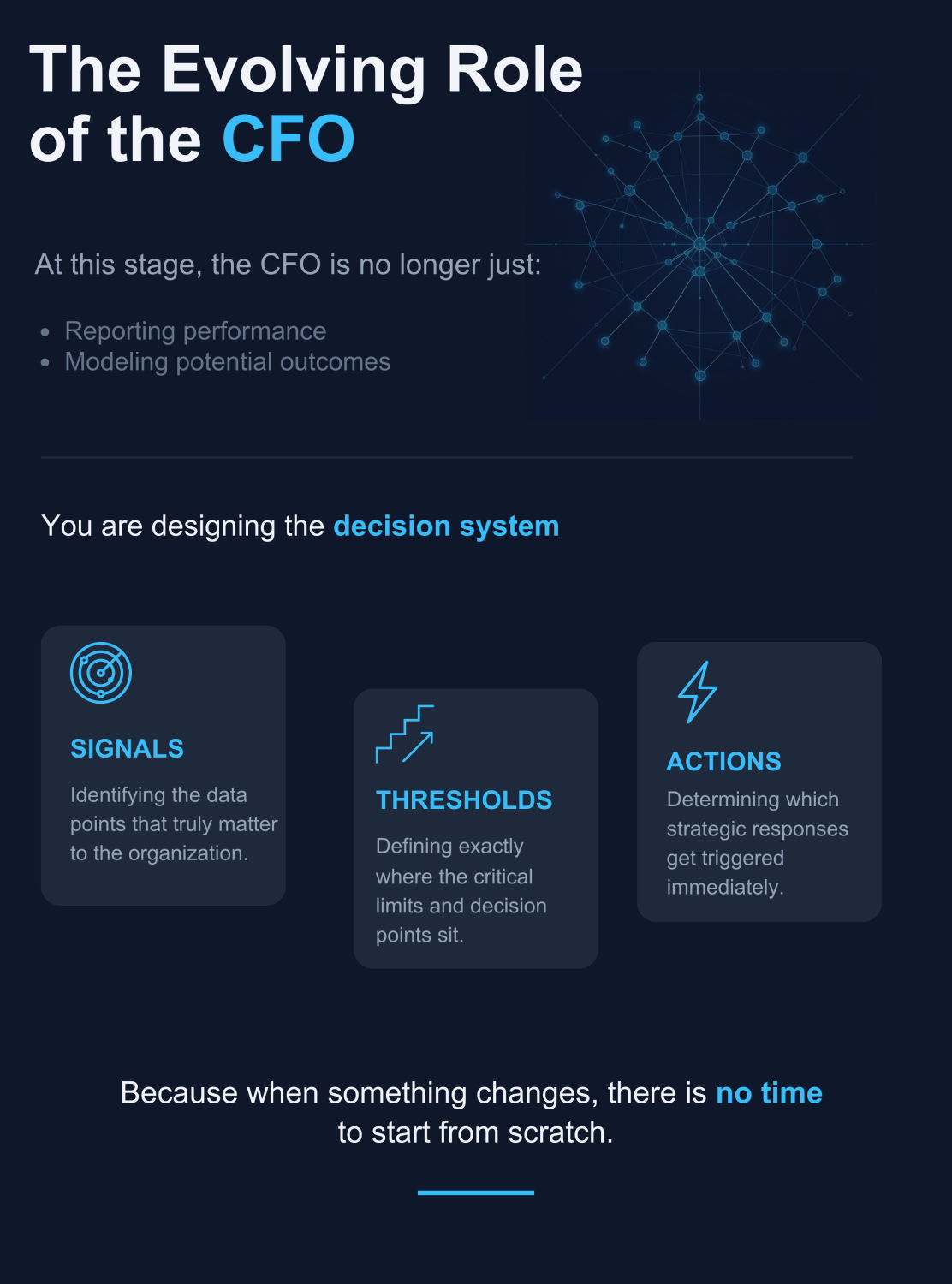
The Evolving Role of the CFO
At this stage, the CFO is no longer just:
-
Reporting performance.
-
Modeling potential outcomes.
You are designing the decision system:
-
What signals matter.
-
Where thresholds sit.
-
What actions get triggered.
Because when something changes, there is no time to start from scratch.
A Simple Test
Ask yourself:
-
If costs spike tomorrow, what actions trigger automatically?
-
If revenue slips this week, what changes immediately?
-
If demand doubles, how do we allocate capital and capacity?
If the answer is “we need to discuss,” you are still in reactive mode.
Final Thought
In AI, speed is not just an advantage.
It is a control mechanism.
The best FP&A teams do not just model scenarios. They embed decisions into them.
So when reality shifts, execution is already in motion.
Go deeper: Guide 02, FP&A, Budgeting & Board Reporting, part of the CFO Guide Series: 24 one-page guides for CEOs and founders.
