
The Nimble CFO in AI (Part 5): Scenario Intelligence as a Competitive Advantage
Let’s zoom out.
Over the last few articles, we have covered:
-
Why static FP&A fails.
-
Why astuteness matters.
-
How to turn scenarios into action.
-
How to build a system that actually keeps up.
But the bigger point is this:
This is not just about better finance.
It is about winning in AI.
The Real Divide
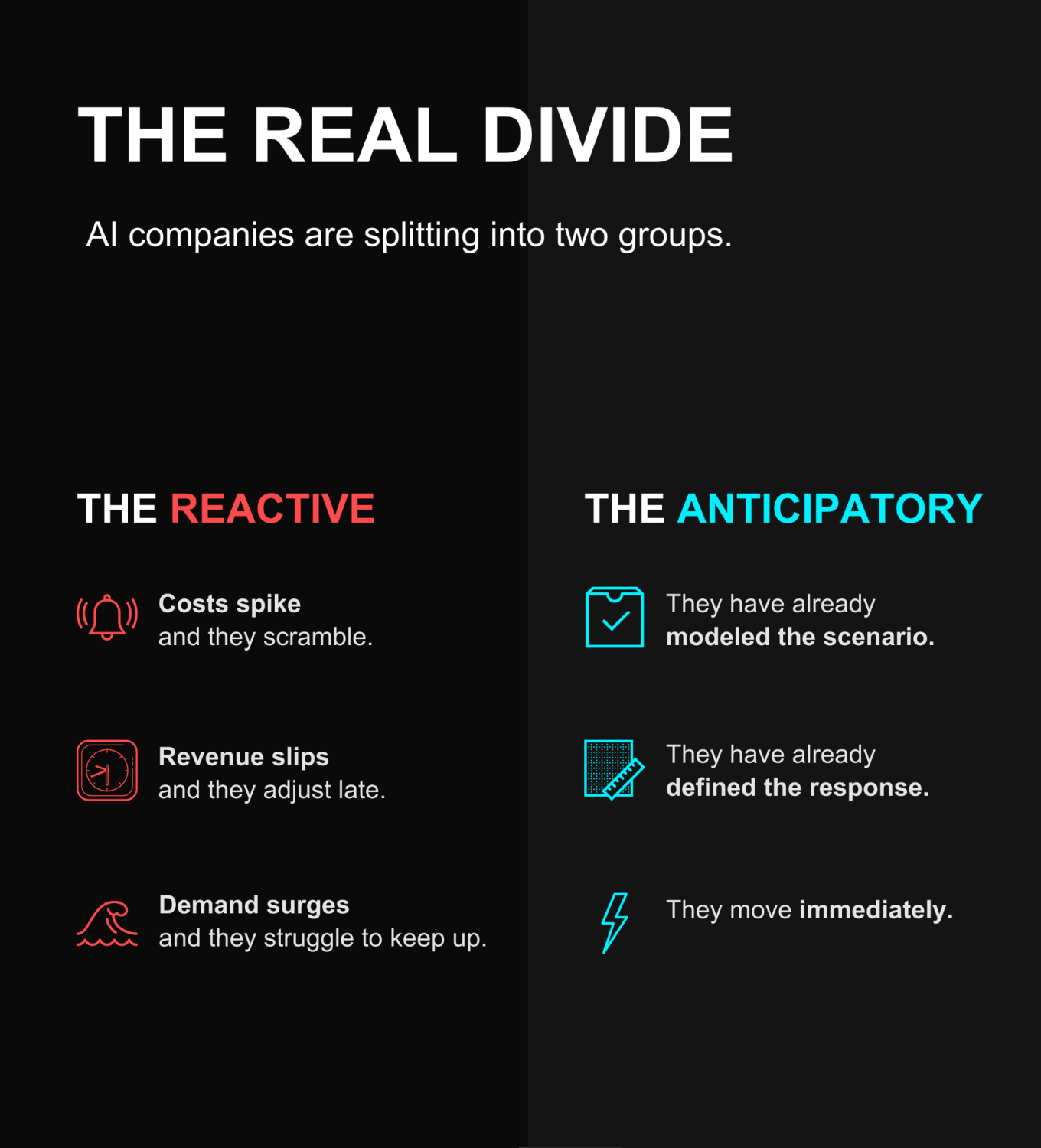
AI companies are splitting into two groups.
The first group reacts.
-
Costs spike, and they scramble.
-
Revenue slips, and they adjust late.
-
Demand surges, and they struggle to keep up.
The second group anticipates.
-
They have already modeled the scenario.
-
They have already defined the response.
-
They move immediately.
Same market. Same volatility. Very different outcomes.
Where Companies Sit Today
Most teams fall somewhere along this curve:
-
Reactive: no scenario planning.
-
Structured: static scenarios.
-
Predictive: driver-based scenarios.
-
Adaptive: real-time scenario updates.
-
Strategic: scenario-driven decision-making.
The uncomfortable truth?
A lot of teams think they are predictive. In practice, they are still structured.
Why AI Makes This So Important
AI amplifies everything:
-
Cost volatility from compute, memory, and infrastructure.
-
Demand unpredictability from usage and monetization timing.
-
Capital intensity from build-versus-buy decisions.
That means small misses can turn into major outcomes.
In AI, timing matters as much as strategy.
Where Scenario Intelligence Creates Advantage
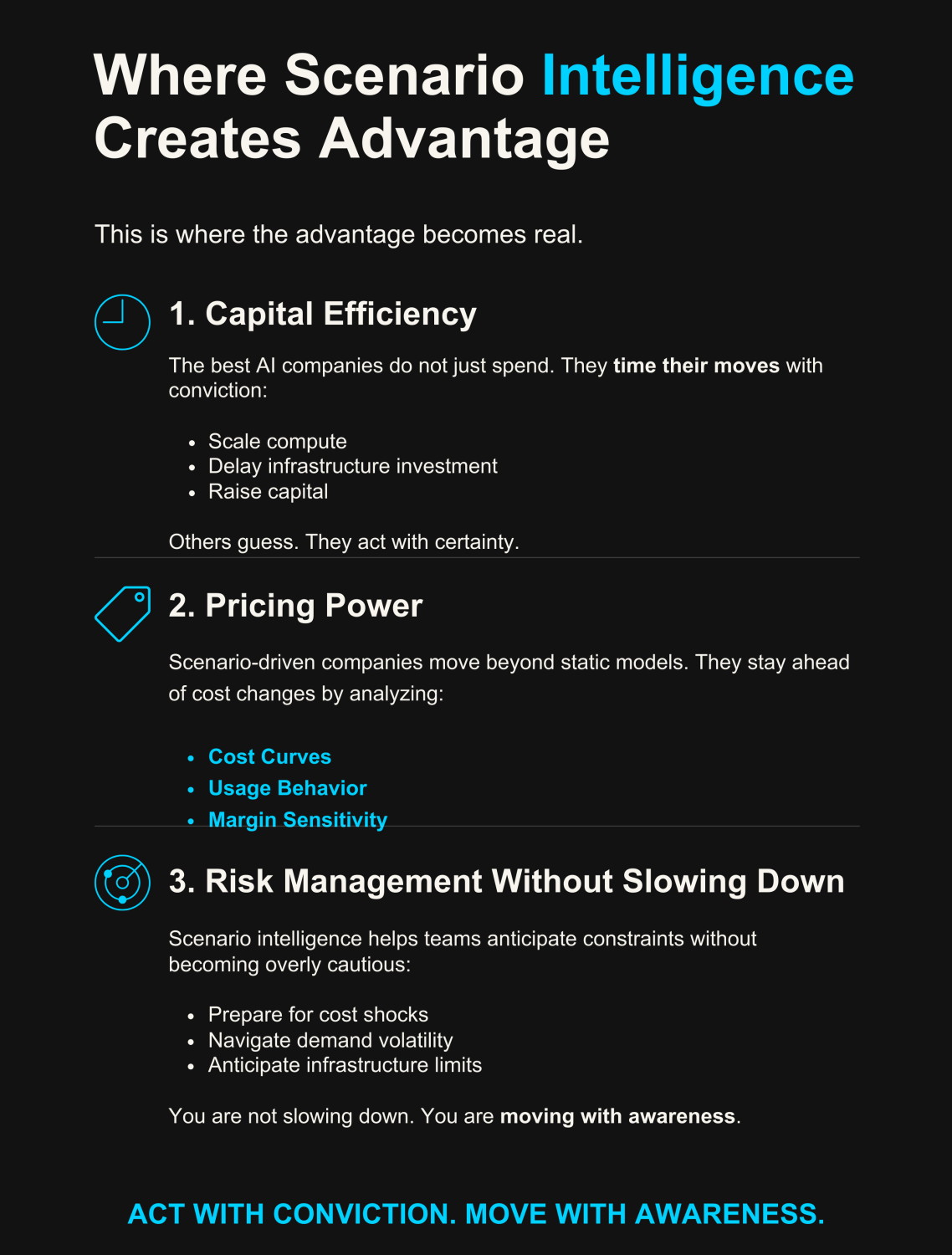
This is where the advantage becomes real.
1. Capital Efficiency The best AI companies do not just spend. They time their moves. They know when to:
-
Scale compute.
-
Delay infrastructure investment.
-
Raise capital.
Others guess. They act with conviction.
2. Pricing Power Most companies price based on:
-
Competitors.
-
Intuition.
-
Static models.
Scenario-driven companies price based on:
-
Cost curves.
-
Usage behavior.
-
Margin sensitivity.
They do not just react to cost changes. They stay ahead of them.
3. Risk Management Without Slowing Down Scenario intelligence helps teams:
-
Prepare for cost shocks.
-
Navigate demand volatility.
-
Anticipate infrastructure constraints.
Without becoming overly cautious.
You are not slowing down. You are moving with awareness.
What This Looks Like
Two AI companies face the same situation:
-
DRAM prices rise.
-
Compute costs increase.
-
Usage keeps growing.
Company A reacts:
-
Margins compress.
-
Cost cuts happen late.
-
Decisions lag.
Company B is scenario-driven:
-
The impact was already modeled.
-
Pricing or workloads are adjusted immediately.
-
Control and momentum stay intact.
Same inputs. Different outcomes.
The New Standard
This changes the role of the CFO and CEO.
You are no longer just:
-
Reporting performance.
-
Managing costs.
You are building a system that:
-
Anticipates change.
-
Simulates outcomes.
-
Drives faster decisions than competitors.
That is not a finance function. That is a competitive advantage.
The Framework
If you take one thing from this series, it is this:
-
Fluidity = ability to adapt.
-
Astuteness = ability to judge.
-
Scenario intelligence = ability to anticipate.
Most teams have one. Few have all three.
That combination is the edge.
Final Thought
In AI, the future is not forecasted. It is simulated.
And the companies that simulate it best will win
Go deeper: Guide 02, FP&A, Budgeting & Board Reporting, part of the CFO Guide Series: 24 one-page guides for CEOs and founders.
