
Someone will bring you a business case this quarter that compares a subscription price against a number of hours saved. The subscription is real. Almost everything else in that comparison is missing.
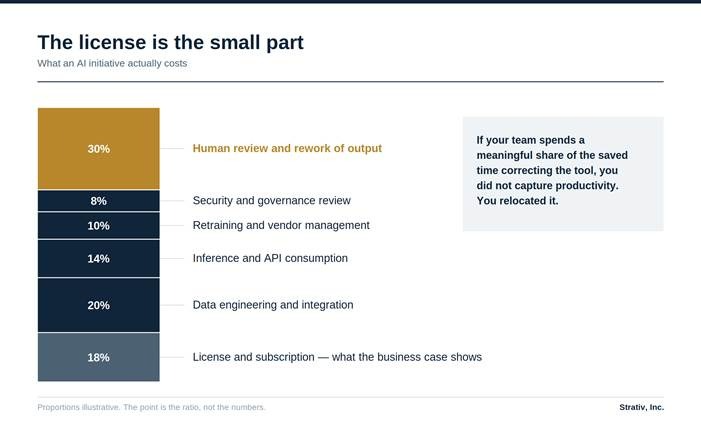
Proportions illustrative. The point is the ratio, not the numbers.
The item at the top of that stack is where the return actually goes, and it appears in almost no business case I’ve been handed. If your team spends a meaningful share of the saved time correcting the tool, you didn’t capture productivity. You relocated it. The hours moved from doing the work to checking the work, and checking is often the less pleasant job.
There’s a cost that isn’t on the chart because it never appears on an invoice: the attention of the two or three people in your company who genuinely understand the stack. That capacity is scarce, it’s shared across every AI initiative you run, and it’s the reason your fifteenth pilot moves slower than your first.
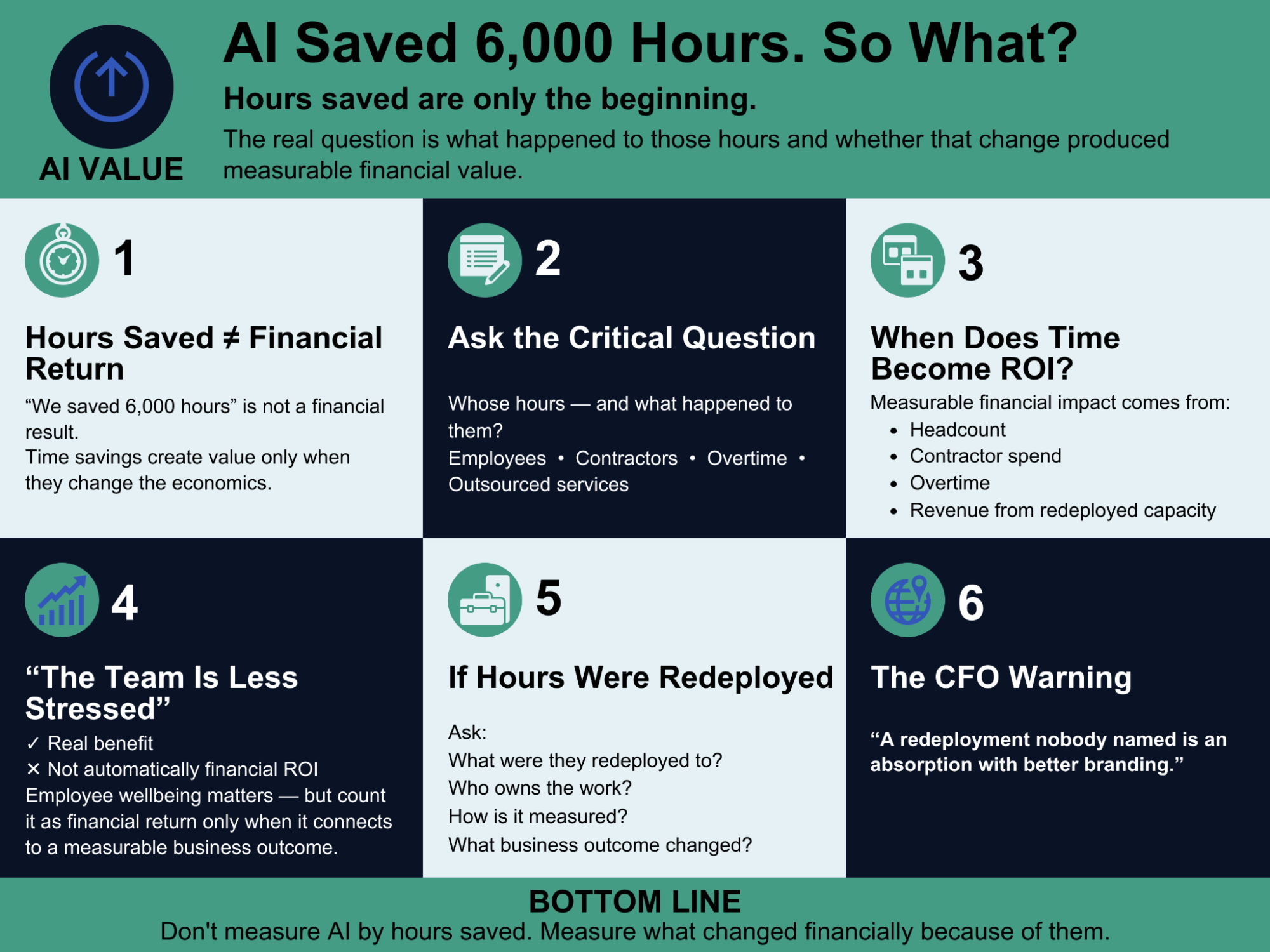
Whose hours, and what happened to them?
“We saved 6,000 hours a year” is the most common AI claim you will receive. It is not a financial result.
It becomes one when headcount, contractor spend, overtime, or an outsourced service fee actually changes — or when the freed capacity gets redeployed against revenue and somebody can show you the revenue.
So ask the plain version. Whose hours, and what happened to them?
If the answer is “the team is less stressed,” that’s a real benefit and I’m not dismissing it. It isn’t a return, and it shouldn’t be sitting in anyone’s business case as one.
If the answer is “we redeployed them,” ask what to, who owns it, and how it’s measured. A redeployment nobody named is an absorption with better branding.
Attribution, briefly
AI savings routinely coincide with a hiring freeze, a reorg, an offshoring decision, or a demand shift. If you can’t separate the effects, you don’t have an ROI figure. You have a coincidence and a sponsor, and eventually an auditor or a board member will take it apart in front of people.
The cheapest defense is to write down, at approval time, what you expect to change and why you’d attribute it to this rather than to everything else happening that year. It takes ten minutes when everyone is optimistic. It becomes impossible later.
What to do about it
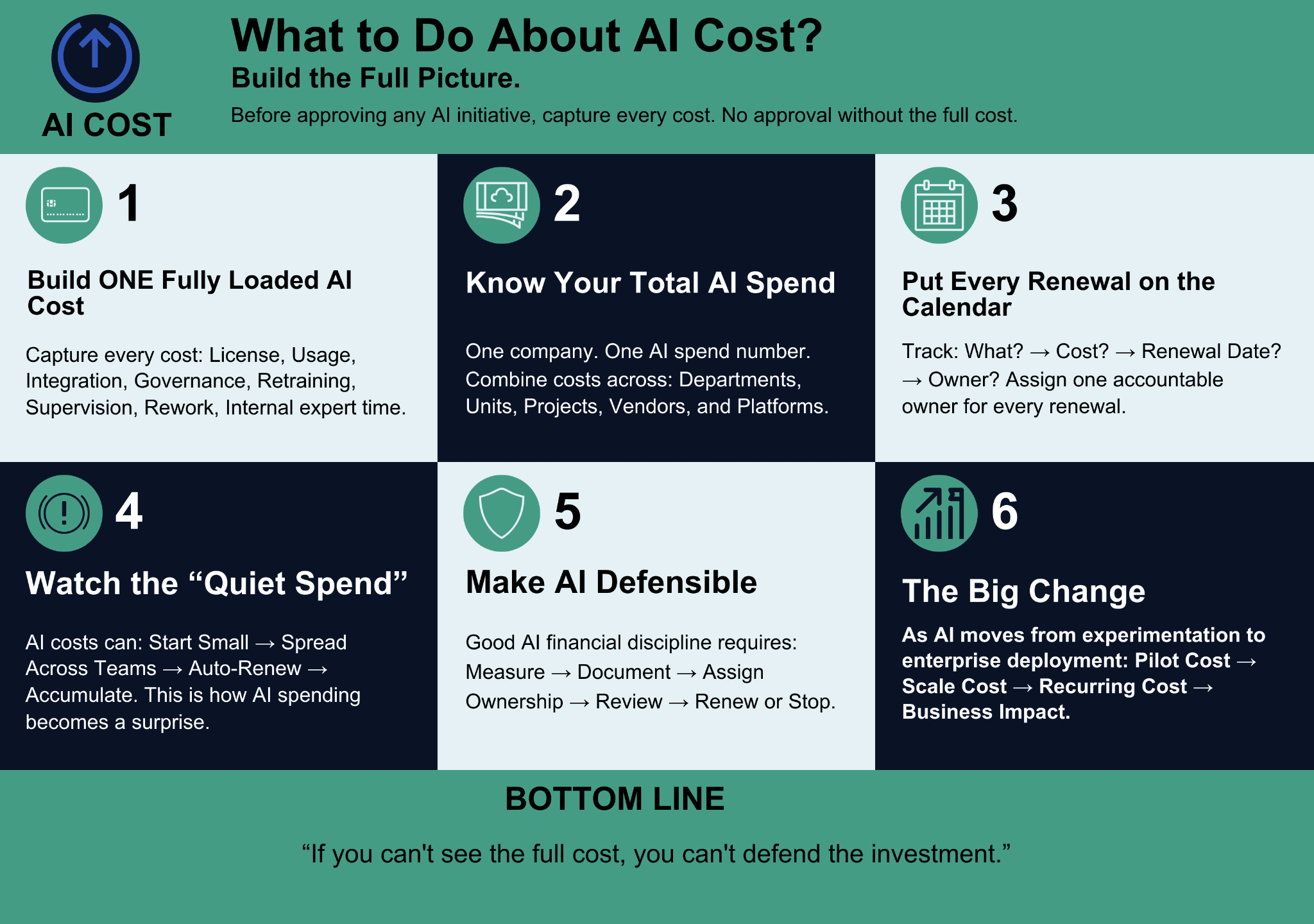
Build a single fully loaded cost line for every AI initiative and require it before approval. License, consumption, integration, governance, retraining, supervision and rework, and an honest estimate of internal expert time.
Then total your AI spend across the company, in one number, and put a renewal date for each component on a calendar somebody owns. It should probably be you. AI spend accumulates quietly across departments and renews automatically, which is exactly the profile of the spend that surprises companies in a bad quarter.
None of this is exciting. That’s rather the point. The measurement discipline that makes AI defensible is the same discipline that makes anything defensible, and most organizations skipped it because the first pilot was small enough not to require it.
The pilots aren’t small anymore.
Two weeks to the CFO Leadership Council roundtable on 12 October. If you’ve built a genuinely fully loaded AI cost model, come and show it — that’s the artifact everyone wants and almost nobody has.
Go deeper: Guide 05, Finance Automation & AI Implementation, part of the CFO Guide Series: 24 one-page guides for CEOs and founders.
