
What did your company spend on AI last year? Not the flagship project. The total.
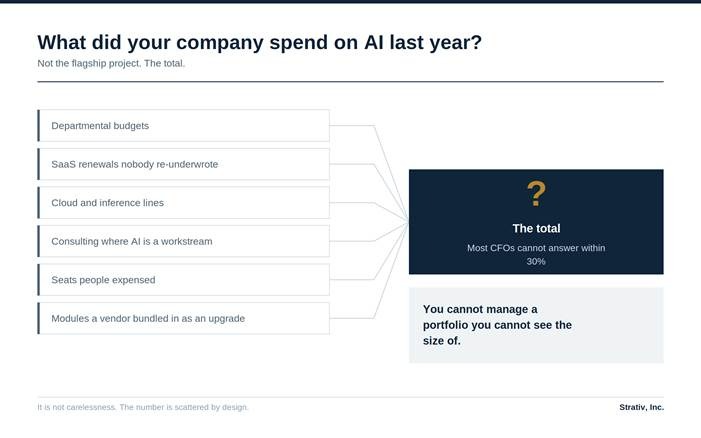
It isn’t carelessness. The number is scattered by design.
Most CFOs I ask can’t answer within 30%, and every time I’ve gone looking, the number came back materially higher than the one in the CFO’s head.
You cannot manage a portfolio you can’t see the size of. Meanwhile you’re approving the next one on its own merits, one decision at a time, which is exactly how your company has always approved capital projects and exactly the wrong instrument here.
[Insert the AI spend dashboard screenshot here — caption: what the answer looks like when somebody actually builds it.]
AI bets aren’t independent. Your business cases assume they are.
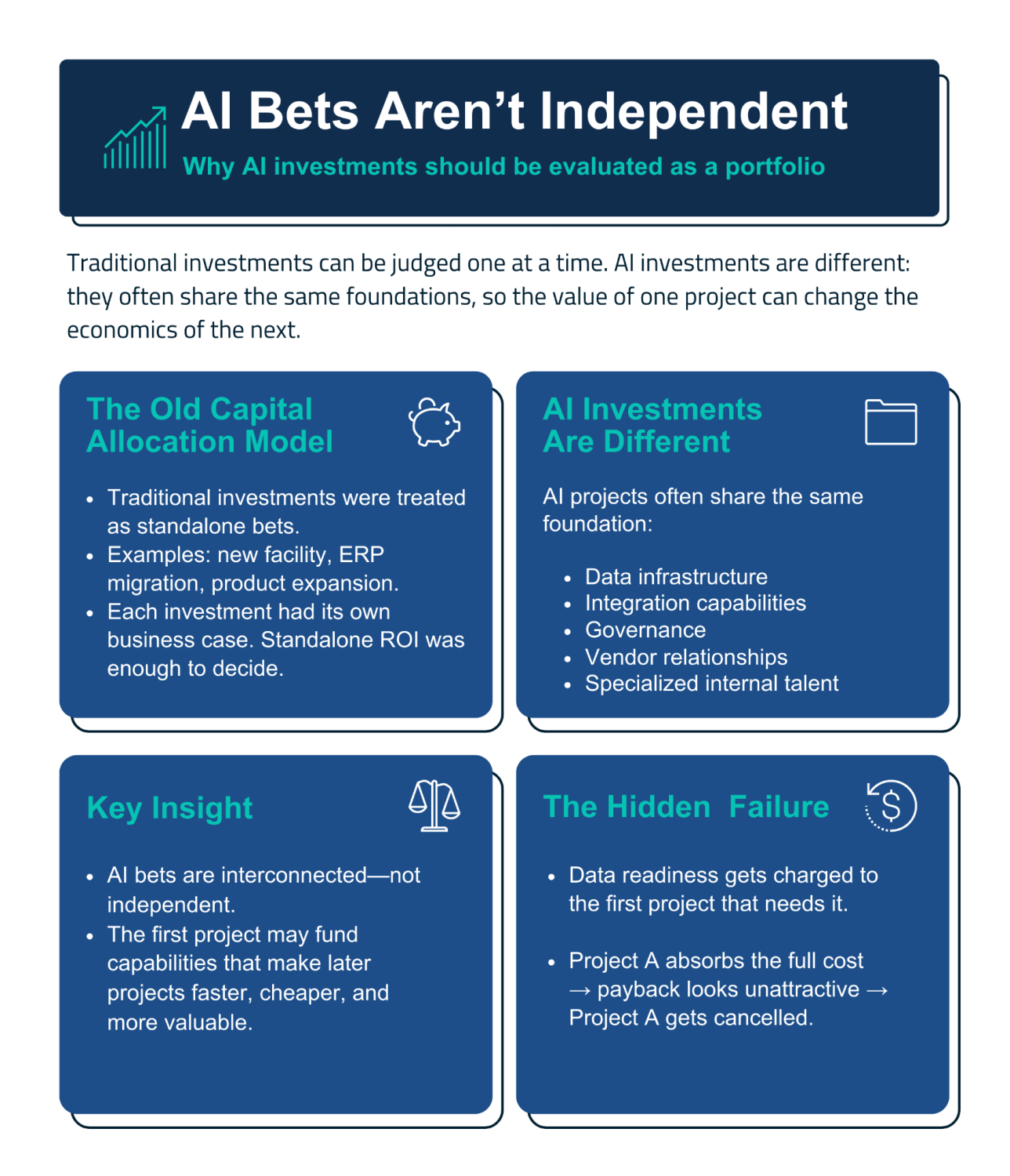
Traditional capital allocation was built for a small number of large, independent bets. A new facility. A line extension. An ERP migration. Each stands alone, and the standalone business case is the right tool.
AI bets share data infrastructure, integration work, governance overhead, vendor relationships, and the same short list of internal people who actually understand the stack. Two projects that each look mediocre standalone may be strong together, because the second rides on capability the first paid for.
Which produces a failure you may have already lived through. The data readiness work gets charged to whichever project asked for it first. That project’s payback looks terrible. It gets killed, and takes the foundation for the next four use cases with it.
If data readiness is the binding constraint across your whole portfolio, fund and evaluate it as shared infrastructure rather than burying it inside one use case’s payback calculation. The question that matters is rarely what the return on Project A is. It’s how Project A sits relative to Project B given they need the same underlying capability — and that question has no answer in a standalone business case.
Four decisions, and each one somebody would rather defer
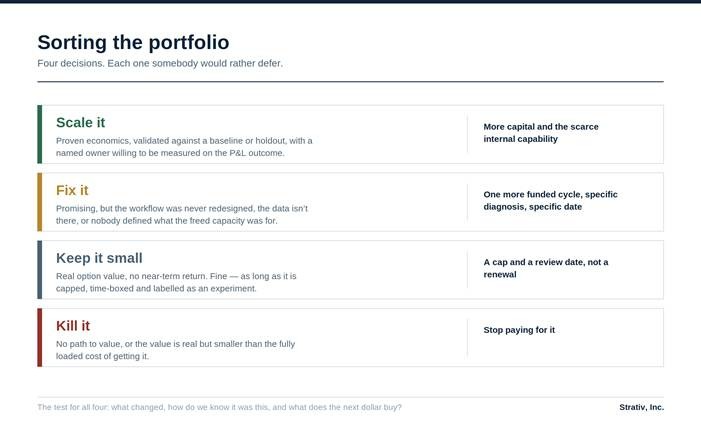
What separates the four isn’t sophistication. It’s whether anyone can answer three questions: what changed, how do we know it was this, and what does the next dollar buy?
Two of those need defending.
Most companies underfund their winners, because capital gets spread evenly across everything rather than concentrated on the thing that’s working. Scaling means giving a proven initiative not just more money but the scarce internal capability, which is a harder allocation to make.
And “keep it small” fails through drift. Experiments have a way of becoming permanent overhead without ever passing a gate.
The kill decision is political, not financial
Everyone nods along at “kill the losers.” Almost nobody does it, and it’s worth being honest about why.
Killing an AI project in 2026 isn’t like killing a software project in 2016. AI is in your board narrative. It may be in your investor deck. A senior person’s credibility is attached to it. The vendor is a strategic partner. And whoever proposes the kill becomes, in the room’s shorthand, the person who doesn’t get it.
So the project gets quietly downsized, defunded by attrition, and left on the renewal schedule for another eighteen months.
Three mechanisms solve most of this, and none of them costs anything.
Budget the failure rate in advance. Set an explicit assumed failure rate of 40 to 50 percent across the portfolio at the start of the year, in front of your board, as a portfolio parameter. Now a kill isn’t an embarrassment — it’s the portfolio performing as designed. You said this would happen. It happened. And the reverse becomes true too: if you haven’t killed anything, either you weren’t ambitious enough or you aren’t measuring.
Tranche the capital. A pilot gets enough money to prove one thing and not enough to become permanent. More capital releases against a defined milestone, not against enthusiasm or sunk cost. Fund it the way your investors fund you.
Put the renewal dates on a calendar somebody owns. AI spend accumulates quietly across departments and renews automatically. Somebody should be totaling it. It should probably be you.
I’ve been on the other side of this. When I came into [client] the company was in genuine distress, and part of the work was cutting costs quickly and renegotiating contracts that no longer made sense. What I learned there applies directly: the decision is never hard because the math is unclear. It’s hard because somebody owns the thing you’re cutting. Making the kill rate a stated policy up front is the cheapest way I know to take the personality out of it.
S&P Global tracked the share of companies abandoning most of their AI initiatives climbing to 42%, up from 17% a year earlier. Those cancellations happen on your calendar, against a pre-agreed trigger, or in a panic in a quarter where you can least afford the distraction.
Sort your reporting into three buckets
This is the single most useful thing you can hand a board.
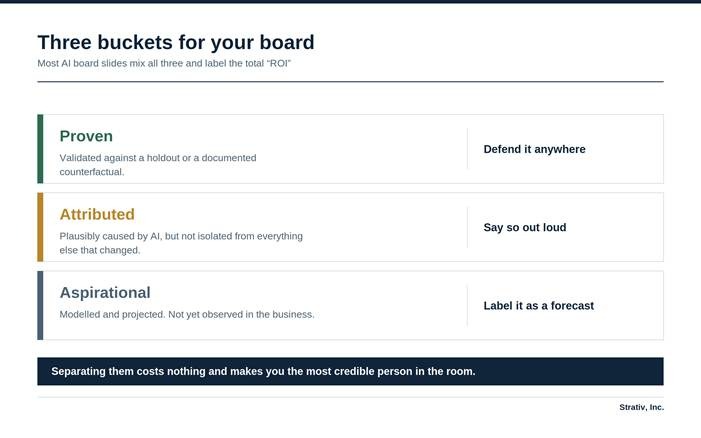
Most AI board slides mix all three and label the total “ROI.”
Separating them costs you nothing and immediately makes you the most credible person in the room on the subject.
Funded use cases beat fifteen pilots
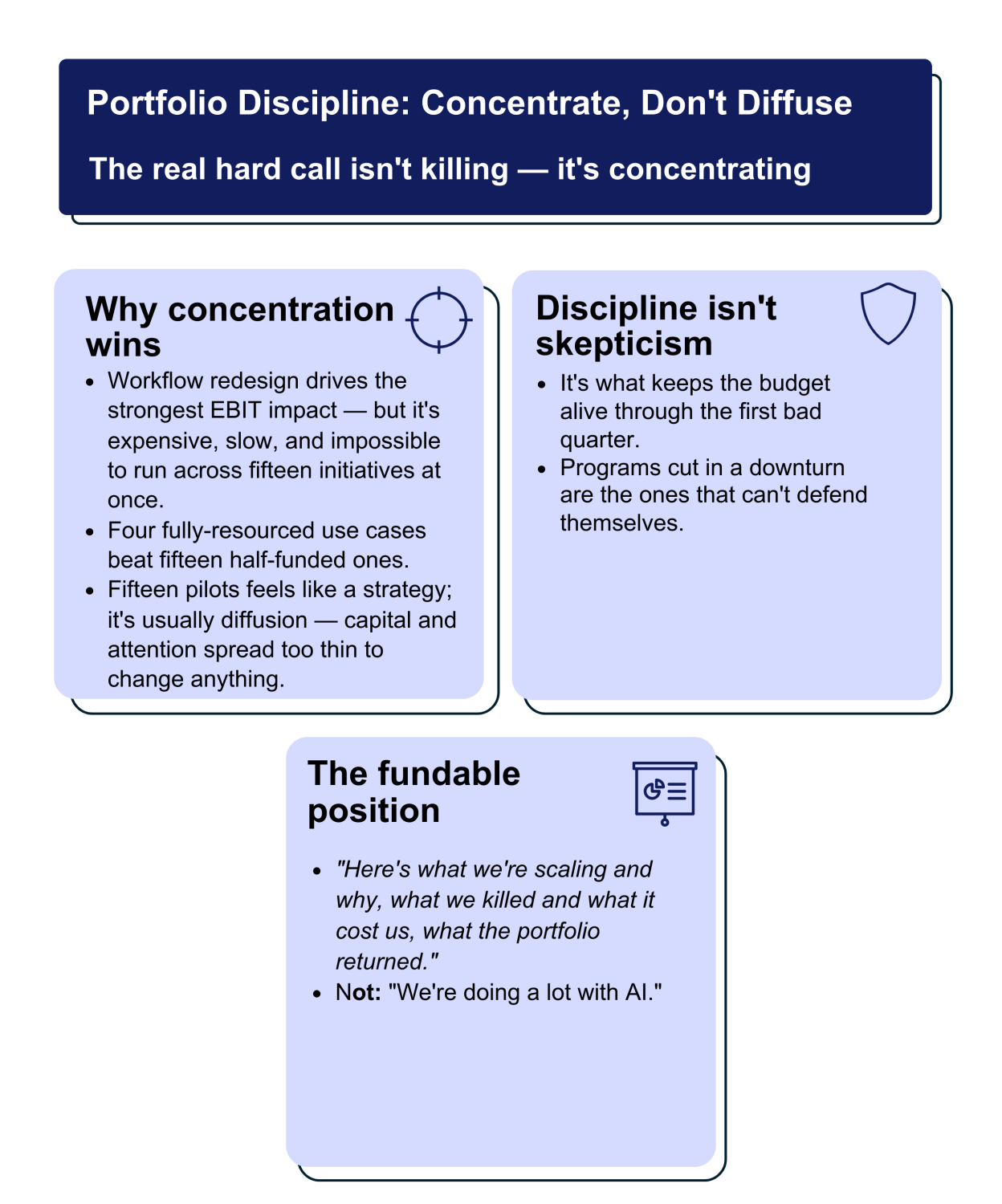
The portfolio discipline that matters most isn’t the killing. It’s the concentrating.
Workflow redesign is what’s most strongly linked to actual EBIT impact, and workflow redesign is expensive, slow, and impossible to do across fifteen initiatives at once. Most companies would generate more value from four fully-resourced use cases than from fifteen half-funded ones.
Fifteen pilots feels like an AI strategy. It’s usually AI diffusion — capital and attention spread thin enough that nothing crosses the threshold where the work actually changes.
Portfolio discipline gets misread as skepticism, so let me be plain. If AI is going to become one of the largest categories of technology spend inside companies, applying real financial discipline to it isn’t resistance. It’s the thing that keeps the budget alive through the first bad quarter. The programs that get cut in a downturn are the ones that can’t defend themselves.
“Here’s what we’re scaling and why, here’s what we killed and what it cost us, here’s what the portfolio returned” is a fundable position. “We’re doing a lot with AI” is not.
The two questions I’d ask
If I were sitting across from a CFO today, I wouldn’t ask what they’re doing with AI. I’d ask two things.
Where have you actually seen measurable economic value from AI? The answer I’m listening for is specific and small. One process, one number, a before and an after. “We cut days-to-close from nine to four and eliminated the temp accounting support in Q2” beats any portfolio-wide claim, because it’s verifiable, and because a CFO who can produce one real number can usually produce the next five. The answers that tell me the work hasn’t been done: a user adoption figure, a vendor’s ROI study, or a percentage with no baseline attached.
What are you doing differently with the capital and capacity you’ve freed up? This is the one that separates a cost-cutting exercise from a strategy. If AI freed up 15,000 hours and $2 million and the honest answer is “we absorbed it,” the company bought efficiency and spent it on nothing. That’s an unmade decision, not a technology failure.
Those two questions get past the hype quickly, in either direction. They’re also the two questions your board is roughly eight months away from asking you.
Go deeper: Guide 05, Finance Automation & AI Implementation, part of the CFO Guide Series: 24 one-page guides for CEOs and founders.
