
Five Questions Before You Approve Another AI Request
You don’t need an AI strategy to start. You need a gate.
These aren’t sophisticated. They’re the same questions you’d ask about a facilities lease, which is precisely the point — the problem with AI spend isn’t that it needs special treatment, it’s that it stopped getting ordinary treatment.
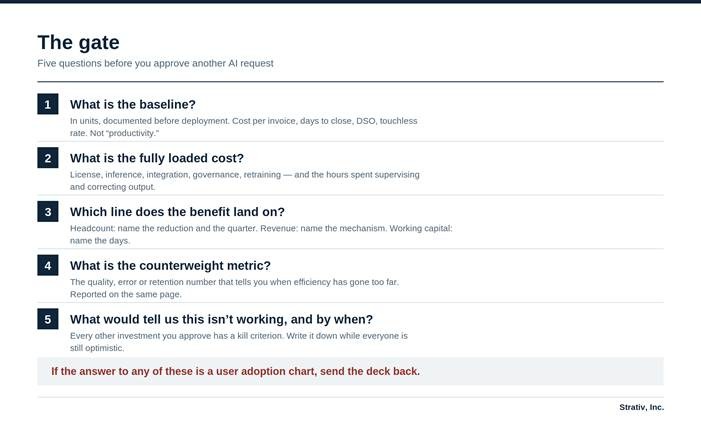
1. What is the baseline?
In units, documented before deployment. Cost per invoice. Days to close. DSO. Touchless rate. Cost per resolved ticket. First-pass yield.
Not “productivity.” Not “efficiency.” A number with a unit attached, measured before the tool arrives. You cannot compute a delta against a “before” you never measured, and no amount of analysis afterward will reconstruct it.
2. What is the fully loaded cost?
License, inference and API consumption, data engineering and integration, security and governance review, vendor management, retraining — and the internal hours spent supervising and correcting the output.
If your team spends a meaningful share of the saved time fixing the tool, you didn’t capture productivity. You relocated it.
3. Which line does the benefit land on?
Name it. If it’s headcount, name the reduction and the quarter. If it’s revenue, name the mechanism. If it’s working capital, name the days.
“Improved efficiency” is not a line on any financial statement you produce.
4. What is the counterweight metric?
This is the one people skip, and it’s the one that saves you.
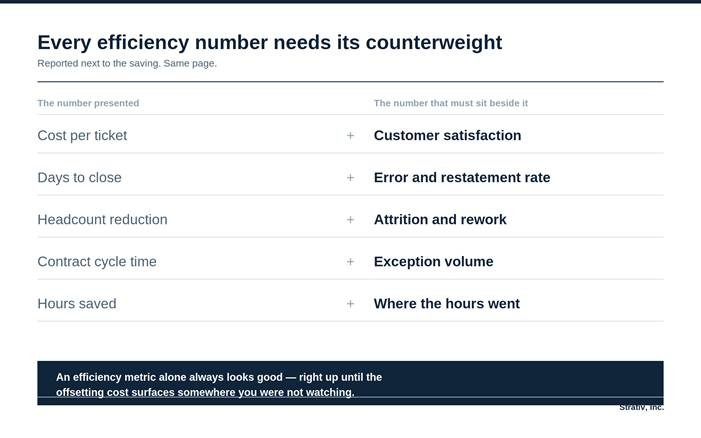
Report the counterweight next to the saving. Same page.
An efficiency metric alone will always look good — right up until the offsetting cost surfaces somewhere you weren’t watching, usually in a quarter when you’d rather not explain it.
We already know how to do this. It’s the same instinct that stops you from celebrating a DSO improvement that came from factoring receivables. The savings are real; the mechanism disqualifies them.
Klarna is the cleanest public version. The AI wasn’t broken — on the queries it was built for it beat the human baseline on speed and consistency. The measurement architecture was broken. Volume and cost were tracked precisely, customer outcome quality was not, and the quality problem surfaced only after the scale-up was complete.
5. What would tell us this isn’t working, and by when?
Every other investment you approve has a kill criterion. This one should too.
Write it down while everyone is optimistic. It becomes unwriteable later, when the vendor is a strategic partner and someone’s credibility is attached.
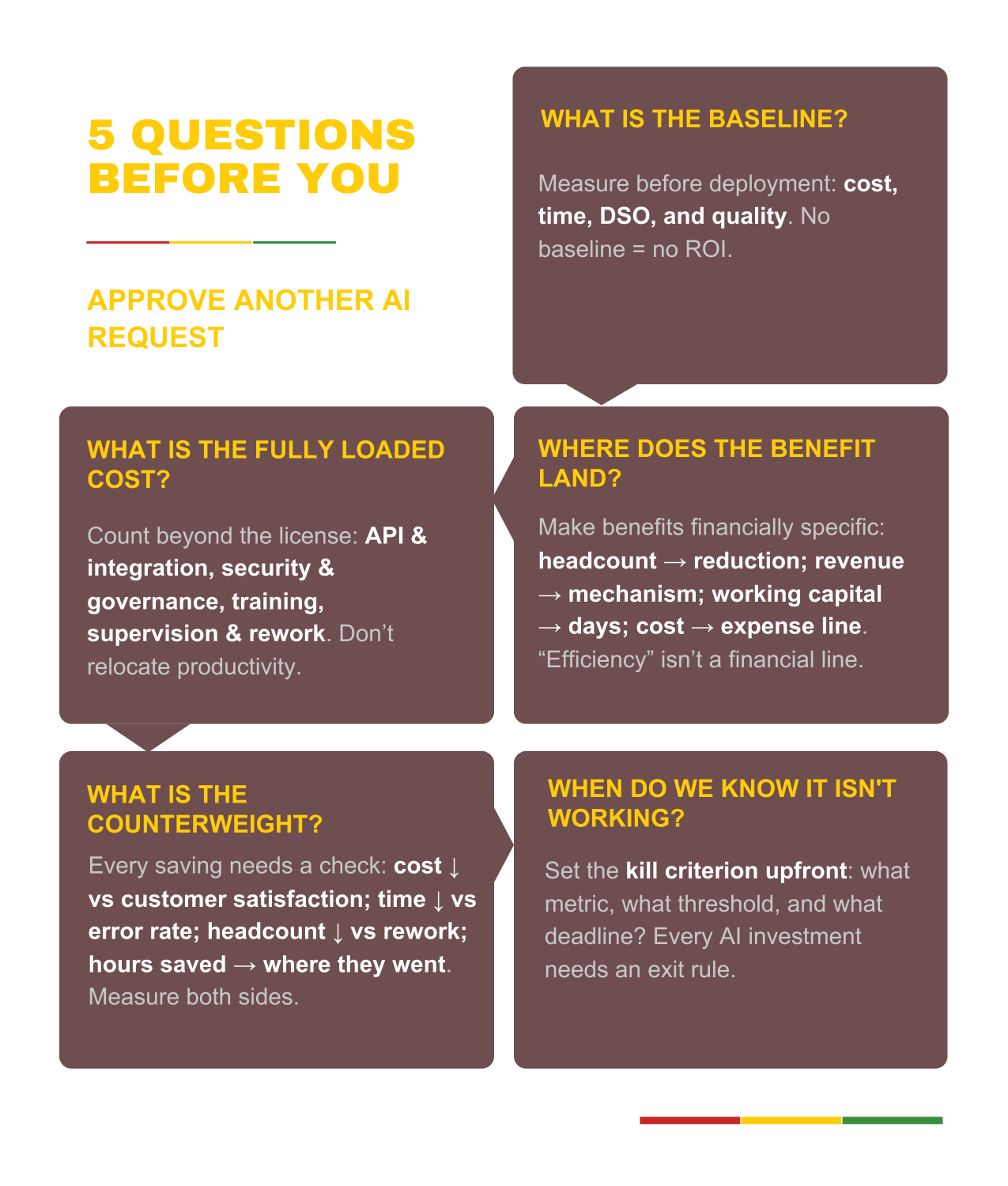
Using the gate
If the answer to any of these is a user adoption chart, send the deck back.
And if the answers are good, approve it faster than you otherwise would. A gate that only ever says no teaches people to route around you. The point isn’t to slow the spend down. It’s to make the yes defensible.
One practical note. Run these questions on something already deployed, not just the next request. Most companies have three to five AI initiatives already running that have never been through any gate at all, and that’s usually where the interesting answers are.
Go deeper: Guide 05, Finance Automation & AI Implementation, part of the CFO Guide Series: 24 one-page guides for CEOs and founders.
