
The CFO Question Is Changing
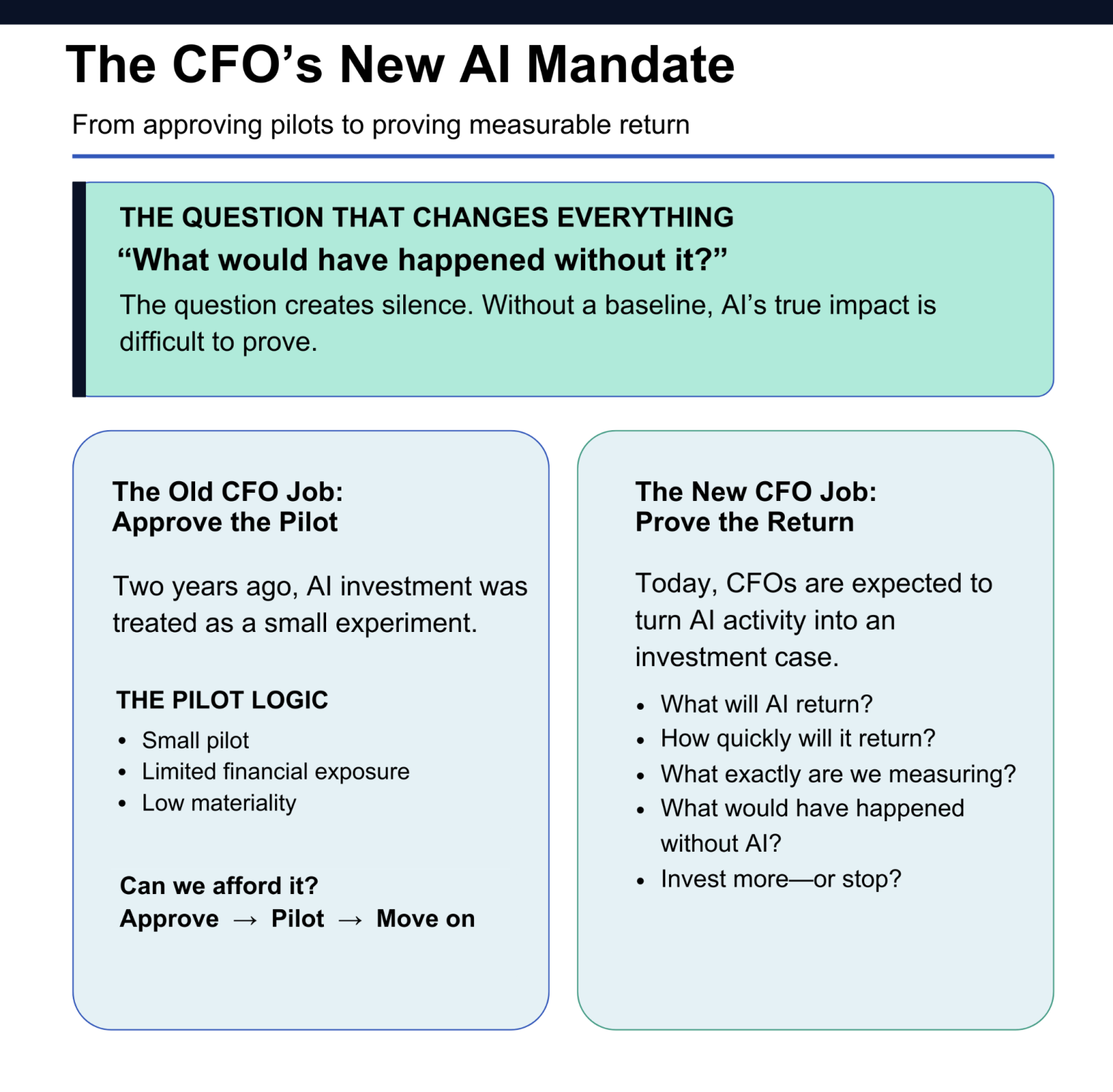
Ask this in your next AI steering committee and watch what happens.
“What would have happened without it?”
The room goes quiet. Not because anyone is hiding something — because nobody built the measurement that answers it.
Two years ago that question didn’t exist. Your job on AI was to decide whether you could afford the pilot. It was small, it wasn’t material, you approved it and moved on.
That job is over. What you’re being asked now is what it will return, how quickly, what you’re measuring, what would have happened without it, and whether to put in more capital or stop.
The last one is the real shift. You are no longer approving a line item. You are running a capital allocation process on an asset class with no history, no comparables, and no depreciation schedule that makes any sense — while everyone requesting the money is considerably more certain than the evidence supports.
The question that disqualifies most business cases
The savings number in front of you was almost certainly calculated by comparing this year to last year. Nobody isolated AI from the reorg, the hiring freeze, the volume decline, or the process improvement that was already underway six months before the tool arrived.
That distinction is the difference between a number you can defend to a board, a sponsor, or an auditor, and one that comes apart under the first serious question.
The discipline that fixes it is borrowed from marketing.
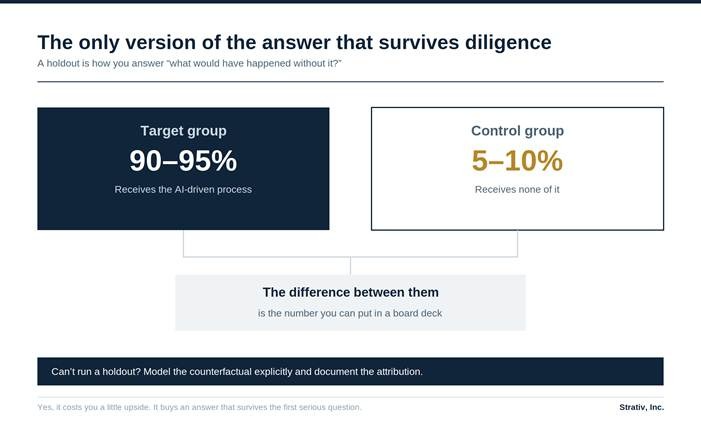
A European B2B pricing deployment run this way measured up to 10 percentage points of gross margin difference between target and control.
Yes, holding back 5 to 10 percent of accounts, SKUs, territories or reps costs you a little upside. It buys the only version of the answer that survives diligence.
“Margin improved after we deployed the tool” is not that answer.
If you truly can’t run a holdout, model the counterfactual explicitly — what the baseline trend would have produced on its own, adjusted for volume and inflation — and write down the attribution reasoning at approval time. Most AI ROI claims don’t fail review because the data is wrong. They fail because there was never a pre-program baseline and never a written reason for assigning the gain to AI rather than to everything else that changed that year.
200 basis points against 2,000 hours
Some AI investments produce obvious savings. Automating reconciliations reduces hours. Automating document processing reduces outsourced fees. Easy to model, easy to explain, easy to approve.
Also the lowest ceiling in the building — and they only convert to cash if somebody actually removes the cost.
The more interesting opportunities are harder to measure and worth considerably more. Pricing more intelligently. Reducing churn. Forecasting demand accurately enough to change an order quantity. Identifying unprofitable customers. Those aren’t productivity improvements. They change the economics of the business.
Do the arithmetic.
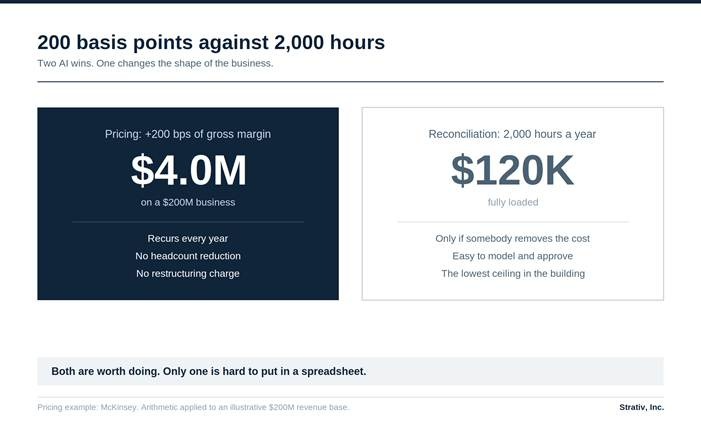
Both are worth doing. Only one is hard to put in a spreadsheet.
McKinsey documents a B2B pricing transformation that replaced manual pricing across more than 1.5 million SKUs with data-driven guidance and governance, delivering more than 200 basis points of margin improvement, with a pricing copilot layered on top finding roughly another 50 basis points within ten weeks.
Two hundred basis points of gross margin on a $200 million business is $4 million. It recurs. No restructuring charge, no difficult conversation with your operating team.
The same asymmetry runs through working capital. Better forecast accuracy is worth nothing on its own. It becomes worth something when it changes an order quantity, a safety stock level, or a shift plan. If your planners are getting better forecasts and still buying the way they always bought, you’ve purchased a better prediction of a decision you’re not making differently.
So for every “AI improved our X by Y%” claim that reaches you, the question is: what decision changed, who made it differently, and when?
The productivity trap
Here’s the one I see most often.
AI saves 100 employees ten hours a week. Did the company save money?
Maybe. Probably not. At least not yet.
Those employees may have simply used the time to do more work. That isn’t a failure — it may well be the better outcome. But it’s a completely different financial event and it belongs in a different row of your model.
Two things look identical on a slide and are not remotely the same. Cost reduction means the expense actually leaves the P&L. Capacity creation means the expense stays and you now have more productive capacity for the same money. Both are legitimate. Conflating them is how AI business cases end up overstated by an order of magnitude.
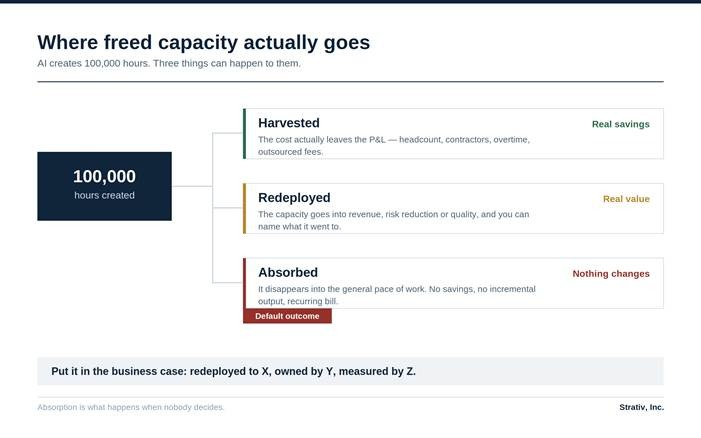
Absorption is the default. It’s what happens when nobody decides.
I watched a client do the middle one properly, and it’s rare enough to be worth describing. [Company] had capability that was freed up as we rebuilt how the business was priced and delivered. Rather than cutting or absorbing it, we packaged it into a paid education and training offering and sold it as its own SKU alongside the core product. The capacity became a revenue line with a different cash profile than the licensing business. [Add the result: what it contributed, how quickly.]
That only worked because somebody named the destination before the capacity existed. Which is the actual rule:
The capacity created will be redeployed to X, owned by Y, measured by Z.
If nobody will sign that sentence, you don’t have a capacity creation case. You have a subscription.
You’d never approve a second production line without a demand plan for it. Capacity with no plan attached isn’t an asset. It’s slack, and eventually it’s a write-down.
What this means for the next request
When the next AI request reaches your desk, the question is not whether the technology works. Assume it does.
The question is what decision changes, who makes it differently, and when.
Cost reduction is the easy conversation. Capacity creation is the strategic one. The difference between them is a decision somebody has to make on purpose.
Go deeper: Guide 05, Finance Automation & AI Implementation, part of the CFO Guide Series: 24 one-page guides for CEOs and founders.
