
A CEO asked me last year: "We spend six figures on finance software. Why does the close still take 12 days?"
So we went through it. Fourteen tools. Three of them basically did the same thing. Two integrations ran off one analyst's spreadsheet. Nobody could tell me who decided the stack should look like that.
Nobody did. Tools got added over time and nobody owned the whole picture.
I see this all the time. Finance teams don't have a tech problem. They have a decision problem.
There are 200+ finance tools out there right now. Accounting, FP&A, AP, AR, expense, payroll, payments, close, reporting, data, forecasting, AI. More every quarter. Most of them are good. They all demo well. That makes picking harder, not easier.
The question I ask clients is simple: where does another tool actually help your finance team?
Buyers look at features. CFOs live with the results.
When you buy software, you look at the demo and the price. When you're the CFO, you deal with everything after. The implementation. The integrations. Training. The audit trail. Months of your team's time.
If it goes wrong, you're the one who owns it. Two years later someone is still reconciling by hand because the migration never got finished.
It's not a people problem
Finance people are smart. The issue is how these decisions get made:
-
The market moves faster than procurement. By the time a tool gets approved, there are newer options.
-
No one sees the whole stack. Finance sees the process. IT sees security. Procurement sees contracts. So no one notices three tools doing the same job.
-
The real costs don't show up on the approval form. The license is easy to see. Integration, maintenance, training, and depending on the one person who set it up are not.
My rule
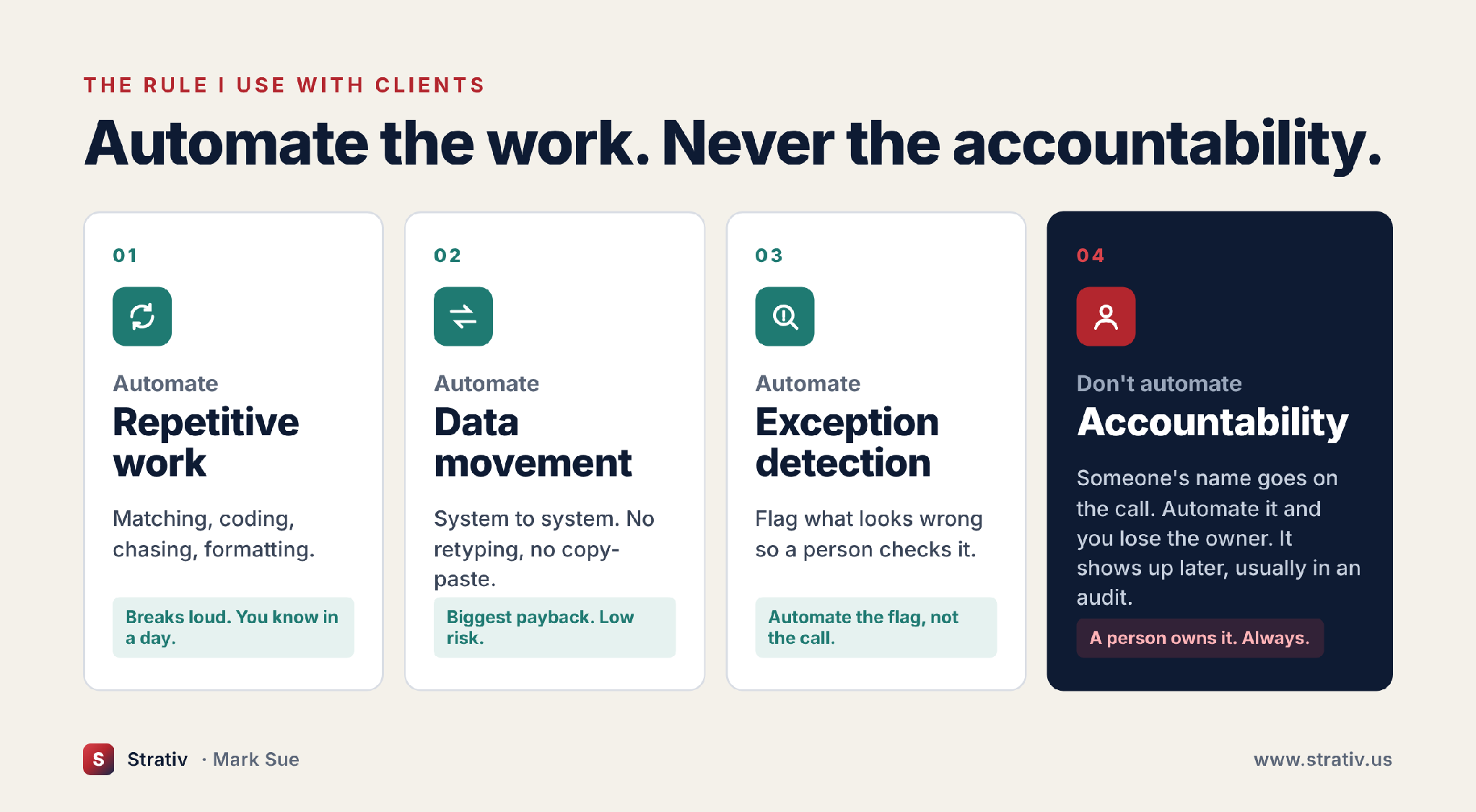
Automate repetitive work. Automate data movement. Automate exception detection. Don't automate accountability.
-
Repetitive work: matching, coding, chasing, formatting. Safe to automate. If it breaks, you find out fast.
-
Data movement: getting numbers from one system to another without anyone retyping them. Usually the biggest payback, low risk.
-
Exception detection: have the system flag things that look wrong so a person can check. Most teams skip this one. They shouldn't.
Accountability is different. Someone has to own the call. If you automate that, you haven't saved work. You've just lost track of who's responsible. It comes back later, usually in an audit.
AI agents make this more important
Plug-ins do what you tell them. AI assistants make suggestions and a person decides. AI agents take action on their own, across systems, often with nobody watching at the time.
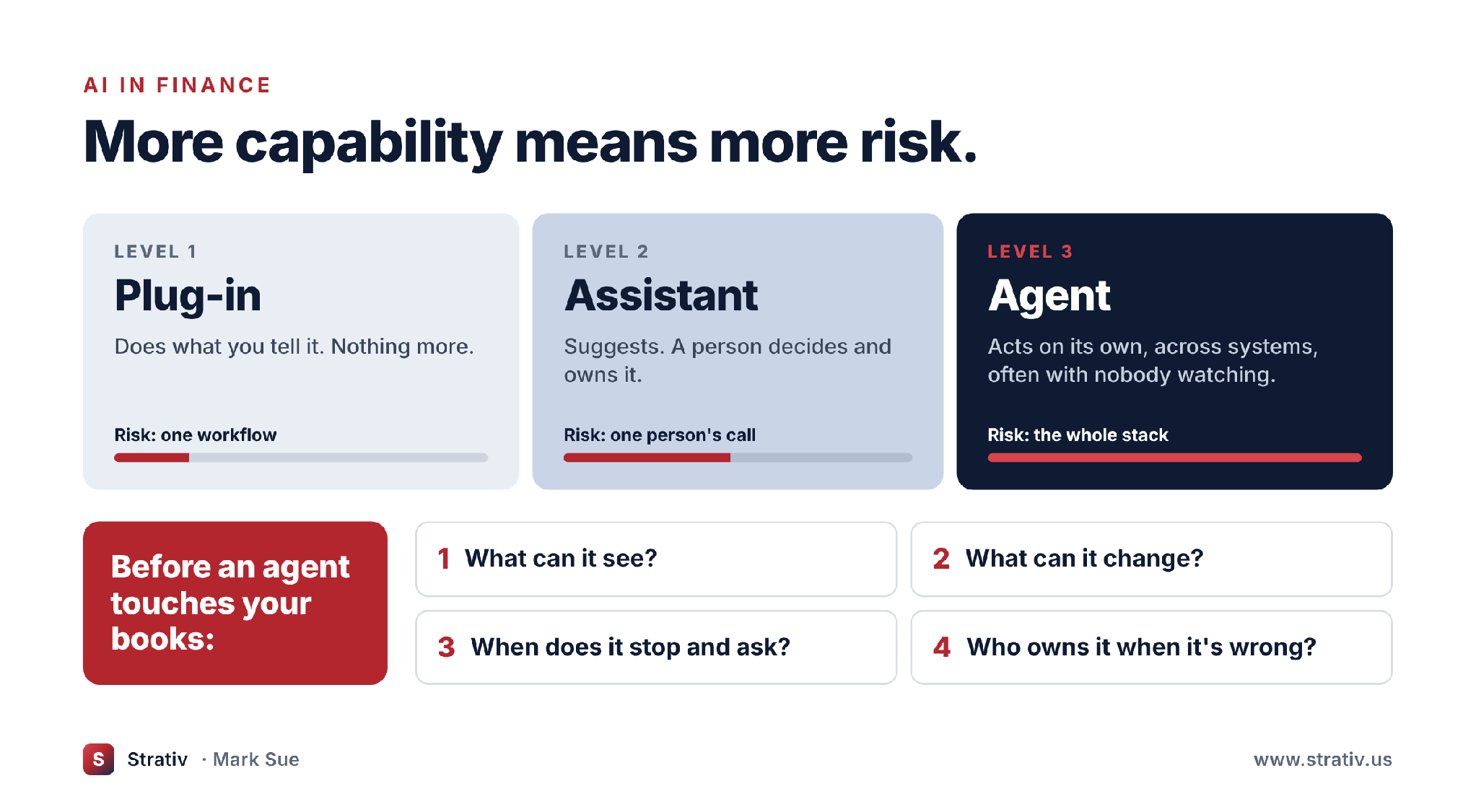
That's powerful. It's also more risk. Before you let an agent near your books, you need clear answers to four questions:
-
What can it see?
-
What can it change?
-
When does it have to stop and ask?
-
Who owns it when it gets something wrong?
If you can't answer those, you're not ready.
The poster
We mapped 200+ finance tools across 20 categories on one page.
Comment "STACK" and I'll send it to you.
Also curious: what's the first finance process you'd automate if you could? Not the biggest one. The first one.
Strativ helps finance teams pick, integrate, and manage the tech behind their finance function.
Go deeper: Guide 04, Finance Tech Stack & AI, part of the CFO Guide Series: 24 one-page guides for CEOs and founders.
