
I recently moderated the CFO Tech Automation Challenge at the CFO Leadership Council Fall Conference. CFOs sent in their real automation problems, and vendors answered them live.
One question that kept coming back wasn't about features. It was this: if an AI agent gets it wrong, whose name is on it?
"One CFO said her team was piloting an agent for AP and nobody could tell her who signs off when it pays the wrong amount…or worse the wrong invoice”
That's the question every finance team needs to answer before an agent touches the books.
Three phases in three years
• 2024: Plug-ins. Connect one system to another. Data moved, but people ran every step.
• 2025: AI assistants. Ask a question, get an answer. A person still decided what to do with it.
• 2026: AI agents. The software carries out several steps on its own.
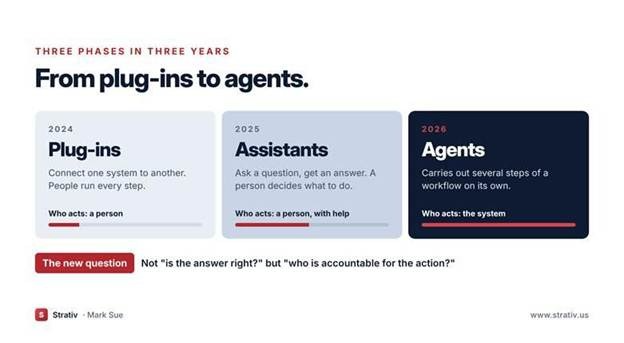
That last one is the big change. The software doesn't just inform the decision anymore. It can act on it.
Where I draw the line…for Now
• An agent can prepare a journal entry. It shouldn't post it.
• An agent can flag an invoice for payment. It shouldn't release the cash.
• An agent can spot a forecast variance. It shouldn't change the assumption.
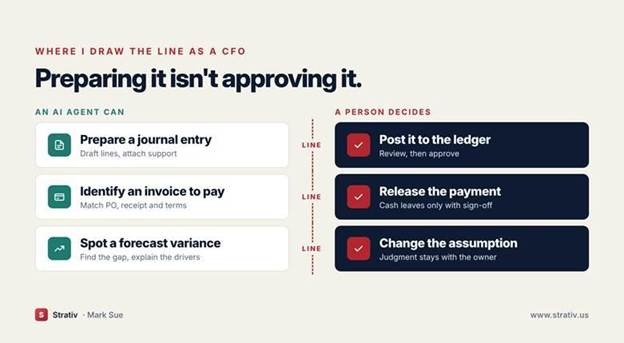
The preparation is where AI saves time. The decision is where accountability sits. That stays with a person.
My rule: AI can propose and even recommend. People approve.
The line to automation is shifting. Auditors and boards will trust agent-driven workflows when they can see who approved what, under which policy, and why. Not before so we still need people
What this looks like at Strativ
When I step in as CFO, the first thing I do before any automation goes live is build the approval map:
1. Walk the close and payables process end to end. Every step gets labeled: the agent prepares it, or a person decides it.
2. Set thresholds. Under $10,000, a single reviewer. Over it, two. Anything that moves cash always needs a human.
3. Apply segregation of duties to agents too. The agent that prepares a payment can't be the one that approves it, the same as a person.
4. Log everything. Every action the agent takes leaves a record of who approved it and why.
Talk to your peers, at one client, we went from stepping in at 25 days to close to 14 without adding audit risk, Yes the size of the organization matters, I’m just saying.
Clear rules up front are what let us give agents more room over time, not less.
If you're in defense tech, this isn't optional
Many of the companies I work with sell to the government. Once you're on government contracts, auditors expect a clean record of who approved every charge, timesheet and payment. An agent that posts on its own without a named approver is a finding waiting to happen. Set the rules first, then automate.
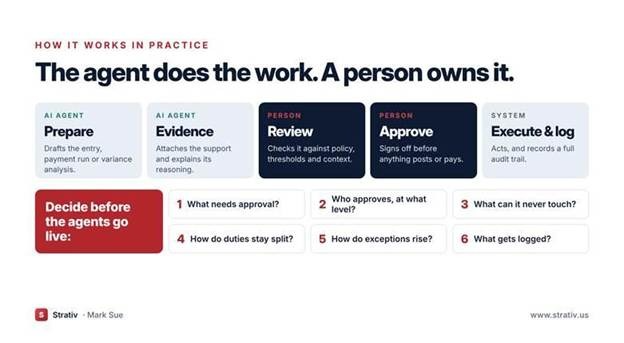
Before go-live, decide:
1. Which actions always need approval?
2. Who approves, and at what threshold?
3. How does segregation of duties apply to agents?
4. What can an agent never touch?
5. How do exceptions get escalated?
6. What gets logged?
Making those calls after the first surprise costs far more.
What's your rule?
What's the first task you'd let an AI agent do without human approval?
One task. Drop it below.
Thanks to the CFO Leadership Council AvidXchange, Inc. and Baker Tilly US for a sharp session in Denver. A lot of this came out of that room.
Strativ provides CFO leadership for growth companies, with a focus on finance systems, AI and capital strategy.
Go deeper: Guide 05, Finance Automation & AI Implementation, part of the CFO Guide Series: 24 one-page guides for CEOs and founders.
