Sales celebrates at closed-won. Finance celebrates when the cash clears. In between sits the closed-won to cash process: a contract, a handoff, an invoice, collections and a reconciliation. Each one is a place where cash gets delayed, discounted or lost.
Most companies measure the front of the lead to cash process in detail: leads, conversion, pipeline, win rate. Very few measure the back half with the same rigor. Here is where the leaks usually are, and how to find yours. None of them is dramatic on its own. Together they decide how long a closed deal takes to become cash you can spend.
1. Payment terms in the quote and the contract
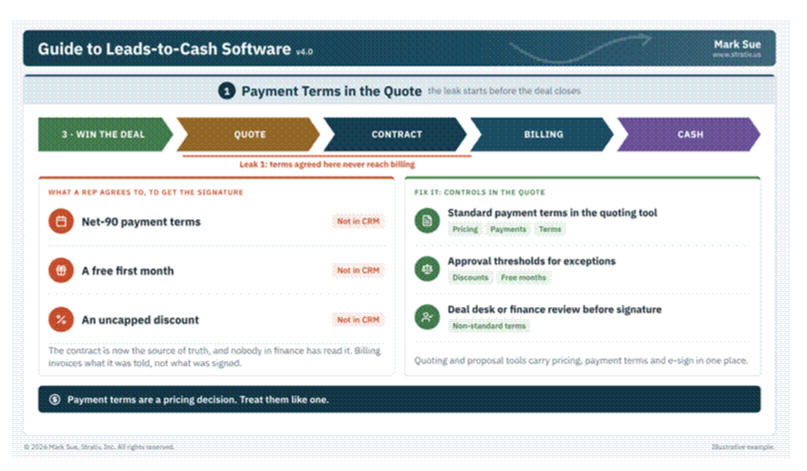
The leak starts before the deal closes. A rep agrees to net-90 payment terms, a free first month or an uncapped discount to get the signature. None of it shows up in the CRM in a form billing can use.
The contract is now the source of truth, and nobody in finance has read it. Billing invoices what it was told, not what was signed.
Fix it: standard payment terms in the quoting tool, approval thresholds for exceptions, and a deal desk or finance review on any non-standard term before signature. Payment terms are a pricing decision. Treat them like one.
2. The CRM-to-billing handoff
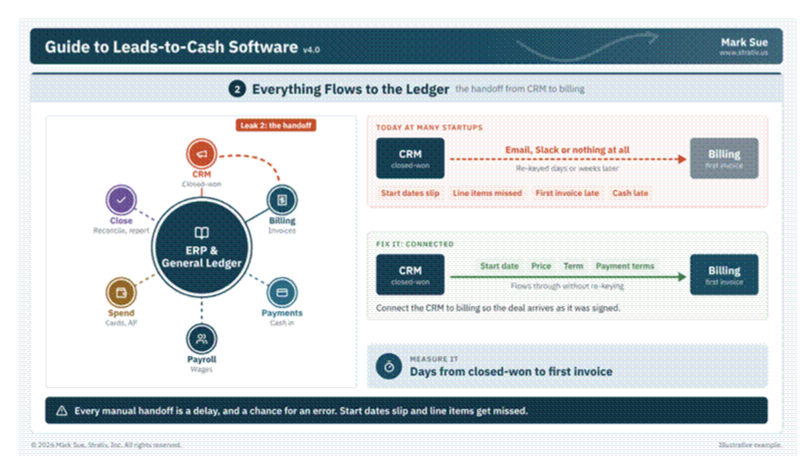
At many startups, closed-won triggers an email, a Slack message or nothing at all. Someone in finance re-keys the deal into the billing system days or weeks later. Start dates slip. Line items get missed. The first invoice goes out late, so the cash comes in late.
Fix it: measure days from closed-won to first invoice. Set up a CRM to billing integration so the subscription start date, price, term and payment terms flow through without re-keying. Every manual handoff is a delay, and a chance for an error.
3. Invoices that get disputed
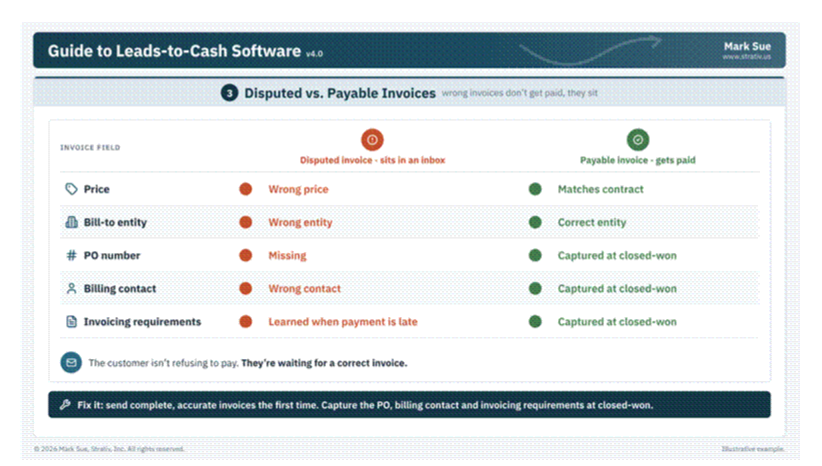
An invoice with the wrong price, the wrong entity, a missing PO number or the wrong billing contact does not get paid. It gets disputed, quietly, by sitting in someone's inbox. The customer isn't refusing to pay. They're waiting for a correct invoice.
Fix it: send complete, accurate invoices the first time. Capture the PO, billing contact and invoicing requirements at closed-won, not when the first payment is late.
4. Collections nobody owns, and a rising DSO
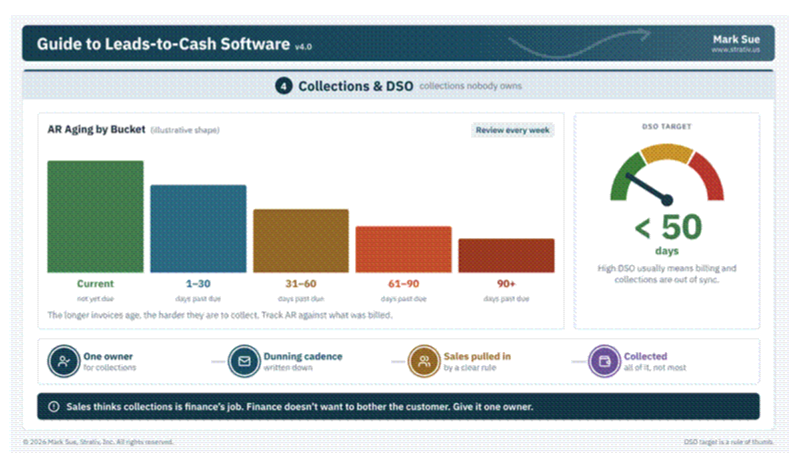
Sales thinks collections is finance's job. Finance doesn't want to bother the customer sales just closed. So past-due invoices age, and the longer they age, the harder they are to collect.
High DSO usually means billing and collections are out of sync. A reasonable target is under 50 days. Review accounts receivable aging every week by bucket (current, 1-30, 31-60, 61-90, 90+), and track AR against what was billed.
Fix it: one owner for collections, a written dunning cadence, and a clear rule for when sales gets pulled in. Collect all receivables, not most of them.
5. Renewals, expansions and contract amendments
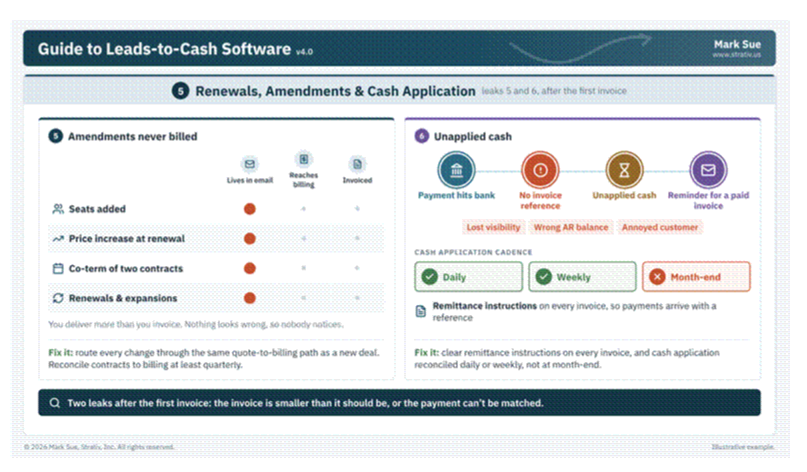
Contracts change after they are signed. Seats get added, a price increase kicks in at renewal, a co-term aligns two contracts. If those changes live in email and never reach the billing system, you deliver more than you invoice. Nobody notices, because nothing looks wrong. The customer is happy and the invoice goes out on time. It is just smaller than it should be.
Fix it: route every amendment, renewal and expansion through the same quote-to-billing path as a new deal. Reconcile active contracts to billing at least quarterly.
6. Unapplied cash that can't be matched
A payment hits the bank without a clear invoice reference. It sits as unapplied cash while the customer gets reminder emails for an invoice they already paid. The leak here isn't lost cash. It's lost visibility, a wrong AR balance and an annoyed customer.
Fix it: clear remittance instructions on every invoice, and cash application reconciled daily or weekly, not at month-end.
How to measure closed-won to cash
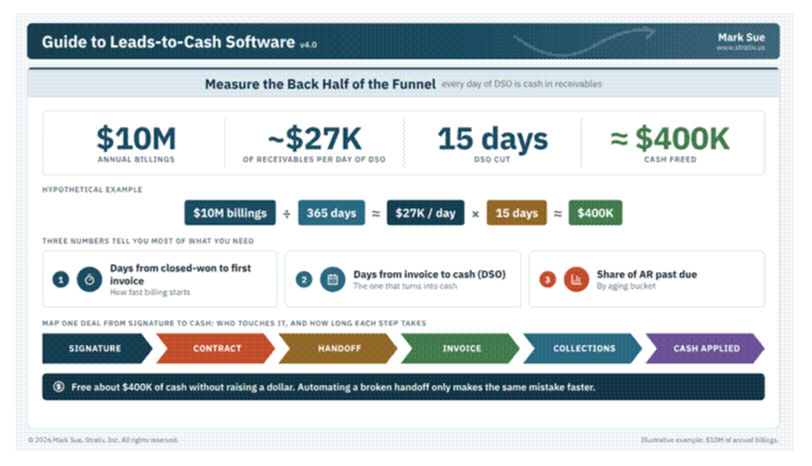
Everything eventually flows to the ledger: CRM, billing, payments, payroll, spend. The question is how fast and how clean. Three numbers tell you most of what you need:
• Days from closed-won to first invoice
• Days from invoice to cash (DSO)
• Share of AR past due, by aging bucket
A hypothetical example: on $10M of annual billings, every day of DSO is roughly $27K of cash sitting in receivables. Cut DSO by 15 days and you free about $400K of cash without raising a dollar. That kind of DSO reduction belongs on the board's KPI page.
Map one deal from signature to cash
None of this requires new software first. Map the path one deal takes from signature to cash, step by step, with who touches it and how long each step takes. The leaks are usually obvious once it is written down. Then decide what to automate. Automating a broken handoff only makes the same mistake faster.
A deal isn't done when it's signed. It's done when the cash clears.
Closed-won to cash FAQ
What is a good DSO target for a startup? A reasonable target is under 50 days. High DSO usually means billing and collections are out of sync.
What is the lead to cash process? The full path from first lead to cash collected. The front half runs from marketing and sales to closed-won. The back half, closed-won to cash, covers the contract, the CRM to billing handoff, invoicing, collections and cash application, and it is where most cash leaks sit.
How do you measure the closed-won to cash process? Track three numbers: days from closed-won to first invoice, days from invoice to cash (DSO), and the share of AR past due by aging bucket.
How much cash does reducing DSO free up? In a hypothetical company with $10M of annual billings, each day of DSO is roughly $27K in receivables. Cutting DSO by 15 days frees about $400K of cash.
Why do customers not pay invoices on time? Often the invoice is wrong: wrong price, wrong entity, missing PO number or wrong billing contact. The customer is waiting for a correct invoice. Capture those details at closed-won.
The Guide to Leads-to-Cash Software maps the platforms and dashboards across six stages, from first lead to cash collected, on one page.