
Ever keep reminding the CEO what you will run out of cash unless you get those big "committed with blood" deals in? And shaking your head when marketing needs more money? Well how about looking like the hero and coming up with a bunch of cash on your own...that's non dilutive?
In my work with early-stage companies, turnarounds and founders getting ready to raise, non-dilutive capital usually isn't on the financing plan at all. They don’t even think about it while some don’t even know its out there.
Grants, R&D tax credits and state incentives are capital, real money. They're the only capital you can raise without giving up ownership or a board seat.
I break it into four pillars: government grants, tax credits, state and local incentives, and industry programs. Most companies I meet use one, maybe two. Here's how I'd run all four, with the same discipline you'd bring to an equity raise.
1. The R&D tax credit is a cash program
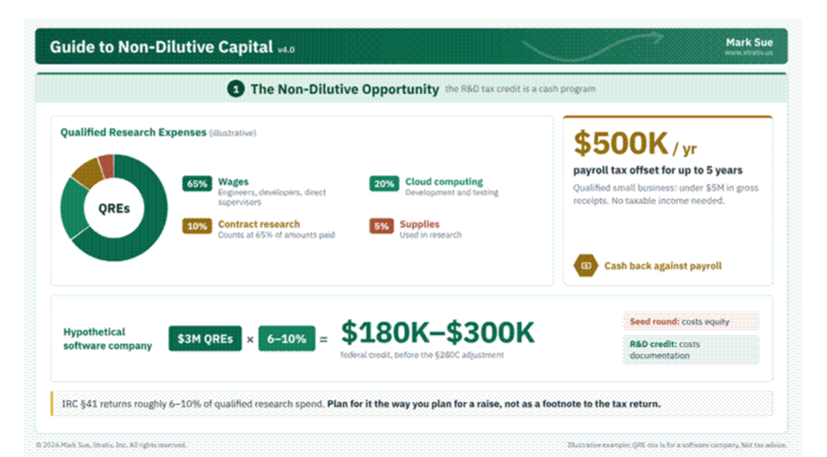
The federal R&D credit (IRC §41) is worth roughly 6-10% of qualified research spend, before the §280C adjustment. Qualified research expenses (QREs) are mostly wages: engineers, developers and the people directly supervising them. Add research supplies, cloud costs for development and testing, and 65% of contract research.
What surprises founders most: you don't need to be profitable. A qualified small business, meaning under $5M in gross receipts, can apply up to $500K a year of the credit against payroll taxes, for up to five years. If you're burning cash, that's cash coming back.
Run the numbers on a hypothetical software company with $3M of qualified research spend. That's roughly $180K-$300K of federal credit. Raise the same amount in a seed round and you pay in equity. Claim it as a credit and you pay in documentation. I'll take documentation every time.
So I put the credit in the financing plan, next to the raise, with a date and an owner. Not in a footnote to the tax return.
2. Section 174A brings back immediate R&D expensing
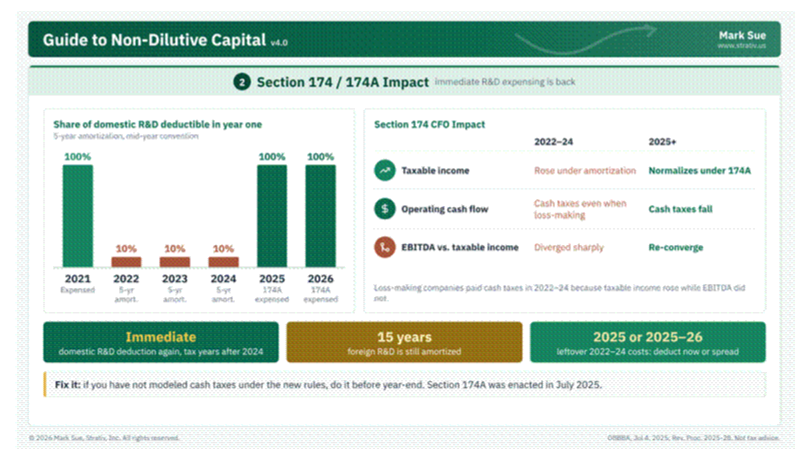
This one hurt. From 2022 through 2024, domestic R&D costs had to be amortized over five years. Plenty of loss-making companies ended up writing checks to the IRS, because taxable income went up while EBITDA didn't move.
Section 174A, enacted in July 2025, fixed that for tax years after 2024. Domestic R&D is immediately deductible again. Leftover 2022-24 costs can be deducted in 2025 or spread across 2025 and 2026. Foreign R&D is still amortized over 15 years.
My advice: if you haven't re-run your cash tax forecast under the new rules, do it before December 31. It's an afternoon of work, and it may change your runway.
3. SBIR and STTR grants are back
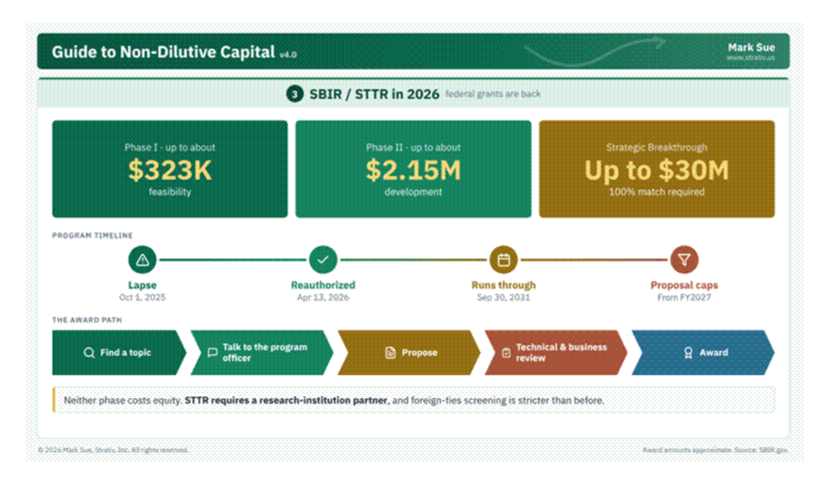
The SBIR and STTR programs lapsed in October 2025 and were reauthorized on April 13, 2026, through September 30, 2031. Phase I pays up to about $323K to prove feasibility. Phase II pays up to about $2.15M to build. Neither takes equity. STTR requires a research-institution partner, and foreign-ties screening is stricter than it used to be, so look hard at your investors and advisors before you apply.
For defense tech founders especially, this is the front door. The playbook hasn't changed: pick the topic, talk to the program officer before you write a word, submit, then get through technical and business review.
4. Stack state and local incentives without double counting
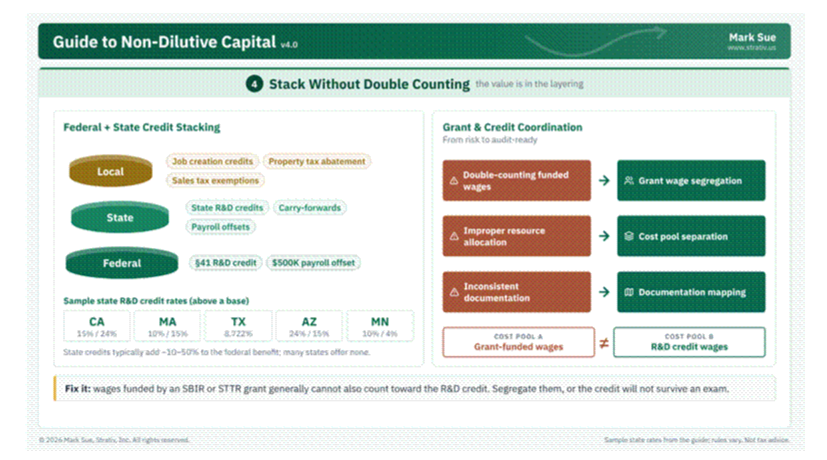
The real value is in the layers. Where states offer an R&D credit, it typically adds 10-50% on top of the federal benefit. Many states offer nothing. Local property tax abatements, sales tax exemptions and job creation credits sit on top of that.
The mistake I see most is double counting. Wages paid with SBIR or STTR money generally can't also count toward the R&D credit.
My advice: put grant-funded wages in their own cost pool from day one. Untangling them in the middle of an exam is miserable, and the credit may not survive it.
5. Run R&D credits as an annual, audit-ready program
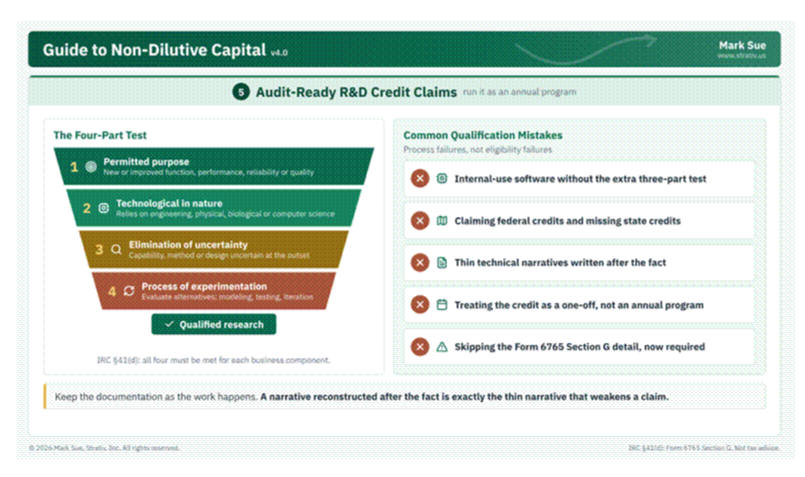
Almost every R&D credit problem I've seen was a process failure, not an eligibility failure:
Claiming the federal credit and leaving the state credit on the table
Technical narratives written months later, thin on detail
Treating the credit as a one-time project instead of an annual program
Claiming internal-use software without passing the extra three-part test
Skipping the Form 6765 Section G detail, which is now required
Every business component also has to pass the four-part test: a permitted purpose, technological in nature, elimination of uncertainty, and a process of experimentation. Document it while the work is happening. A narrative pieced together in March from Jira tickets and memory is exactly what an examiner pushes on.
At Strativ, Dawn Um, our Head of Tax Incentives, runs this as an annual program for our clients, with a focus on technology and defense tech companies. The goal is no year-end scramble.
6. Track non-dilutive capital KPIs at the board level
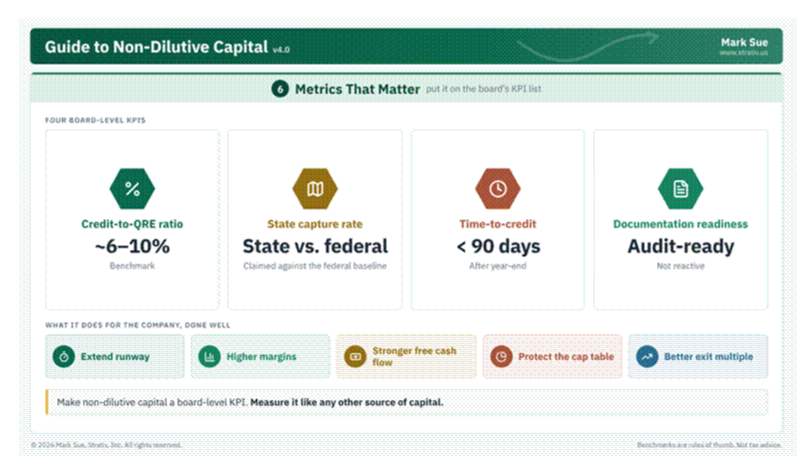
KPIs are most of what I do for clients, and the rule is simple: if the board doesn't see it, nobody owns it. Non-dilutive capital belongs on the board KPI list, right next to burn and pipeline:
Credit-to-QRE ratio: benchmark about 6-10%
State capture rate: state credits claimed against the federal baseline
Time-to-credit: under 90 days after year-end
Documentation readiness: audit-ready, not reactive
From my years in equity research, I can tell you investors won't put a separate value on your tax credits. They value what the credits do: longer runway, a cleaner cap table, and eventually better margins and free cash flow. That's what shows up in the exit multiple.
Claim what you're owed before the next equity round
Before you set terms on your next round, know what the company can claim this year and next. Every dollar from a credit or a grant is a dollar you don't have to sell at today's valuation.
The cheapest dollar you'll ever raise is the one you were already owed. If you want a second set of eyes on what you might be leaving on the table, book a call.
Non-dilutive capital FAQ
What is non-dilutive capital?
Funding that costs no ownership and no board seat. It comes from four pillars: government grants, tax credits, state and local incentives, and industry programs.
Can a startup with no taxable income use the R&D tax credit?
Yes. A qualified small business with under $5M in gross receipts can apply up to $500K a year of the federal R&D credit against payroll taxes, for up to five years.
How much is the federal R&D tax credit worth?
Roughly 6-10% of qualified research spend before the §280C adjustment. On $3M of qualified research spend, that's about $180K-$300K.
What changed with Section 174A?
Section 174A, enacted in July 2025, restored immediate expensing of domestic R&D for tax years after 2024. Foreign R&D is still amortized over 15 years.
Can SBIR grant wages also count toward the R&D credit?
Generally no. Wages funded by an SBIR or STTR grant generally can't also count toward the R&D credit, so keep grant wages in a separate cost pool.
Not tax advice. Confirm with your CPA.
The Guide to Non-Dilutive Capital covers the four pillars, Section 174A, SBIR and STTR, state credit stacking and the audit-ready process on one page.
