Investors are jaded and cynical these days. They're also the ones with the boatload of cash.
Your job is to get the money. After sitting through enough pitches, I can tell you most founders aren't prepared. They think the raise is about the technology and spend too little time on what investors actually need to see. If you were employee #5 at Anthropic, that's a different story. For the rest of us, preparation is the edge.
Most founders treat investor due diligence as something that starts after the term sheet. It starts the moment an investor opens your data room. A disorganized room sets the tone for everything that follows. And don't hand the data room to your lawyers. Nobody wants to dig through arcane folders behind a new login just to check your financials.
In the first few minutes, a serious investor isn't rereading your deck. They're checking whether the company behind the deck is as clean as the story. Here's what they look at first, what it tells them, and what to fix before you send the link.
Investor due diligence checklist: the first 10 minutes
1. Fully diluted cap table: who owns what after every SAFE, note and option converts.
2. Financial model vs. the books: whether last year's actuals match your financial statements.
3. Capital efficiency: burn multiple, gross margin and the Rule of 40.
4. Customer contracts and concentration: whether revenue is what you say it is.
5. Use of proceeds and runway: dollars tied to milestones, and how long the cash lasts.
6. Data room structure: whether the room is complete and labeled on day one.
1. Fully diluted cap table: who owns what after everything converts
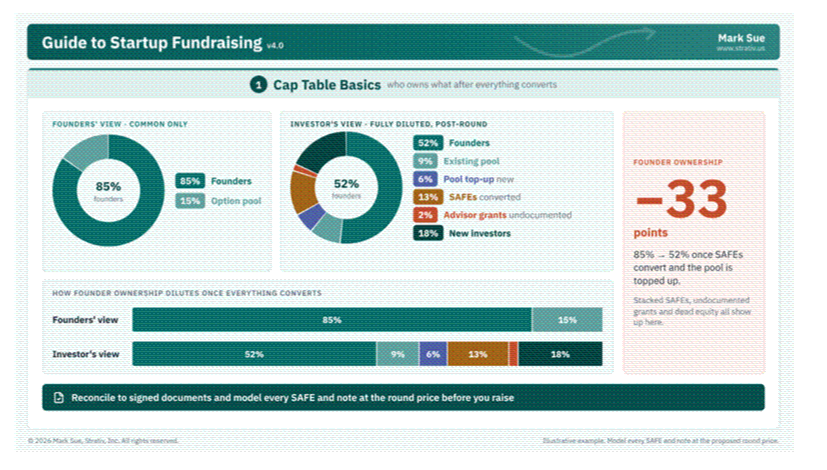
The first question is simple: who owns what, in which securities, and what happens when everything converts.
Investors want a fully diluted cap table that includes every SAFE, convertible note, warrant and option, plus the option pool. The usual problems are stacked SAFEs with different caps, advisor grants that were promised but never documented, and equity held by people who left. Too much convertible debt is its own problem. Side deals are worse: I've seen investors pass on a company because of unusual terms the founders cut along the way.
Most of these won't kill a deal on their own. Together they tell an investor the company hasn't been run carefully.
Fix it: reconcile the cap table to signed documents. Model how every SAFE and note converts at the proposed round price, and show the founders' ownership after the new pool. Clean up dead equity before you raise, not during. Make it simple enough that a new investor can do the math in minutes.
2. Startup financial model: does it tie to the books?
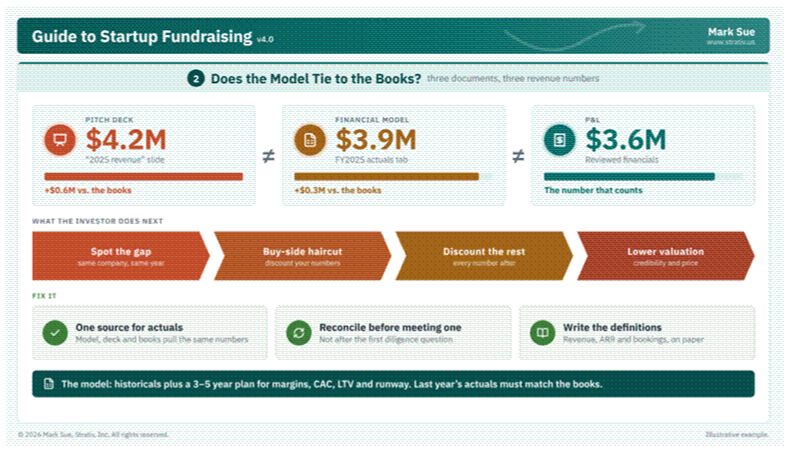
Next is the financial model: historicals plus a 3–5 year plan covering margins, CAC, LTV and runway. Ever seen a startup financial model that wasn't up and to the right?
Ambition is fine. Unrealistic ambition gets the buy-side haircut: investors discount your numbers and move on. The sharper check is whether last year's actuals in the model match your financial statements. If revenue in the model, the deck and the P&L are three different numbers, every number after that gets discounted further. That costs you credibility, and it costs you valuation.
Fix it: one source for actuals. Reconcile the model, the deck and the books before the first meeting, and write down how you define revenue, ARR and bookings.
3. Capital efficiency: burn multiple, gross margin and the Rule of 40
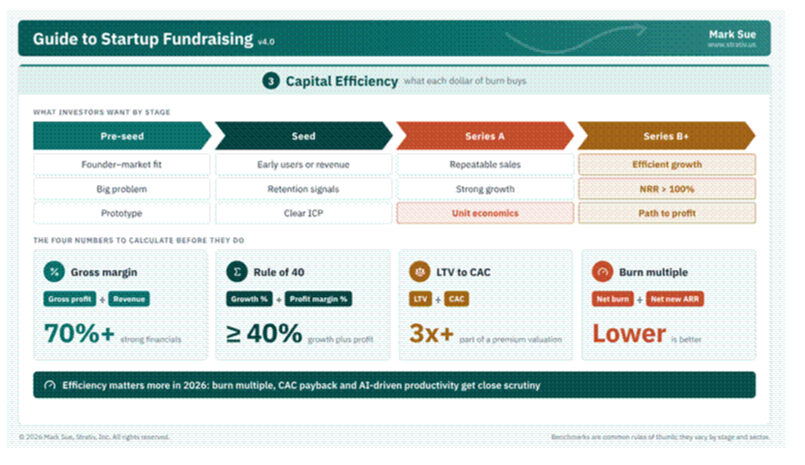
Efficiency gets close scrutiny now. Growth still matters, but a J-curve that never reaches profitability, with heavy burn along the way, turns a lot of investors off. They want to know what each dollar of burn buys.
The marks of strong financials are high growth, gross margin above 70%, and a pass on the Rule of 40 (growth rate plus profit margin of at least 40%). Burn multiple is net burn divided by net new ARR. Lower is better. Think about it from the investor's side: money goes in, something has to come out, and the engine needs to get good mileage.
Fix it: calculate these metrics yourself, with written definitions, before an investor does it for you and gets a worse answer.
4. Customer contracts and revenue concentration
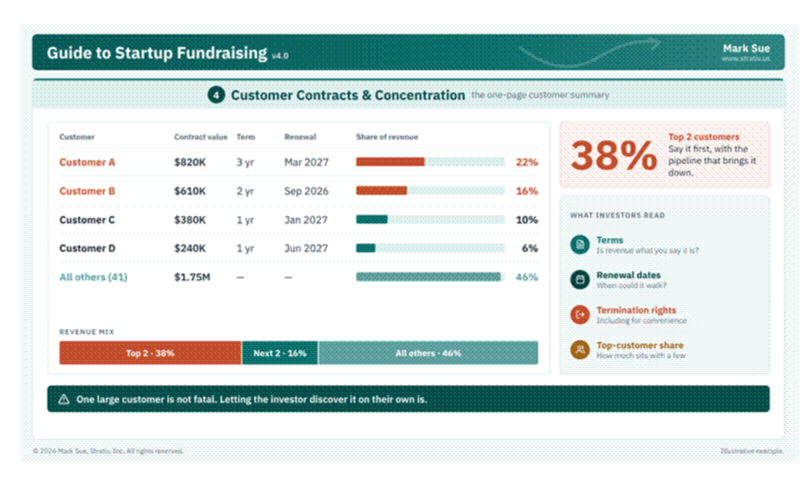
Investors open the customer contracts folder to confirm that revenue is what you say it is. They read terms, renewal dates and termination rights, including termination for convenience, and they look at how much revenue sits with your top few customers. Much of that review now runs through AI tools, so messy or inconsistent contracts get flagged fast.
A broad customer base and an LTV to CAC ratio above 3 are part of what earns a premium valuation. One large customer is not fatal. Letting the investor discover it on their own is a problem.
Fix it: a one-page customer summary listing top customers, contract value, term, renewal date and share of revenue. Raise concentration yourself, and if revenue is concentrated, show the pipeline and how that concentration comes down over time.
5. Use of proceeds and runway: tie dollars to milestones
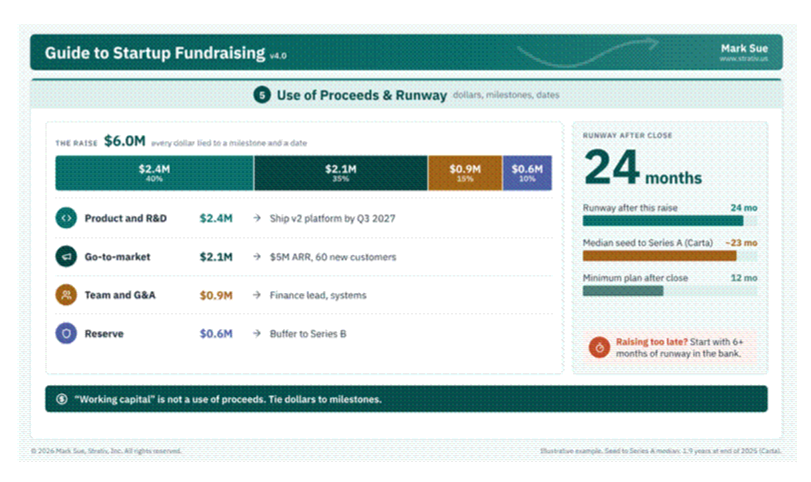
"Working capital" is not a use of proceeds. Most founders drop in the standard pie chart and assume nobody will ask. Investors want dollars tied to milestones: how much goes to R&D, hiring and go-to-market, and whether those costs improve as a percentage of revenue over time.
They also check runway, in both directions. Plan for 12–18 months or more of runway after close, because the median gap between seed and Series A is now close to two years (1.9 years in Q4 2025, according to Carta). And start the raise with at least six months of runway in the bank. If you start later, the investor sees it, and it shows up in your terms.
Fix it: a use-of-proceeds table with dollars, milestones and dates, and a cash forecast that shows when the money runs out. In other words, show why you're confident it won't run out before you hit the milestones.
6. Startup data room checklist: eight folders, one "Start here" note
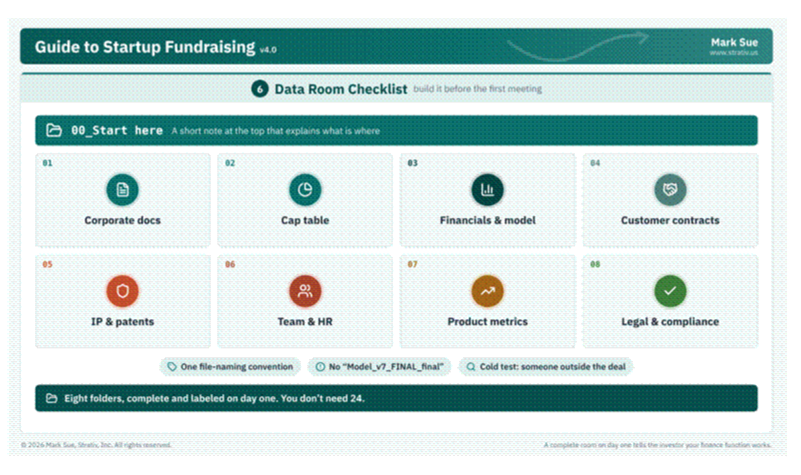
The structure itself is a signal. A complete startup data room has eight folders: corporate documents, cap table, financials and model, customer contracts, IP and patents, team and HR, product metrics, and legal and compliance. That's it. You don't need 24 folders. The full startup data room checklist is in the Strativ Guide to Startup Fundraising.
A room that is complete and labeled on day one tells the investor your finance function works. A room that fills up over three weeks of follow-up requests tells them the opposite, and it stretches a diligence phase that already takes weeks.
Fix it: build the room before the first meeting. Put a "Start here" note at the top that explains what's where. Use one file-naming convention so nobody has to guess, and for goodness' sake, no files named "Model_v7_FINAL_final." Then have someone outside the deal open the room cold and try to answer the basic questions without asking you.
Why data room readiness speeds up due diligence
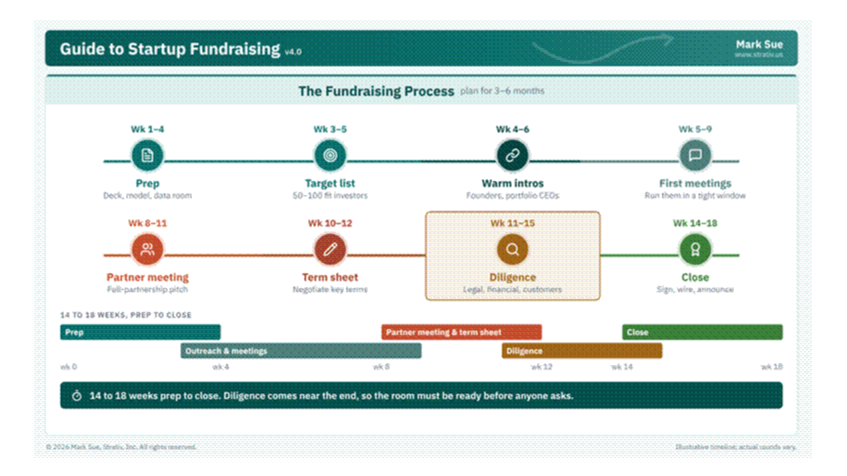
A typical startup fundraising process runs 14 to 18 weeks from prep to close, with diligence near the end. You can't speed up an investor's calendar (according to their assistant, they're traveling). You can remove every reason for them to slow down, re-price or walk.
Diligence rewards the company that was ready before anyone asked.
Investor due diligence FAQ
What do investors check first in due diligence? The fully diluted cap table, whether the financial model ties to the financial statements, capital efficiency metrics, customer contracts and concentration, use of proceeds and runway, and how the data room is organized.
What should be in a startup data room? Eight folders: corporate documents, cap table, financials and model, customer contracts, IP and patents, team and HR, product metrics, and legal and compliance. Add a "Start here" note and use consistent file names.
How long does startup due diligence take? Usually three to five weeks, near the end of a fundraising process that runs 14 to 18 weeks from prep to close. A complete data room on day one is the main thing a founder controls.
What is a fully diluted cap table? A cap table that shows ownership as if every SAFE, convertible note, warrant and option, plus the unissued option pool, had already converted into shares. It is the number investors use to work out their ownership, and yours, after the round.
What is a good burn multiple? Burn multiple is net burn divided by net new ARR. Under 1.5 is strong, 1.5 to 2 is acceptable, and above 2 invites hard questions about how efficiently the company turns cash into growth.
When should I build my data room? Before the first investor meeting, not after the term sheet.
The Strativ Guide to Startup Fundraising puts the whole process on one page: sources of capital, term sheet terms to watch, cap table and dilution math, the fundraising timeline, the data room checklist and the 10-slide pitch.
Get the Guide to Startup Fundraising: www.strativ.us/guides