
The insurance industry faces a unique set of challenges, including stringent regulations and complex financial reporting, as well as the continuous management of risk across various entities and jurisdictions. For insurance firms, selecting an appropriate core accounting or ERP system is crucial. It's not just about financial record-keeping; it's about ensuring compliance, boosting operational efficiency, and fostering strategic growth.
We delve into the specific accounting needs of insurance companies. We'll then examine LA Insurance's successful transition using Sage Intacct and explore other ERP solutions available to the industry.
The Unique Accounting and Finance Requirements of Insurance Firms
Insurance accounting is governed by a specialized set of rules and standards designed to protect policyholders, ensure solvency, and provide transparency to regulators and investors. Key requirements include:
1. Regulatory Compliance: SAP and GAAP/ASC 944
-
Statutory Accounting Principles (SAP): U.S. insurers are required to prepare financial statements in accordance with SAP, which emphasizes conservative asset valuation and solvency.
-
GAAP and ASC 944: Public insurers must also comply with GAAP, with a focus on investor transparency and income statement presentation.
2. Detailed Financial Reporting and Disclosure
-
Insurers must provide granular disclosures on reserves, risk exposures, reinsurance, and policyholder surplus.
-
Annual statutory statements are required for regulatory review and approval.
3. Premium and Claims Accounting
-
Premiums are recognized for risk, not when received.
-
Accurate tracking of written, earned, and unearned premiums, as well as claims and reinsurance, is essential.
4. Actuarial Reserving and Capital Requirements
-
Actuarial models are used to estimate future claims and set aside adequate reserves.
-
Firms must meet risk-based capital (RBC) thresholds and maintain sufficient surplus.
5. Multi-Entity and Multi-Jurisdictional Complexity
-
Many insurers operate across multiple states or countries, requiring consolidated financial management and compliance with diverse regulations.
6. Technology, Integration, and Security
-
Modern insurers need systems that integrate policy, claims, and financial data, support automation, and ensure data security and privacy.
Case Study: LA Insurance’s Financial Upgrade with Sage Intacct
The Challenge: Bottlenecks and Barriers
LA Insurance, a Michigan-based insurance provider with nearly 160 stores in seven states, faced operational hurdles that are all too familiar in the industry:
-
40-Day Monthly Close: Manual reconciliations and data silos delayed financial reporting.
-
Labor-Intensive Processes: Reliance on Microsoft Dynamics GP and spreadsheets led to inefficiency and errors.
-
Limited Reporting: Leadership lacked real-time insights for decision-making.
-
High External Support Costs: Frequent consultant involvement increased overhead.
-
Scalability Constraints: Legacy systems were unable to keep up with growth.
The Solution: Why Sage Intacct?
After evaluating several platforms (including Oracle NetSuite), LA Insurance selected Sage Intacct for its:
-
User-Friendly Interface: Accelerated adoption by staff.
-
Multi-Entity Support: Simplified consolidation across locations.
-
Automation: Streamlined journal entries, reconciliations, and reporting.
-
Custom Dashboards: Enabled granular, real-time profitability analysis.
-
Cost-Effectiveness: Lower total cost of ownership and reduced reliance on consultants.
Implementation Highlights
-
Automation First: Automated journal entries and financial statement preparation.
-
Real-Time Insights: Dashboards provided location-wise performance data.
-
Seamless Integration: APIs connected Sage Intacct to other internal systems.
-
Centralized Oversight: Enabled both centralized financial control and decentralized decision-making.
Transformative Results
-
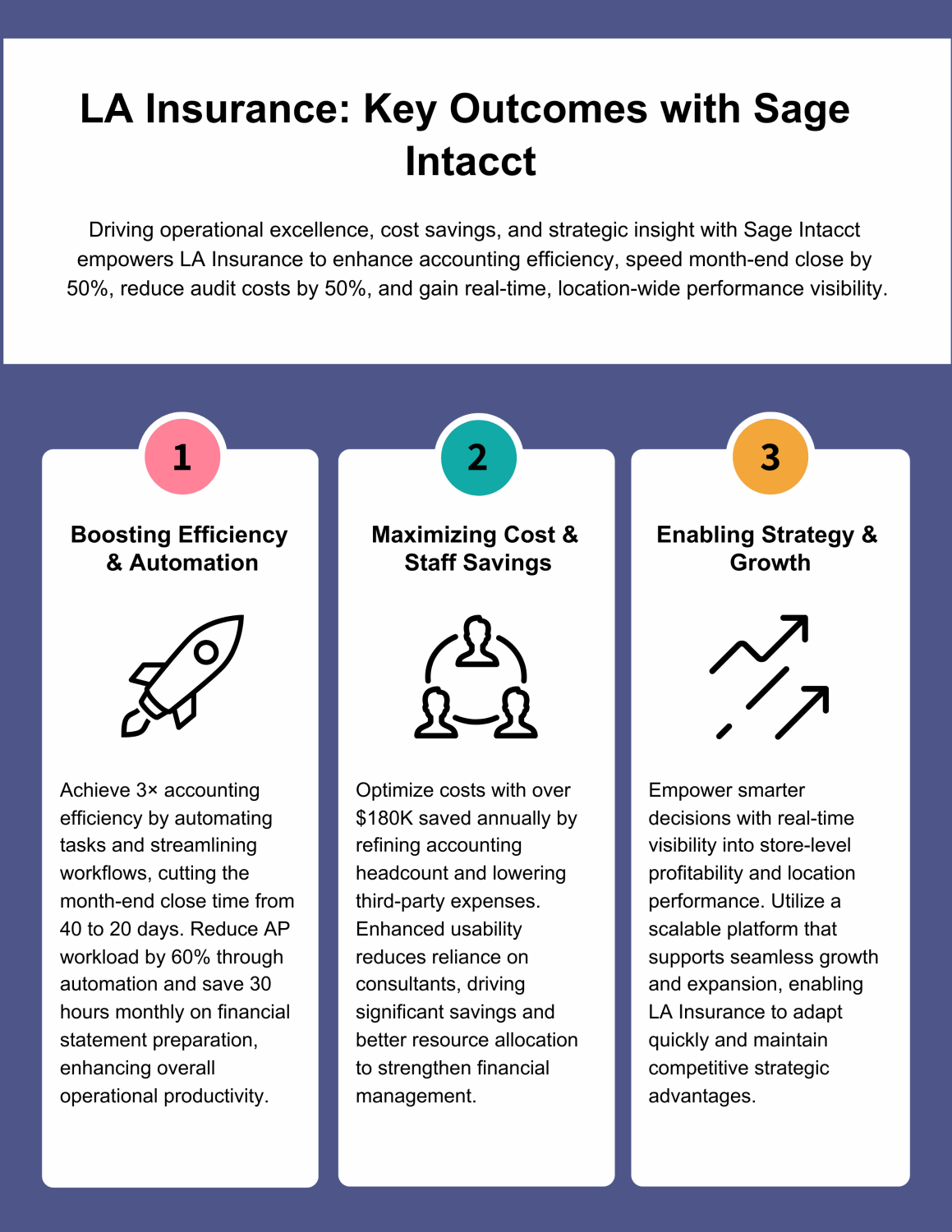
3x Accounting Efficiency: Staff shifted from manual work to analysis and strategy.
-
50% Faster Close: Monthly close time dropped from 40 to 20 days.
-
60% Lower AP Workload: Automation sped up vendor payments.
-
$180,000+ Annual Savings: Leaner accounting team and reduced audit/consultant costs.
-
Empowered Decision-Making: Store-by-store insights led to smarter business actions.
-
Scalability: New locations could be added with minimal back-office impact.
ERP/Accounting System Selection: What Insurance Firms Must Consider
The LA Insurance case illustrates that the right ERP system must align with insurance-specific requirements:
Key Selection Criteria
-
Regulatory Compliance: Support for SAP, GAAP, and insurance-specific reporting.
-
Multi-Entity Management: Consolidation and reporting across multiple entities and jurisdictions.
-
Automation and Integration: Streamlined workflows and seamless data flow between policy, claims, and finance.
-
Real-Time Reporting: Customizable dashboards and analytics for compliance and strategy.
-
Scalability: Ability to grow with the business.
-
Security: Robust data protection and privacy controls.
-
Cost-Effectiveness: Lower total cost of ownership and reduced need for external consultants.
Other ERP and Accounting Options for Insurance Firms
While Sage Intacct proved ideal for LA Insurance, several other solutions are available, each with unique strengths:
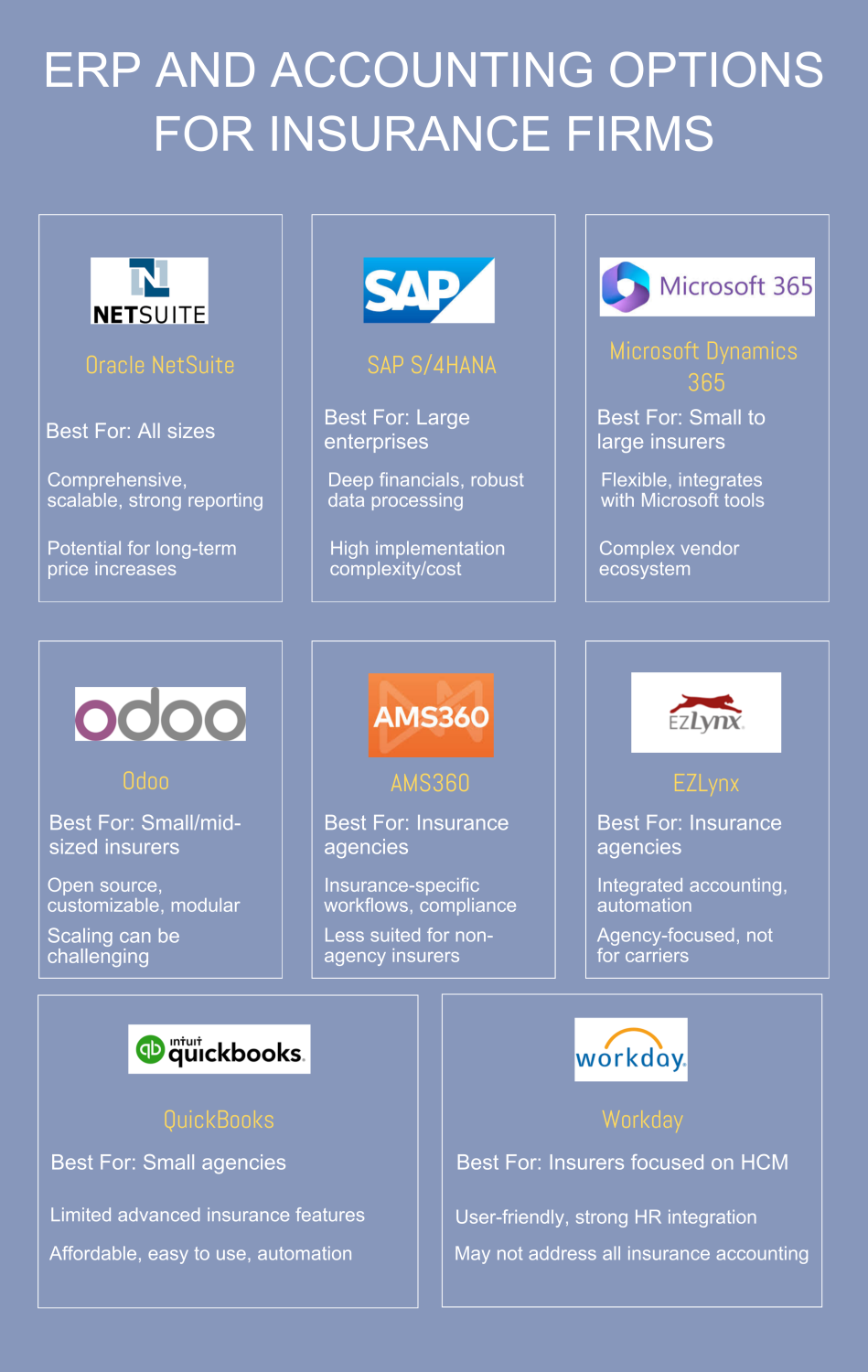
The best choice depends on your firm’s size, complexity, growth plans, integration needs, and regulatory environment.
Turning Finance into a Competitive Advantage
LA Insurance’s journey with Sage Intacct is a powerful example of how modern, cloud-based ERP systems can transform insurance accounting from a compliance headache into a strategic asset. By automating manual tasks, enabling real-time insights, and supporting regulatory requirements, the right system empowers insurance firms to operate with agility, clarity, and control.
Key Takeaway:
Whether you choose Sage Intacct, Oracle NetSuite, SAP S/4HANA, or another leading platform, the secret to success is aligning your ERP/accounting system selection with the unique demands of the insurance industry ensuring compliance, efficiency, and the ability to scale for future growth.
Ready to modernize your insurance firm’s accounting? Evaluate your needs, compare solutions, and follow the blueprint set by industry leaders like LA Insurance to turn your finance function into a true competitive advantage.
Go deeper: Guide 18, Professional Services Finance & Metrics, part of the CFO Guide Series: 24 one-page guides for CEOs and founders.
