
The R&D Tax Credit: The Million-Dollar Opportunity Hiding in Plain Sight
The month closed with a thud. Your engineering payroll hit $420,000 for the month—salaries, taxes, benefits, contractors. On the board slide, it shows up as a single, brutal expense line, and for the quarter, yikes. When the Board member asks, “How much runway do we have if we keep spending like this?”, you start thinking about headcount reductions and a bridge round.
Then you remember: you’re paying full price for innovation.
This article is about the credit you already earned—and why the R&D tax credit belongs in your board deck and cash forecast, not buried on a workpaper in your tax file.
1. Reframing the R&D Credit as Capital
Most founders and even many CFOs hear “R&D tax credit” and immediately think “tax gimmick” or “something our CPA will handle at year‑end.” That framing can cost you, dearly.
At its core, the R&D credit is:
-
A dollar‑for‑dollar reduction of tax, not just a deduction.
-
For many young companies, a direct offset to payroll taxes (a hard cash outflow) rather than a tweak to income tax you might not even be paying yet.
-
A recurring benefit if you’re innovating every year, not a one‑time windfall.
Credit vs deduction in CFO language
-
A deduction reduces taxable income.
-
A credit reduces tax itself.
For early‑stage startups and growth companies that qualify as “small businesses” under the R&D rules, that credit can be used to offset a portion of employer payroll tax, turning some of that $420,000 monthly engineering spend into effectively discounted labor over time.
As a CFO, that is not trivia; it is a capital‑efficiency lever:
-
It extends runway without dilution.
-
It funds incremental headcount (or avoids cuts).
-
It turns historically “fixed” tax leakage into discretionary cash you can redeploy.
-
It makes you look good in front of the board.
2. Why the Credit Is Hiding in Plain Sight
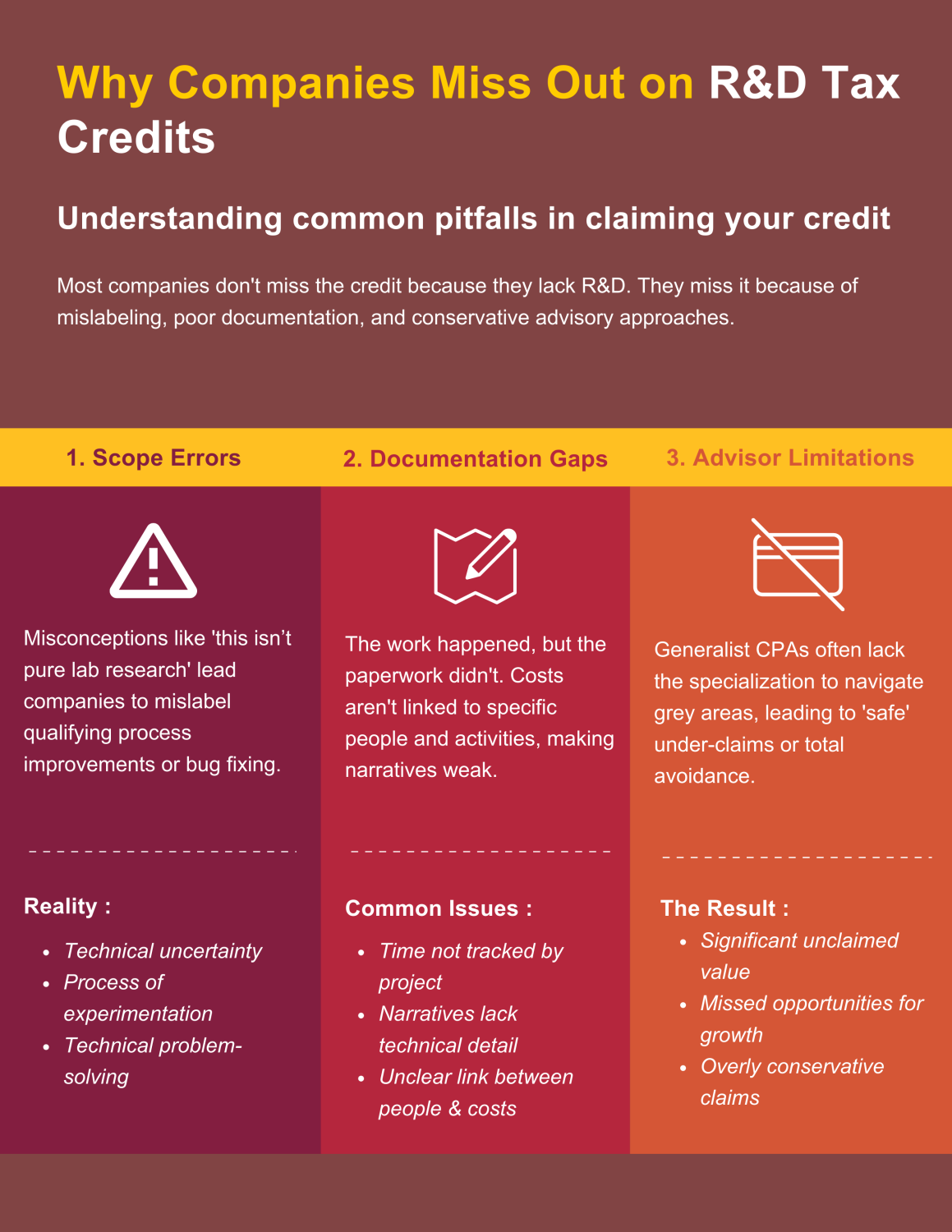
If the benefit is so strong, why is it underused?
Key systemic reasons
-
Scope errors Many companies assume only “pure R&D” or “lab work” qualifies.
-
In reality, the tax aw focuses on technical uncertainty and a process of experimentation, not job titles or departmental labels.
-
Documentation gaps The work is real, but the paper trail is messy or nonexistent.
-
When CFOs and advisors can’t clearly connect activities, people, and costs, they default to under‑claiming to stay “safe”—or skipping the credit entirely.
-
Overly conservative or overstretched advisors Many generalist tax preparers do not have the time or incentive to run a rigorous R&D study.
The combination of misunderstood scope, weak documentation, and conservative posture is why R&D credits are often hiding in the middle of your P&L, unclaimed.
3. A Simple Example: The $420k Month
Let’s put numbers to this.
Assume:
-
Annual engineering‑related spend:
-
After scoping and applying a reasonable methodology, you determine that 50%–60%of that spend relates to qualifying activities in the U.S.
Depending on your exact facts, methodology, and jurisdiction:
-
A realistic federal credit range might be in the low‑ to mid‑single‑digits percent of QREs once the formulas and any Section 280C adjustment are applied.
-
For illustration only, if you ended up with a $150,000–$250,000 federal credit and a meaningful state credit on top, you’ve effectively reduced your net cost of that $5M engineering budget by a non‑trivial amount.
If you are early‑stage and using the payroll tax offset, that’s up to a defined annual cap against employer payroll tax. In practical terms:
-
That might fund one or two senior engineers fully loaded with benefits.
-
Or it might be the difference between a painful cut and holding your team together until the next milestone.
The point isn’t to fixate on an exact percentage. The point is that, for a company spending millions on engineering, the R&D credit is large enough to matter at the board level.
4. Segment 1 – Startups: Turning Credits into Runway
For startups, the R&D credit is most powerful when treated as a forecastable part of your funding strategy, not a surprise, we got money refund.
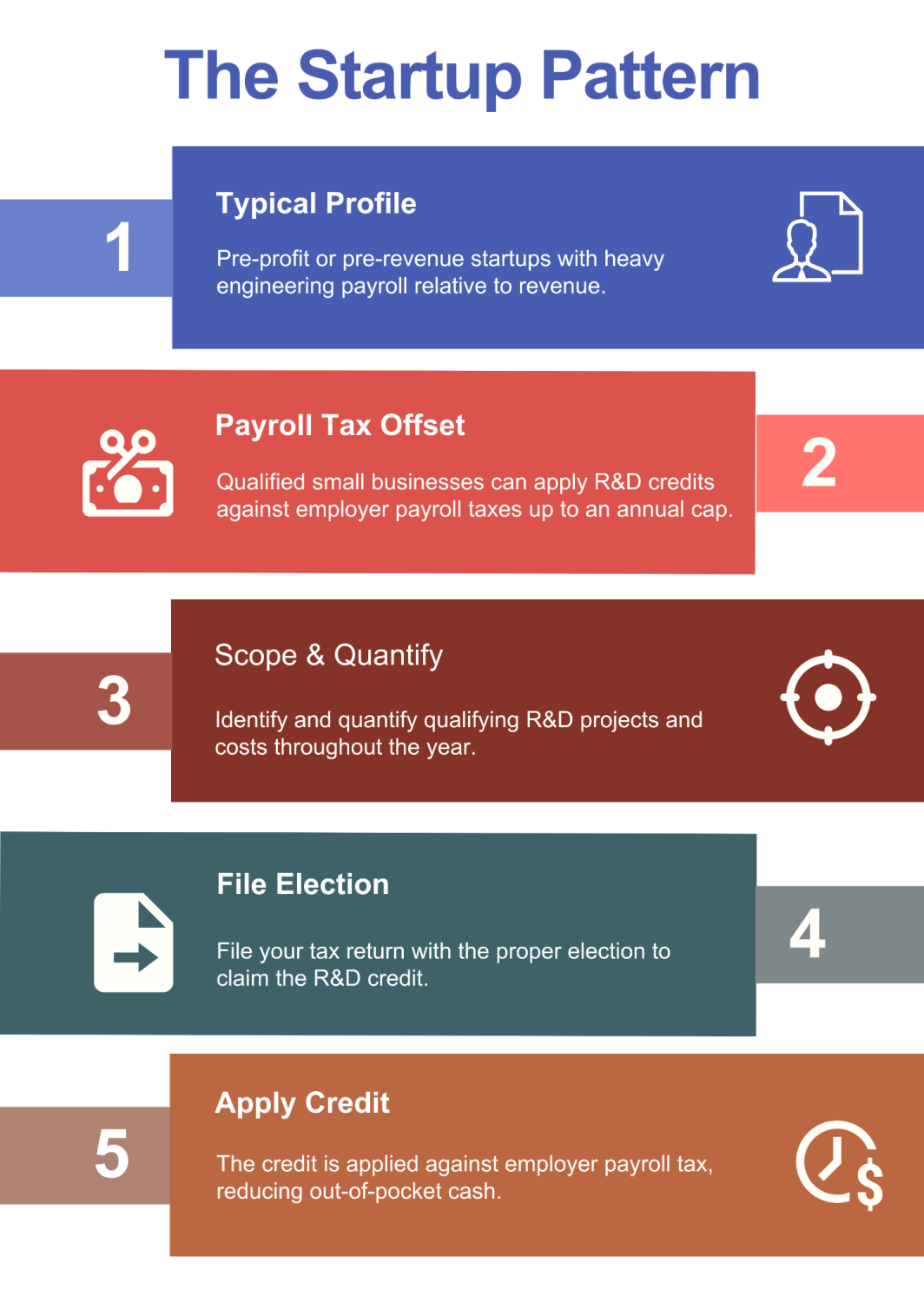
The startup pattern
Typical profile:
-
Pre‑profit, sometimes pre‑revenue.
-
Heavy engineering payroll relative to revenue.
-
Paying meaningful employer payroll taxes, even if income tax is low or zero.
If you qualify as a small business for R&D purposes, you may be able to apply your credit against portions of employer payroll tax, up to an annual cap and subject to ordering rules.
In operational terms:
-
You scope and quantify qualifying projects and costs throughout the year.
-
You file your return with the proper election.
-
The credit is then applied against employer payroll tax in the prescribed order, reducing out‑of‑pocket cash.
Mini case study – B2B SaaS
-
Dev team:
-
Qualifying activities:
After a disciplined review, you determine that about 60 percent of this activity meets the technical criteria and is properly documented. You run the calculation and arrive at a six‑figure annual credit that can be used to offset employer payroll tax (again, within the applicable cap and ordering rules).
Impact:
-
Instead of cutting headcount, you keep two critical engineers through a tough year. Money is money after all.
-
You treat the credit as a recurring part of your runway bridge, alongside revenue growth and cost control.
The founders and board begin to see the R&D credit not as a one‑time win, but as a structural feature of how the company finances innovation. Be the hero.
5. Segment 2 – Manufacturers: Process Engineering as a “Sleeping Giant”
In manufacturing, the R&D credit is often largest where leadership assumes they “don’t do R&D” at all.
The manufacturing reality
Daily life on the shop floor is full of:
-
Yield improvements.
-
Scrap reduction.
-
Cycle‑time reductions.
-
Material substitutions.
-
Automation and fixturing redesigns.
These are exactly the kinds of activities that often involve technical uncertainty and iterative testing.
The issue is rarely qualification. The issue is recognizing the work as R&D and capturing it in a structured way.
Mini case study – Precision manufacturer
-
Company: precision machining and assembly business serving industrial and aerospace customers.
-
Spend:
-
Activities:
Historically, the CFO wrote all of this off as “operational excellence.” After an R&D review:
-
A subset of projects is identified where technical uncertainty and a process of experimentation are clearly present.
-
A “project register” is created with each business component, its uncertainty, and the experiments performed.
-
Payroll and some material costs are allocated to those projects using time estimates, project codes, and production records.
Result: a recurring annual credit that materially reduces the effective cost of engineering and continuous improvement work, with documentation that can survive scrutiny.
From the board’s perspective, that credit funds a portion of ongoing lean and automation initiatives.
6. Segment 3 – DoD and Defense Innovators: Structured Experimentation by Design
Defense and aerospace companies often have the most robust engineering records—and the least optimized R&D credit posture.
Why defense is naturally rich in R&D
Typical DoD‑oriented work involves:
-
Strict performance requirements under unusual environmental conditions.
-
Integration of multiple subsystems with uncertain interactions.
-
Hardware‑software co‑design.
-
Extensive verification and validation cycles.
Those characteristics are hallmarks of technical uncertainty and experimentation.
Mini case study – Defense contractor
-
Company: mid‑size defense contractor developing a new ruggedized sensor platform.
-
Engineering spend:
-
Artifacts:
The work clearly fits an R&D profile. The challenge: labor records are not mapped cleanly to specific projects and experimentation phases for tax purposes.
A disciplined credit process does three things:
-
Aligns business components with DoD programs and internal project codes.
-
Extracts uncertainty statements and experiment descriptions directly from engineering artifacts (trade studies, test plans, failure analyses).
-
Ties wage and certain supply costs to those components and experiments using project accounting, time coding, or reasonable allocation methods.
The outcome is not just a sizeable recurring credit; it is a defensible file that speaks the language of both auditors and program managers.
From the CFO’s viewpoint, this becomes part of the financial model when bidding future programs: the effective cost of engineering can be lower than the gross payroll suggests.
7. Why This Belongs in the Board Pack
For founders and CFOs, the R&D credit only becomes a strategic tool when it graduates from “tax footnote” to “line item in the financing plan.”
Practically, that means:
-
Including an R&D credit line in your multi‑year financial model, with conservative assumptions and sensitivity ranges.
-
Discussing it alongside equity, debt, and non‑dilutive sources like grants and rebates.
-
Reporting annually to the board on:
When you do that, several things change:
-
Product and engineering leaders see that good project tracking and documentation are not bureaucracy—they are cash.
-
The board understands that the company is not leaving “free money” on the table, nor taking reckless tax positions.
-
Your CPA partners position you as a sophisticated client who treats the R&D credit with the seriousness it deserves.
8. What a CFO Should Do Next
If you’re a CFO or founder reading this and suspect you’re paying full price for innovation, the next steps are not about memorizing tax code; they are about running a better process:
-
Inventory your engineering and process‑improvement work
-
Map existing systems to potential evidence
-
Quantify at a high level
-
Decide your operating model
The R&D credit is not about gaming the tax code. It is about recognizing that, if you’re already investing heavily in innovation, you should not be paying full price for it—especially when you can turn that recognition into runway, hiring capacity, and strategic optionality year after year.
Go deeper: Guide 08, Non-Dilutive Capital, part of the CFO Guide Series: 24 one-page guides for CEOs and founders.
