
The Nimble CFO in AI (Part 2): Astute FP&A — Knowing Which Scenarios Actually Matter
In AI, modeling is no longer the hard part.
Judgment is.
You can spin up a new scenario in minutes:
-
Adjust pricing → new forecast.
-
Change usage → new growth curve.
-
Flex costs → new margin profile.
Very quickly, you have 15 to 20 plausible futures.
And yet, many teams walk away less certain than when they started.
When Complexity Becomes a Distraction
It is easy to confuse sophistication with insight.
You will see:
-
Dozens of scenarios.
-
Hundreds of assumptions.
-
Highly detailed models.
But ask a simple question — “What actually matters here?” — and the answer often is not clear.
More modeling does not automatically lead to better decisions.
The Core Reality
You can model almost anything.
Only a handful of variables will truly drive outcomes.
The role of FP&A is not to expand possibilities endlessly. It is to narrow focus to what can materially impact the business.
From Scenario Volume to Scenario Priority
This is where strong finance leadership stands out.
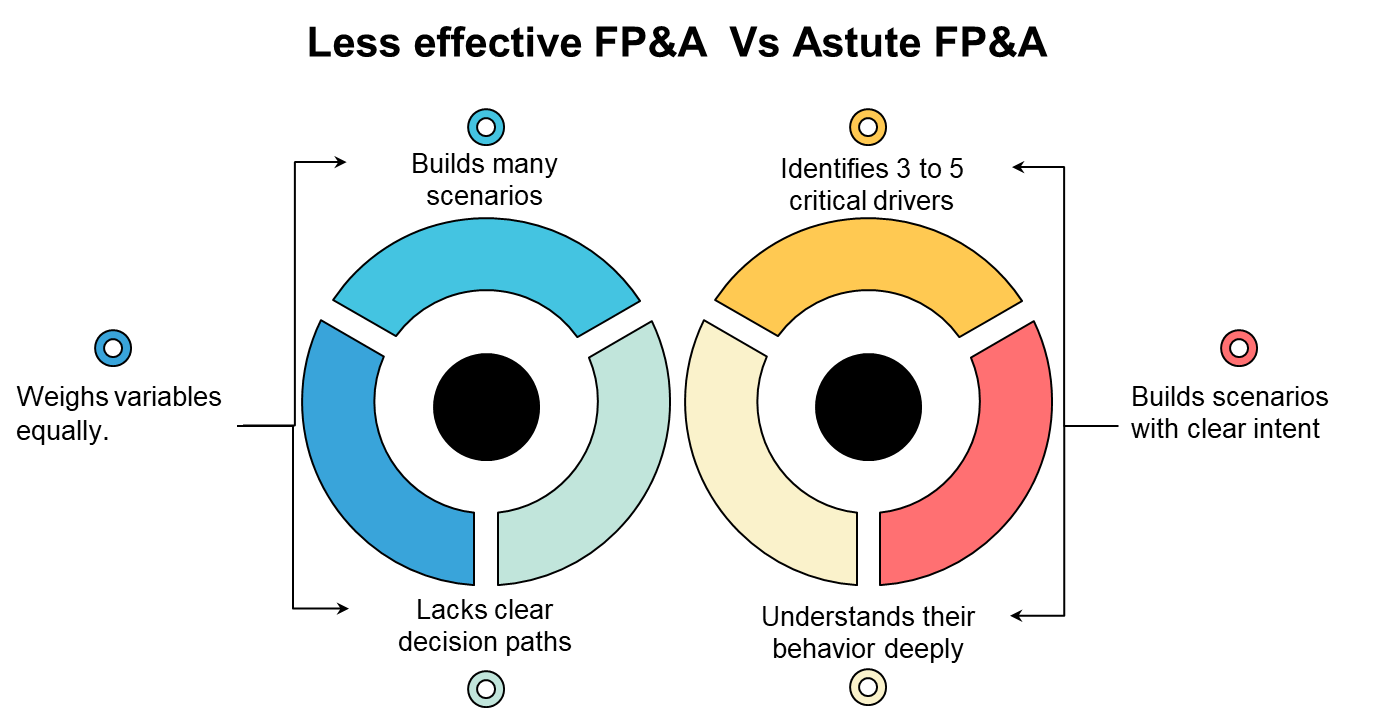
Less effective FP&A:
-
Builds many scenarios.
-
Weighs variables equally.
-
Lacks clear decision paths.
Astute FP&A:
-
Identifies 3 to 5 critical drivers.
-
Understands their behavior deeply.
-
Builds scenarios with clear intent.
It is not about doing less work. It is about doing the right work.
The Drivers That Actually Matter
While every company is different, a few variables consistently dominate:
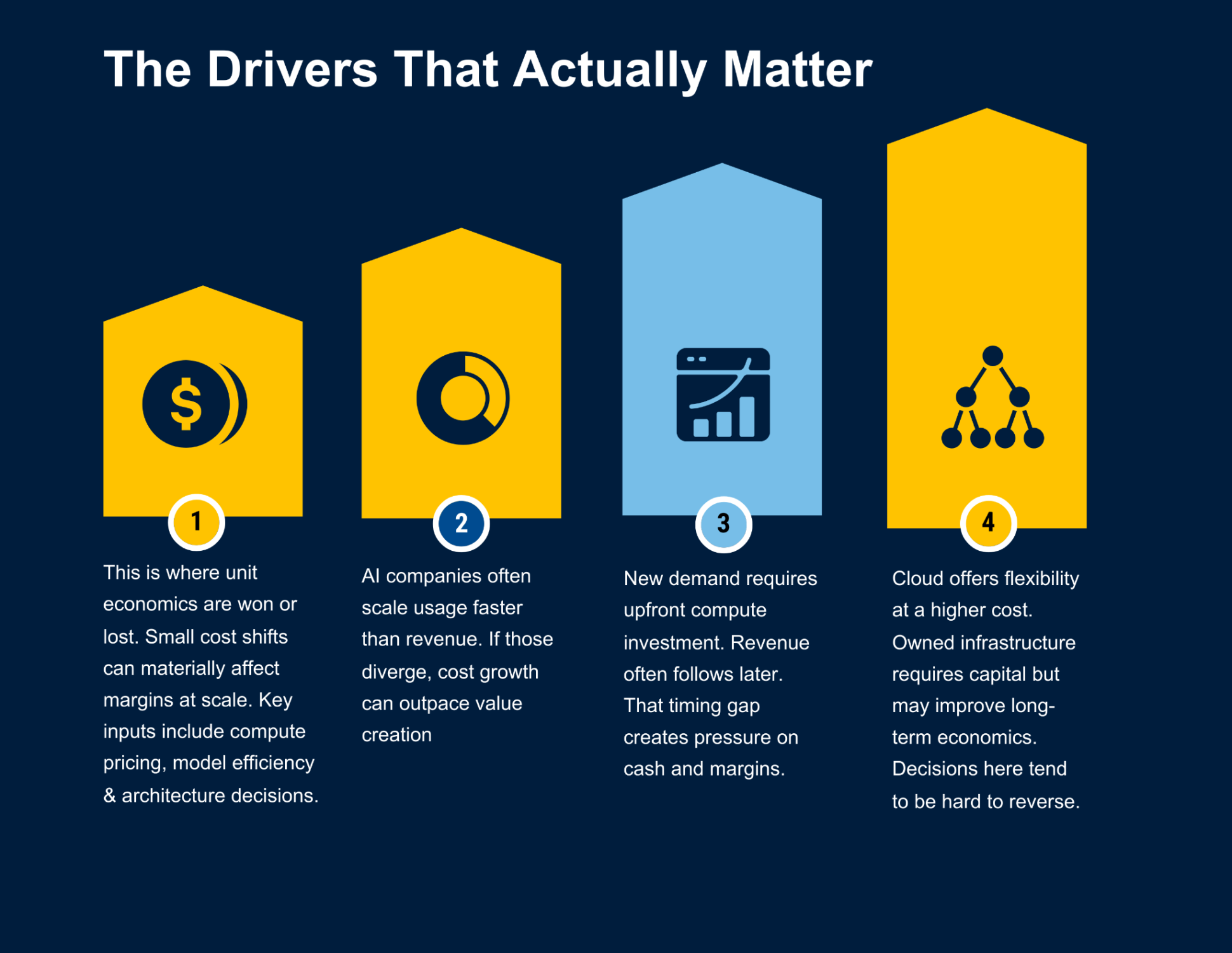
1. Cost per Inference This is where unit economics are won or lost. Small cost shifts can materially affect margins at scale. Key inputs include compute pricing, model efficiency, and architecture decisions.
2. Usage vs. Monetization AI companies often scale usage faster than revenue. If those diverge, cost growth can outpace value creation.
3. Customer Growth vs. Infrastructure Timing New demand requires upfront compute investment. Revenue often follows later. That timing gap creates pressure on cash and margins.
4. Cloud vs. Owned Infrastructure Cloud offers flexibility at a higher cost. Owned infrastructure requires capital but may improve long-term economics. Decisions here tend to be hard to reverse.
Palantir is a strong example of why the key question is not “how many scenarios can we build?” but “which drivers actually change the outcome.” Its commercial business has been scaling quickly, with revenue growth and net retention showing how usage, expansion, and monetization can matter more than exhaustive scenario count.
OpenAI is useful as a conceptual reference for usage-versus-monetization dynamics, especially because its business model is tied to consumption-based API usage and enterprise adoption, where revenue can scale with usage but also depends on enterprise packaging and partnerships.
Cost per inference
CoreWeave is one of the clearest public-company examples for cost per inference and infrastructure economics. It is explicitly positioned as an AI cloud provider, and its business depends on how efficiently it can deliver GPU capacity and compute at scale.
Where Tools Help — and Where They Do Not
Modern FP&A systems are powerful:
-
Rapid scenario generation.
-
Real-time data integration.
-
Instant recalculation.
But they do not tell you what matters.
They do not define thresholds. They do not make trade-offs.
That responsibility still sits with the CFO.
The Three Disciplines of Astute FP&A
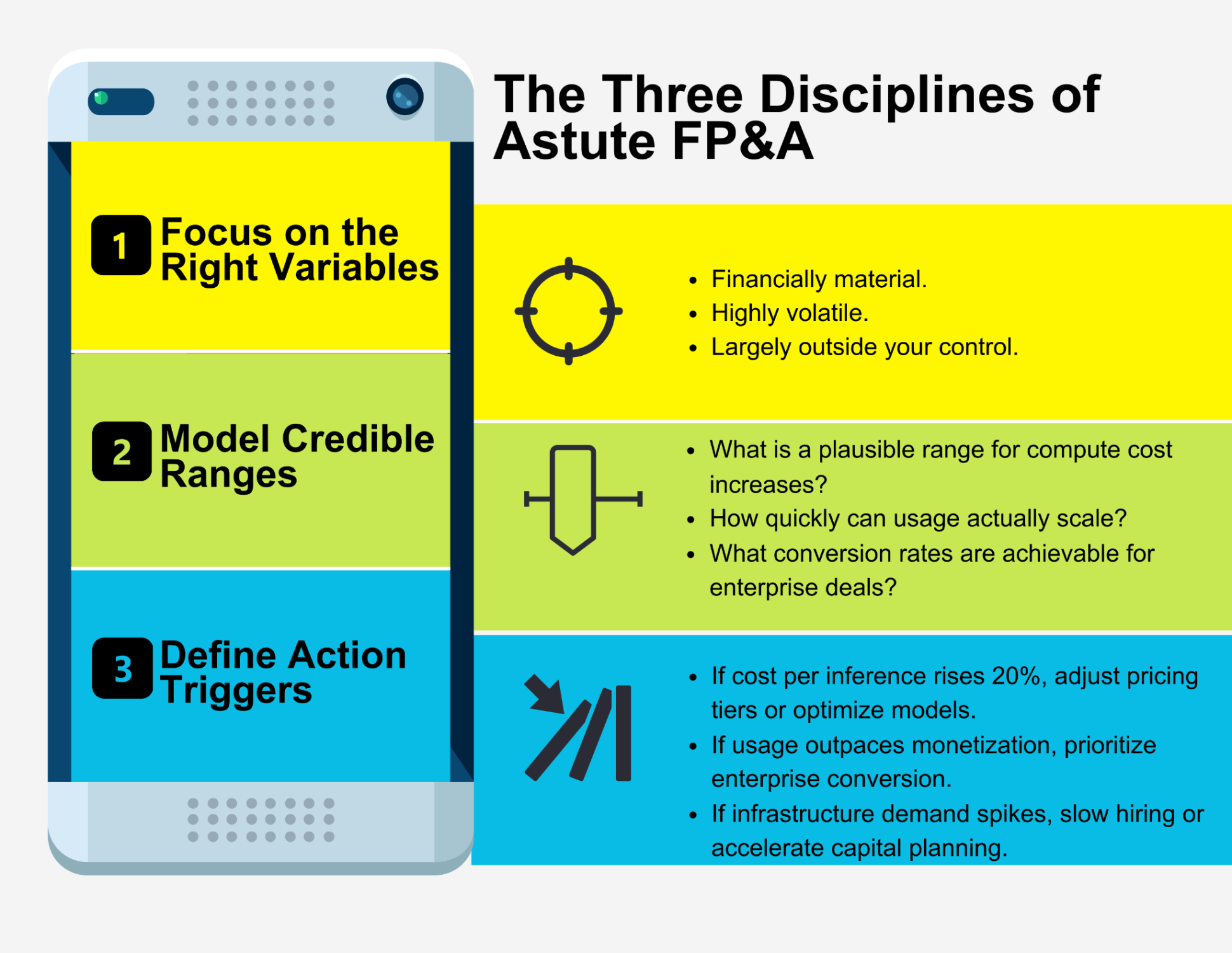
1. Focus on the Right Variables Not all inputs deserve equal attention. Prioritize those that are:
-
Financially material.
-
Highly volatile.
-
Largely outside your control.
2. Model Credible Ranges Anyone can create a scenario. Fewer create realistic ones.
-
What is a plausible range for compute cost increases?
-
How quickly can usage actually scale?
-
What conversion rates are achievable for enterprise deals?
Grounding scenarios in reality is what makes them useful.
3. Define Action Triggers A scenario without a response is just analysis.
For each key scenario, define: “If X happens, we do Y.”
For example:
-
If cost per inference rises 20%, adjust pricing tiers or optimize models.
-
If usage outpaces monetization, prioritize enterprise conversion.
-
If infrastructure demand spikes, slow hiring or accelerate capital planning.
Clarity turns insight into execution.
A Simple Filter
Before building any scenario, ask:
-
Does this variable materially impact outcomes?
-
Is it genuinely uncertain or volatile?
-
Would we act differently depending on the result?
If not, it is probably noise.
Final Thought
In AI, the risk is not missing a minor variable.
It is focusing on the wrong ones.
Astute FP&A is not about producing more scenarios. It is about identifying the few assumptions that truly matter — and preparing for them with intent.
Go deeper: Guide 02, FP&A, Budgeting & Board Reporting, part of the CFO Guide Series: 24 one-page guides for CEOs and founders.
