
The CFO’s Guide to Navigating Tariffs
Have a playbook. No one knows what Elon and Trump will do by the time you wake up so it’s better to have a framework when it comes to tariffs so that your financial team is not just reacting. CFOs must proactively manage the economic impact of tariffs, as trade policies changes have far-reaching implications. Tariff wars and the inclination for escalation with key trading partners like China, Canada, and Mexico will increase operational costs, affect pricing strategies, and disrupt global supply chains and cause a lot of uncertainty.
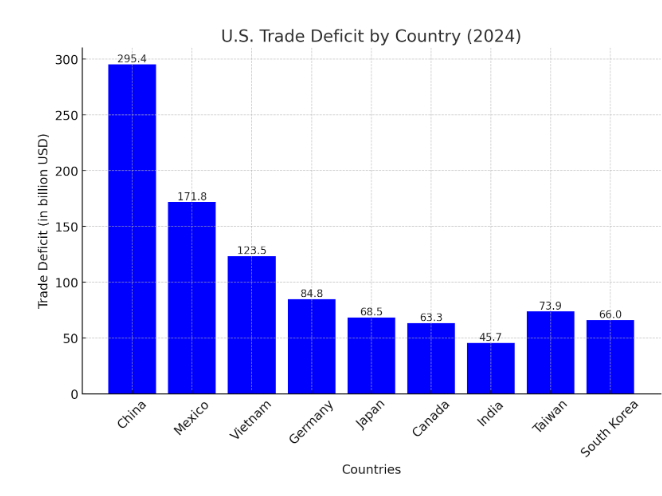
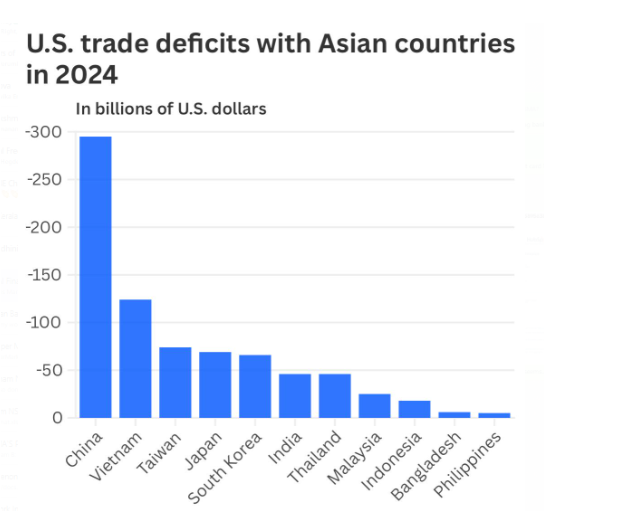
The numbers are pretty staggering. China topped the trade surplus with the U.S. last year at $295.4 billion, followed by Vietnam’s $123.5 billion, Taiwan’s $74 billion, Japan’s $68.5 billion and South Korea’s $66 billion, according to the U.S. Census Bureau. Sort of makes sense why people are mad when other countries will add tariffs of 100% (to Cadillacs or MerecedesBenz autos to China) while it’s around 10% or less the other way around.
Companies reliant on international sourcing must navigate the challenges of fluctuating costs, inventory management complexities, and potential shifts in consumer demand. These evolving trade dynamics require CFOs to develop robust financial forecasting models, assess supplier diversification strategies, and implement risk mitigation plans to ensure stability.
Additionally, organizations must stay agile in adjusting procurement and pricing strategies while optimizing cash flow management to offset the economic impact of tariffs. The uncertainty surrounding ongoing negotiations and potential future tariff adjustments underscores the importance of continuous monitoring and strategic financial planning to safeguard business resilience.
Understanding the Current Tariff Environment
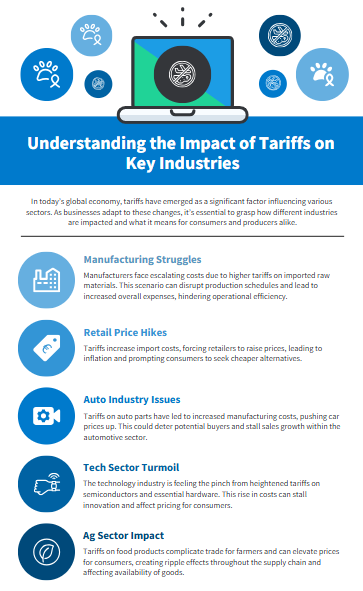
Already this year, the U.S. has implemented a 10% tariff on all goods imported from China and Hong Kong and has announced a 25% tariff on imports from Canada and Mexico, which has been temporarily paused for negotiations. These tariffs will have a significant impact on industries that rely on imports, including manufacturing, retail, automotive, and technology.
Industries Most Affected by Tariffs
-
Manufacturing: Higher input costs for raw materials and components sourced internationally, leading to increased production expenses and potential supply chain disruptions.
-
Retail & Consumer Goods: Increased prices for imported goods, leading to inflationary pressures and shifting consumer behavior.
-
Automotive: Higher costs for parts and assembly components, leading to price hikes and potential declines in sales.
-
Technology & Electronics: Increased tariffs on semiconductors, devices, and hardware components, raising production costs for electronics manufacturers.
-
Food & Agriculture: Tariffs on agricultural imports and exports affecting supply chains and pricing, impacting both producers and consumers.
Impact to the CFO’s Metrics
Tariffs introduce volatility that directly impacts a company’s cash flow, budgeting, and forecasting. Businesses must anticipate fluctuations in costs and revenue due to policy changes, making financial agility a necessity.
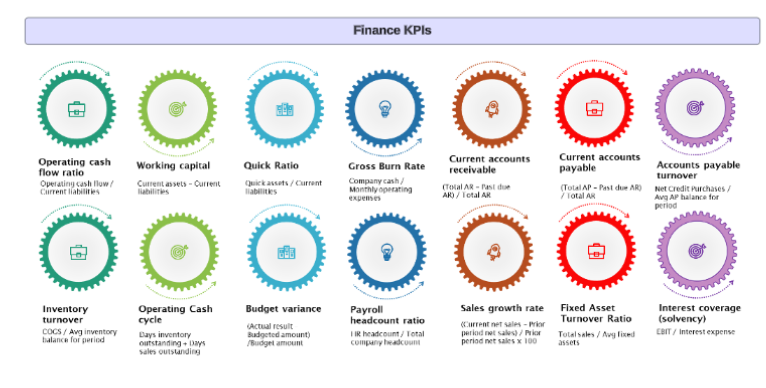
Key financial risks include:
-
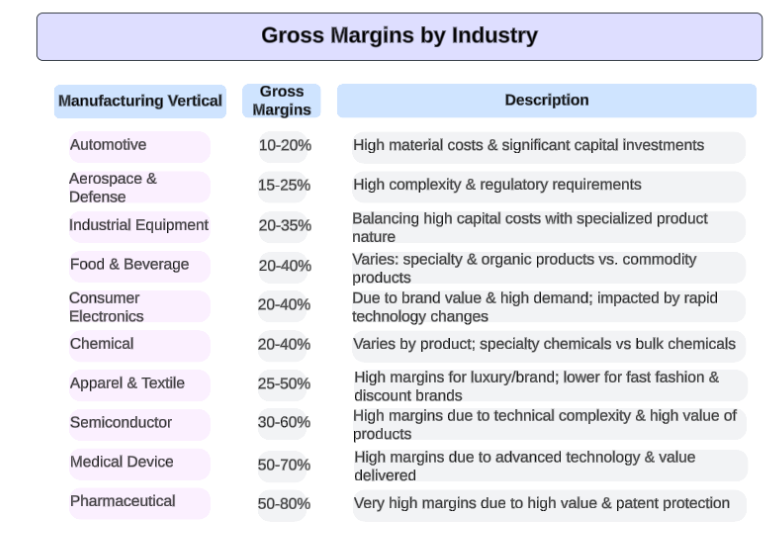
Increased Cost of Goods Sold (COGS): Higher input costs lead to reduced margins, making it essential to adjust pricing strategies. For example, a U.S.-based electronics manufacturer relying on Chinese components may experience a 20% rise in costs due to import duties, requiring adjustments in product pricing or supplier diversification. Manufacturing industries are already constrained when it comes to gross margins so quick navigation and pivoting will be required.
Other financial impact
-
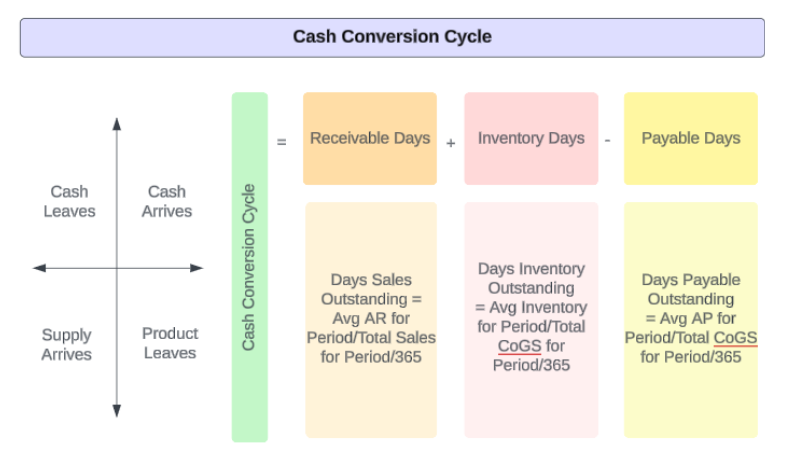
Strained Liquidity: Upfront payments for goods may increase, putting pressure on working capital and requiring efficient treasury management. A fashion retailer importing apparel from tariff-affected regions may need to pay higher initial costs, impacting their ability to invest in seasonal inventory expansion.
-
Delayed Supplier Payments: Companies may need to negotiate extended payment terms or explore alternative financing options to maintain cash flow stability. An automotive parts distributor might extend supplier payment terms from 30 to 60 days to offset higher tariffs on imported steel and aluminum.
-
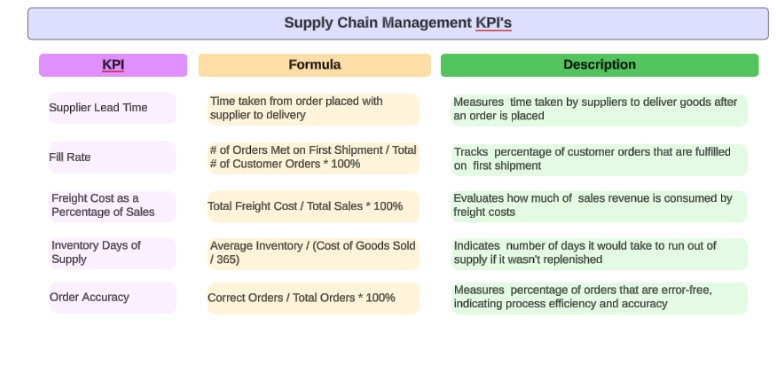
Inventory Challenges: Stockpiling goods before tariffs take effect can tie up cash reserves, requiring careful balance sheet management. A furniture retailer may order excess inventory ahead of tariff hikes on wood and upholstery materials, increasing warehouse costs and liquidity strain.
-
Unpredictable Demand: Price increases can reduce consumer demand, affecting revenue projections and profitability forecasts. For instance, a consumer electronics brand facing a 15% tariff on imported components may see lower sales due to increased retail prices, requiring revised demand forecasting models
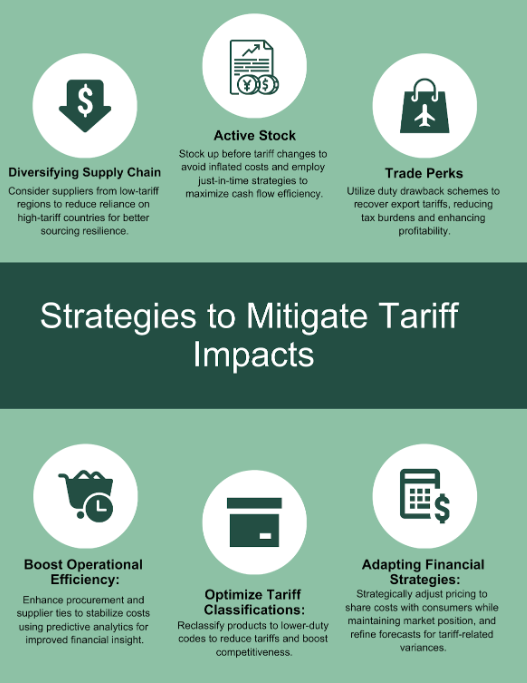
The Playbook for CFOs to Mitigate Tariff Impacts
1. Diversify Supply Chains
Identify alternative suppliers in non-tariff regions (e.g., Southeast Asia, Latin America) to mitigate reliance on high-tariff markets.
Reshore or nearshore production to reduce dependency on tariff-affected countries, ensuring more stable supply chains.
2. Advance Inventory Procurement
Pre-purchase goods before tariff increases take effect to minimize cost increases.
Implement better demand planning and just-in-time inventory management to optimize working capital utilization.
3. Enhance Operational and Financial Efficiency
Optimize procurement processes and strengthen supplier negotiations to control costs.
Streamline financial operations, enhance cash flow forecasting, and implement AI-driven analytics to mitigate tariff-related risks.
4. Implement Tariff Engineering
Reclassify imported goods under lower-duty tariff codes to optimize tax liabilities.
Modify product components to change the country of origin classification and reduce exposure to high tariffs.
5. Adjust Pricing and Financial Planning
Pass some costs to consumers strategically while maintaining competitive pricing.
Adjust financial forecasts to account for tariff-induced cost fluctuations, ensuring accurate financial reporting and scenario planning.
Planning for Volatile Times
Navigating tariffs requires a long-term approach that balances risk mitigation, cost control, and operational flexibility. CFOs must ensure that their organizations are resilient against sudden policy shifts and economic fluctuations. To achieve this, businesses must develop a comprehensive strategy encompassing financial planning, supply chain management, and technological investments.
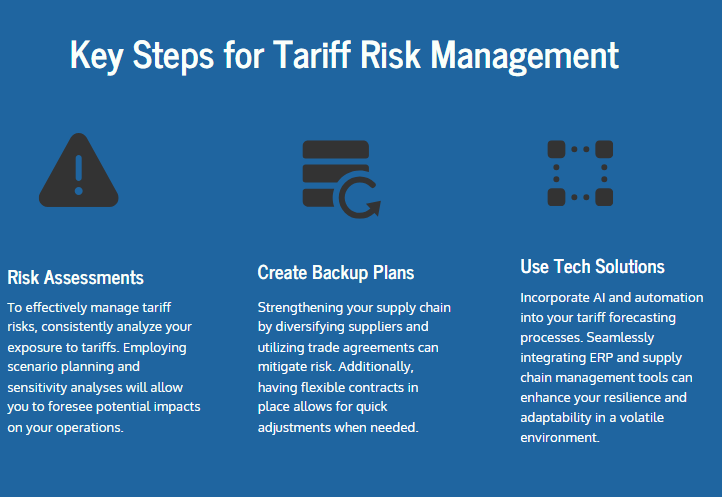
To effectively manage long-term tariff risks, CFOs should establish a tariff risk management framework, which includes the following key initiatives:
-
Conducting Regular Risk Assessments: Periodic evaluations of tariff exposure are critical in understanding how policy changes impact different aspects of the business. CFOs should use scenario planning and sensitivity analysis to gauge the financial effects of varying tariff rates and adjust mitigation strategies accordingly.
-
Building Robust Contingency Plans: Sudden trade policy changes can disrupt supply chains and financial planning. CFOs should create contingency strategies, such as establishing alternative supplier networks, leveraging global trade agreements, and securing flexible contract terms to adapt swiftly to new trade restrictions.
-
Leveraging Advanced Financial and Supply Chain Technologies: Investing in AI-driven analytics and automation can enhance decision-making. AI-powered forecasting tools can model different tariff scenarios, allowing businesses to plan cash flow needs, optimize procurement, and adjust pricing models in real time. Additionally, integrating Enterprise Resource Planning (ERP) and supply chain management software can help monitor and respond to tariff fluctuations efficiently.
Go deeper: Guide 12, Business Turnarounds & Restructuring, part of the CFO Guide Series: 24 one-page guides for CEOs and founders.
