
The CFO Role Is Being Rewritten and Automation Is the Least Interesting Part
For most of the past decade, "finance transformation" was something a CFO did in response to an event: a merger, an ERP migration,8 a change in ownership. That era is over. Gartner's Evanta community, which surveys more than 100 finance chiefs annually, reports that executing finance transformation has held the No. 1 spot on the CFO agenda for a third consecutive year heading into 2026 — with AI and automation climbing to No. 2, up from fourth a year earlier. Transformation is no longer a project. It's a standing agenda item.
The question worth asking is why. The answer says a lot about where the CFO role is headed.
Automation is the small prize
The dominant AI conversation in finance circles is still about automation: reconciliations, invoice processing, close acceleration, data prep. That work matters CFO Connect's Top CFO Tools Report found 56% of finance leaders now use AI tools in their daily work, and most of that adoption sits in administrative workflows.
But compressing a three-day task into three minutes doesn't change a single decision. As Spendesk CFO Pauline Babel put it, most adoption remains stuck in administrative work, and the real opportunity is extending AI into core finance functions accounting, forecasting, compliance, and strategic decision-making.
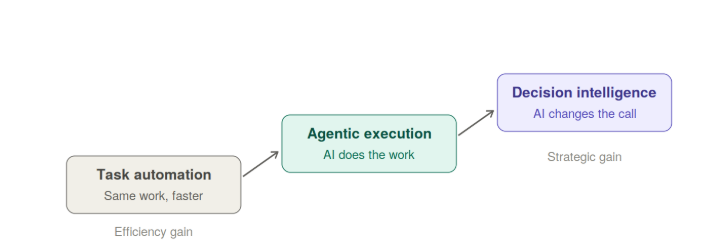
The more consequential shift is AI moving from adviser to partner. A chatbot answers questions. Agentic tools sit inside the files and take on the work itself. Once analysts cross that line, execution stops being the bottleneck. The scarce resource becomes asking the right questions and that's where decisions actually change.
From point estimates to probability
Nowhere is this clearer than forecasting. Most finance teams still deliver "the forecast" one number, refreshed monthly, with everyone in the room quietly aware the real range is wider than the number admits. A single point estimate is false precision dressed up as confidence.
The emerging alternative borrows from meteorology: run many independent models simultaneously and read the spread. Where the models converge, that's confidence. Where they diverge, that's the signal — some variable nobody has pinned down is moving the answer. Finance leaders who have rebuilt forecasting this way report top-line variance dropping from the 9–10% range to roughly 2%. Wellhub CFO Bruno Annicq, who described exactly this rebuild in a recent CFO.com interview, argues the behavioral change matters more than the accuracy gain: finance stops delivering a number and starts delivering a clear view of uncertainty.
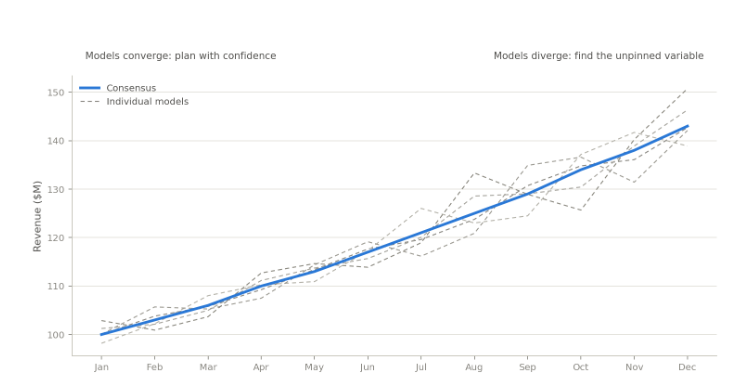
The payoff is not academic. A noisy forecast is a growth problem, not just a credibility problem. When your number is uncertain, you plan around the worst case and under-invest. Tighten the band, and you can deploy the same dollars around the most likely case instead. Probabilistic operating isn't about being less certain it's about being honest about what you know, and that honesty compounds.
What separates real investment from theater
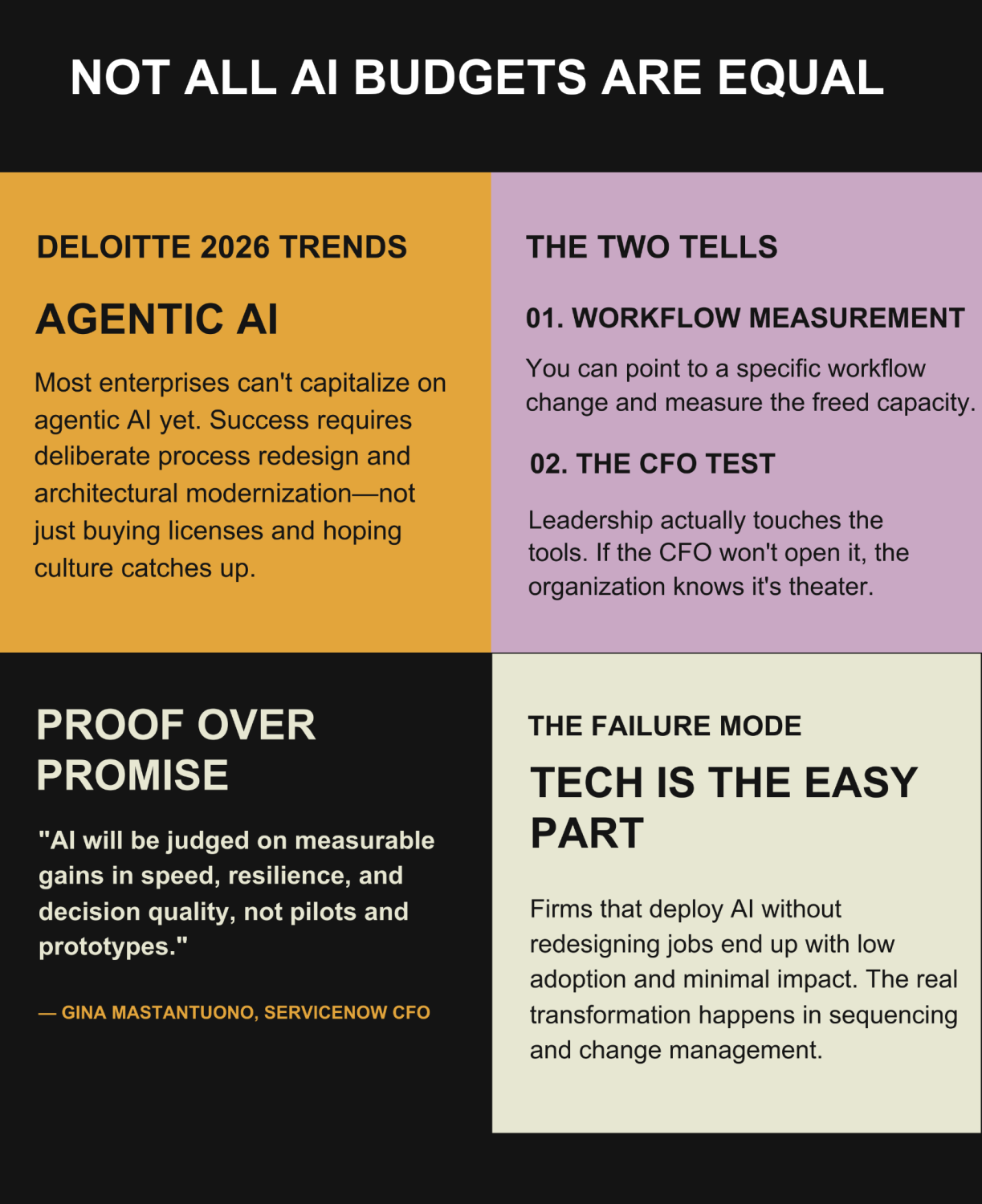
Not every AI budget line is created equal. Deloitte's 2026 tech trends work notes that most enterprises still can't capitalize on agentic AI; the organizations pulling ahead are doing deliberate process redesign, architectural modernization, and governance work not buying licenses and hoping culture catches up.
Two tells separate meaningful investment from trend-chasing. First, you can point to the specific workflow that changed and measure what the freed capacity produced. Second, leadership actually touches the tools. If the CFO won't open the thing, the organization knows it's theater. ServiceNow president and CFO Gina Mastantuono predicted that in 2026, AI will be judged on proof rather than promise measurable gains in speed, resilience, and decision quality, not pilots and prototypes. That standard applies to the CFO's own desk first.
The failure mode is well documented: firms that deploy AI tooling without redesigning jobs and workflows end up with technology deployed, adoption low, and impact minimal.
Technology is not the hard part of this transformation. Sequencing and change management are.
The role itself is changing shape
Underneath the tooling conversation is a structural one. The CFO whose entire job is closing the books and guarding the budget is becoming a smaller job. Finance is the one function that sees across every other function revenue, cost, cash, talent so it's natural that it operates rather than merely reports. Wolters Kluwer's 2026 Future Ready CFO research found 83% of finance leaders identify AI as a key force reshaping their function, and the framing across the industry has shifted from data gatekeeper to strategic business partner.
But "operational" deserves a caveat. It doesn't mean finance colonizes the rest of the company. The operational CFO earns the seat by making other people's decisions better and faster an enabler and co-pilot, not a gatekeeper. The good ones are operational in service of the business, not in competition with it.
What gets hired for next
Compress the trend lines and a picture of the next-generation CFO emerges.
First, hands-on fluency with probabilistic thinking and the AI tooling underneath it doing it, not delegating it. The CFO who personally understands how the forecast is built, and whose own agents can pressure-test the assumptions, makes better calls than the one waiting for the deck.
Second, range. The CFO who only knows finance will lose to the one who understands the operating model, the talent equation, and the hidden cost drivers sitting outside the P&L's traditional lines.
Third and this is the capability people underestimate as more work gets automated the judgment to know what not to automate. As execution gets cheap, the scarce skill becomes recognizing which decisions are irreversible and deserve a human in the room.
A decade ago you hired a CFO for control and reporting. The next generation gets hired for capital allocation under uncertainty and for being the clearest thinker in the building. Automation will keep taking the routine work. The leaders who win won't be the ones who automated the most. They'll be the ones who used the freed capacity to make better decisions and knew which decisions to keep for themselves.
Go deeper: Guide 05, Finance Automation & AI Implementation, part of the CFO Guide Series: 24 one-page guides for CEOs and founders.
