
Multi-Location Payroll Is Broken (Until You Fix the System)
Most growing companies don’t have a payroll problem.
They have a system problem.
And it only shows up when they scale.
That’s exactly what happened at N&N Moving Supplies.
The Hidden Cost of Growth
N&N started as a single-location distributor.
Simple operations.
Tight control.
Manual processes worked.
Then they expanded.
Multiple locations.
More employees.
More complexity.
And suddenly:
-
Payroll errors increased
-
Reporting slowed down
-
Teams lost visibility
Growth didn’t break the business.
Fragmentation did.
The Real Bottlenecks (Most CFOs Miss This)
At first glance, the issues looked operational:
-
Manual time tracking
-
Payroll delays
-
Reconciliation effort
But underneath, the real problems were:
Disconnected systems.
No real-time data.
High manual dependency
Their stack looked like this:
-
QuickBooks for accounting
-
Third-party payroll provider
-
Spreadsheets for time tracking
Result?
Duplicate work + delayed insights + rising errors
The Turning Point: Thinking in Systems
N&N didn’t just “upgrade software”
They redesigned how payroll works.
Their goal wasn’t efficiency.
It was integration.
The Solution: One Unified Finance + HR Engine
They implemented NetSuite ERP
But the real win wasn’t the tool.
It was how they used it:
-
Automated time tracking
-
Integrated payroll + finance
-
Real-time labor visibility
-
Employee self-service access
They also partnered with NOVAtime to bring:
Advanced time-clock functionality
Seamless workforce data capture
Implementation That Actually Worked
Most ERP projects fail because of execution.
This one didn’t.
Why?
Because they treated it like a cross-functional system, not an IT project.
What they did differently:
-
Finance, HR, IT, and operations worked together
-
Custom dashboards (iPad-enabled) at each location
-
Hands-on employee training
-
Clear communication from leadership
This ensured:
Adoption
Accuracy
Long-term success
The Results (This Is Where It Gets Interesting)
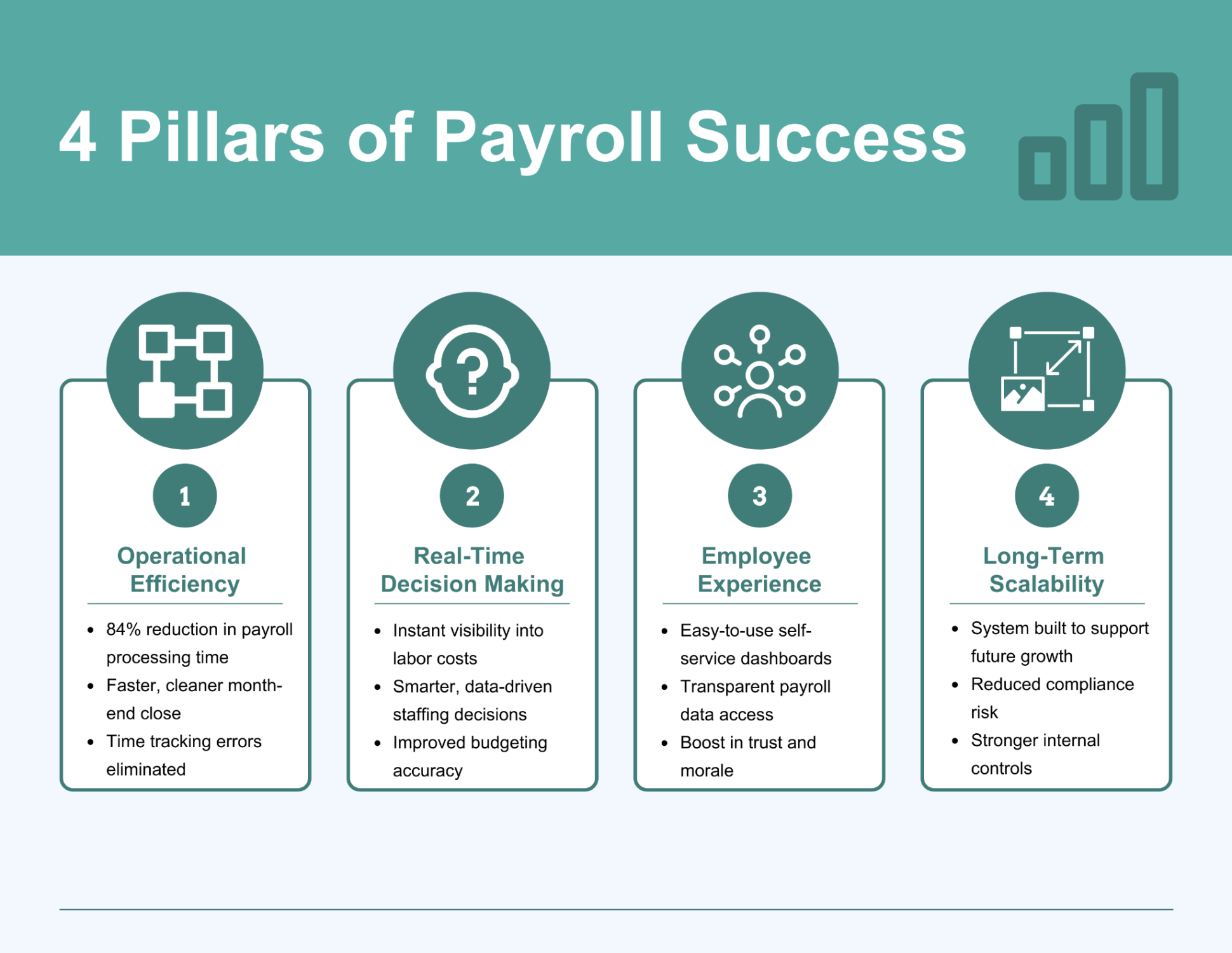
Operational Efficiency
-
84% reduction in payroll processing time
-
Month-end close became faster and cleaner
-
Time tracking errors → eliminated
Real-Time Decision Making
-
Instant visibility into labor costs
-
Better staffing decisions
-
More accurate budgeting
Employee Experience
-
Self-service dashboards
-
Transparent payroll data
-
Increased trust and morale
Long-Term Scalability
-
System supports future expansion
-
Reduced compliance risk
-
Stronger internal controls
The Bigger Insight Most Companies Miss
Payroll isn’t just a back-office function.
It’s a data engine.
When structured correctly, it tells you:
-
Where your costs are rising
-
How efficiently teams operate
-
Where to optimize workforce spend
Without this?
You’re running blind.
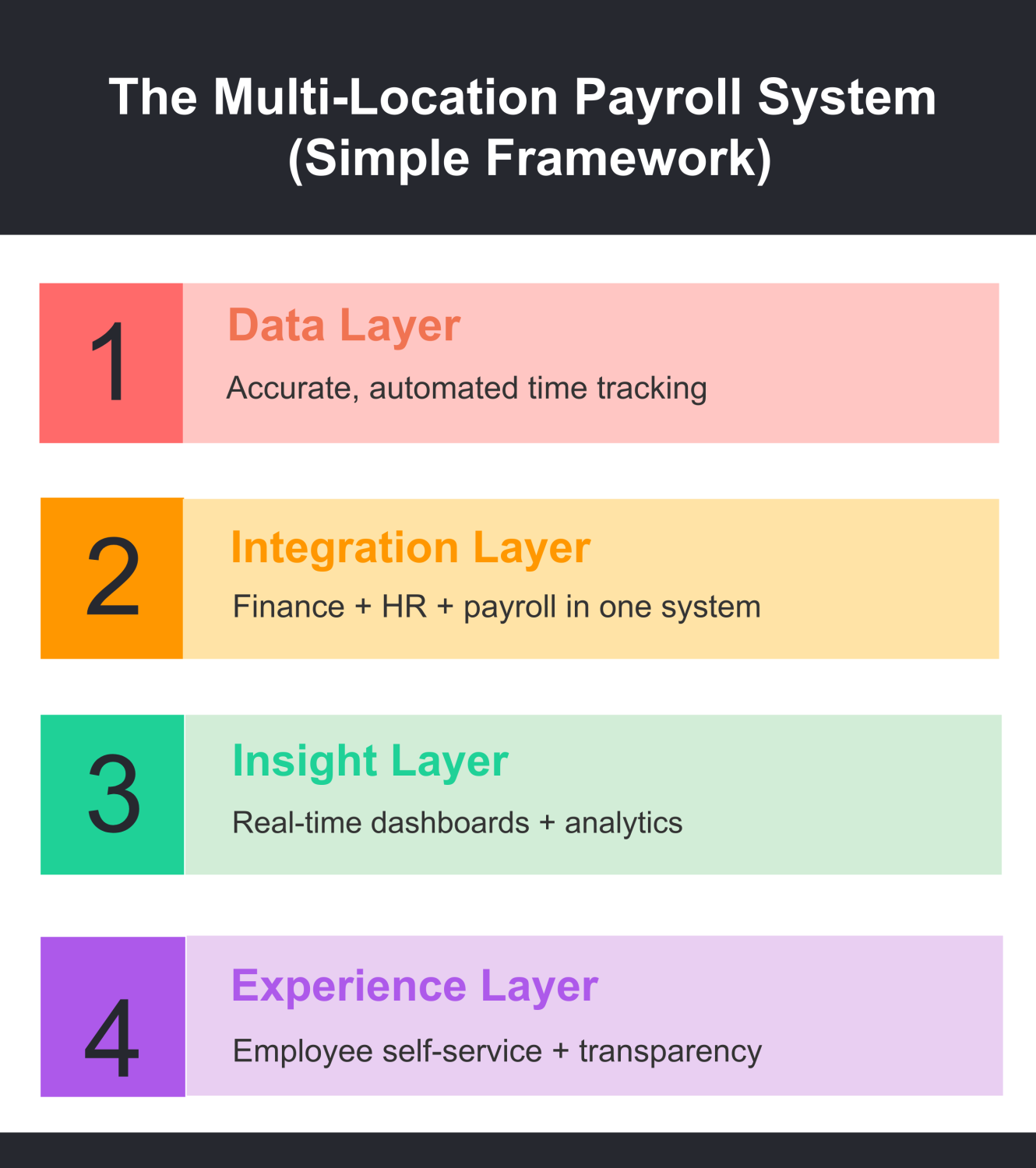
The Multi-Location Payroll System (Simple Framework)
If you’re scaling, think in this model:
1. Data Layer
Accurate, automated time tracking
2. Integration Layer
Finance + HR + payroll in one system
3. Insight Layer
Real-time dashboards + analytics
4. Experience Layer
Employee self-service + transparency
Miss one?
The system breaks.
Go deeper: Guide 16, HR Software & Tools, part of the CFO Guide Series: 24 one-page guides for CEOs and founders.
