
How to Choose the Best FP&A Tool: What CFOs Are Saying
Beyond Spreadsheets – Why FP&A Tools Matter
For finance departments, spreadsheets have long been the go-to tool for budgeting, forecasting, and financial planning. While Excel and Google Sheets provide familiarity and flexibility, they often come with challenges in version control, data integrity, and collaboration. The complexity of managing financial data across multiple spreadsheets increases as you scale, leading to inefficiencies, errors, and limited visibility into real-time insights.
This is where Financial Planning and Analysis (FP&A) tools come into play. By moving beyond basic spreadsheet functionality, these tools offer a more structured, automated approach to financial management. They enable the CFO and finance team to focus on strategic decision-making rather than manual data consolidation, ultimately leading to more accurate forecasting, better scenario analysis, and improved business agility. The right FP&A tool can be a game-changer, helping organizations unlock valuable insights, drive growth, and stay competitive in a dynamic business environment. We summarized some feedback from our CFO buddies below to give you a sense of what people are using.
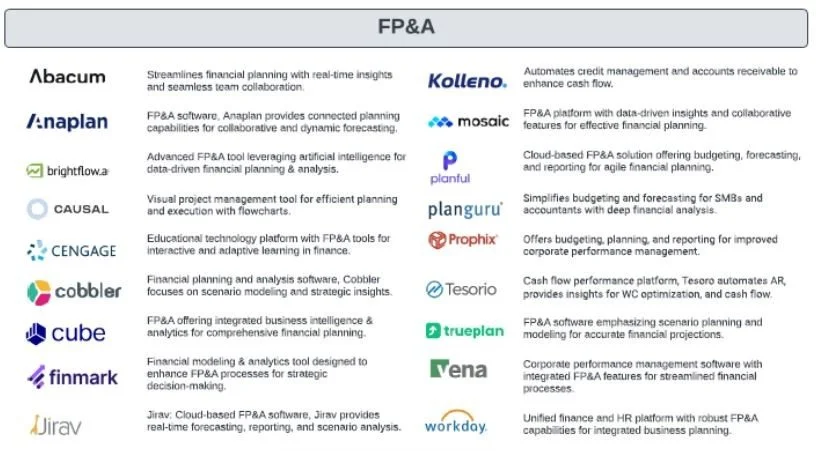
The Pros and Cons of FP&A Tools
Pros and Cons Recap
-
Pros: Enhanced data analysis, improved collaboration, automation of repetitive tasks, integration capabilities, scalability.
-
Cons: Learning curve, implementation complexity, cost, data security concerns, customization limitations.
Detailed Summaries of Specific FP&A Tools:
1. Abacum
-
Best for: Small to medium-sized businesses (SMBs) looking for real-time collaboration and easy-to-use financial planning tools.
-
Pros: User-friendly interface, real-time collaboration, strong data visualization.
-
Cons: Limited integration with other software tools.
2. Anaplan
-
Best for: Large international enterprises and organizations with complex planning needs in sectors like finance, supply chain, and human resources.
-
Pros: Comprehensive connected planning capabilities.
-
Cons: Steep learning curve and higher implementation costs.
3. Brightflow
-
Best for: Startups and SMBs focused on cash flow management and real-time financial analytics.
-
Pros: AI-driven insights and effective cash flow forecasting.
-
Cons: Lacks advanced features required by larger organizations.
4. Causal
-
Best for: Startups and small companies seeking intuitive financial modeling and scenario analysis.
-
Pros: Strong focus on data visualization and scenario analysis.
-
Cons: Limited third-party integrations.
5. Cengage
-
Best for: Educational institutions and finance professionals looking to combine learning with financial analysis tools.
-
Pros: Interactive learning and adaptive finance tools.
-
Cons: Less suitable for enterprise-level planning.
6. Cobbler
-
Best for: Medium to large organizations in industries that require long-term forecasting and scenario modeling.
-
Pros: Strategic insights for financial planning.
-
Cons: Not as user-friendly, which may impact adoption.
7. Cube
-
Best for: Finance teams that prefer working within Excel but need advanced data capabilities for SMBs and medium-sized businesses.
-
Pros: Excel-based interface with powerful data management, a few friends use Cube.
-
Cons: Limited integrations outside the Microsoft ecosystem.
8. Finmark
-
Best for: Early-stage startups and small businesses focused on budgeting and financial planning.
-
Pros: Easy-to-use interface with a focus on SMBs.
-
Cons: Some say that it lacks the sophistication needed for complex financial modeling.
9. Jirav
-
Best for: Growing SMBs and mid-sized companies looking for real-time forecasting and scenario analysis.
-
Pros: Pretty good real-time forecasting and reporting.
-
Cons: Can start to add up for small businesses.
10. Kolleno
-
Best for: Companies of all sizes focusing on credit management and accounts receivable automation.
-
Pros: Automated AR and credit management.
-
Cons: Lacks broader FP&A features.
11. Mosaic
-
Best for: SaaS companies and high-growth startups that need advanced analytics and integration capabilities.
-
Pros: Strong focus on analytics and data visualization.
-
Cons: Complexity in setting up dashboards.
12. Planful
-
Best for: Medium to large enterprises looking for robust FP&A capabilities with scalable growth options.
-
Pros: Powerful data integration and customizable templates.
-
Cons: High learning curve and implementation costs.
13. PlanGuru
-
Best for: Small to medium-sized businesses focused on budgeting, forecasting, and financial analysis.
-
Pros: Simple and affordable budgeting tools.
-
Cons: Limited scalability for larger enterprises.
14. Prophix
-
Best for: Professional services firms and larger enterprises that need integrated performance management.
-
Pros: Comprehensive corporate performance management.
-
Cons: Implementation can be complex and costly.
15. Tesorio
-
Best for: Companies focused on optimizing cash flow and working capital, suitable for mid-sized to large enterprises.
-
Pros: Excellent AR automation and cash flow optimization.
-
Cons: Lacks comprehensive FP&A capabilities.
16. Truplan
-
Best for: Organizations of all sizes that prioritize scenario planning and financial projections.
-
Pros: Emphasizes scenario planning and accurate forecasting.
-
Cons: Requires training to fully utilize its features.
17. Vena
-
Best for: Companies with existing Excel expertise that need a familiar interface for financial planning, suitable for SMBs and larger businesses.
-
Pros: Combines ease of use with advanced analytics.
-
Cons: Customization and non-Microsoft integration limitations.
18. Workday Adaptive Planning
-
Best for: Large enterprises and companies with complex finance and HR needs that require integrated business planning.
-
Pros: Unified finance and HR platform with robust capabilities.
-
Cons: Higher price point, making it less accessible for smaller companies.
Choosing the right FP&A tool depends on your company's specific needs, size, and industry focus. Tools like Planful and Prophix are well-suited for larger enterprises looking for comprehensive capabilities, while solutions like Cube and Vena cater to those who prefer an Excel-based approach. Brightflow and Causal are excellent choices for startups and SMBs focusing on intuitive financial planning and modeling.
Paul Barnhurst has done quite a bit of work on FP&A and has his own site dedicated to FP&A so check it out at: https://www.thefpandaguy.com/
Assess each tool's capabilities, cost, and integration potential to find the best fit for your organization's financial planning and analysis needs. Good luck.
Go deeper: Guide 04, Finance Tech Stack & AI, part of the CFO Guide Series: 24 one-page guides for CEOs and founders.
