
CoPilot: So Many Changes in Such a Short Time
Transforming Finance with AI: Microsoft’s Copilot for Finance – Things will look even more different in 2026
From Introduction to Enterprise Backbone
Microsoft first introduced Copilot for Finance in the early 2020s, it was seen as an experimental leap, a promising AI-driven assistant aimed at eliminating repetitive finance tasks. In 2025, the platform has matured into a mission-critical system embedded across Microsoft’s global finance operations, enabling data-driven forecasting, real-time analytics, and executive-ready narratives at unprecedented speed.
The shift reflects a broader industry reality: finance organizations now grapple less with data scarcity and more with the overwhelming pace and volume of information. The challenge has moved from access to insight, from collecting data to turning it into actionable, timely decisions. Microsoft’s evolution of Copilot addresses this gap, positioning finance as an anticipatory, strategy-led partner to the enterprise.
Microsoft’s Finance Complexity in Context
By FY2025, Microsoft’s finance ecosystem included:
-
30,000+ cost centers worldwide
-
Multiple ERP systems spanning Dynamics 365, SAP, and legacy tools
-
Dozens of global legal entities with diverse compliance requirements
Even with world-class infrastructure, finance teams faced bottlenecks in variance analysis, reconciliations, data contextualization, and stakeholder-ready reporting. The limiting factor wasn’t systems, it was human time. Skilled professionals were buried in validation rather than guiding the strategic direction.
Evolution of Copilot Capabilities Since Launch
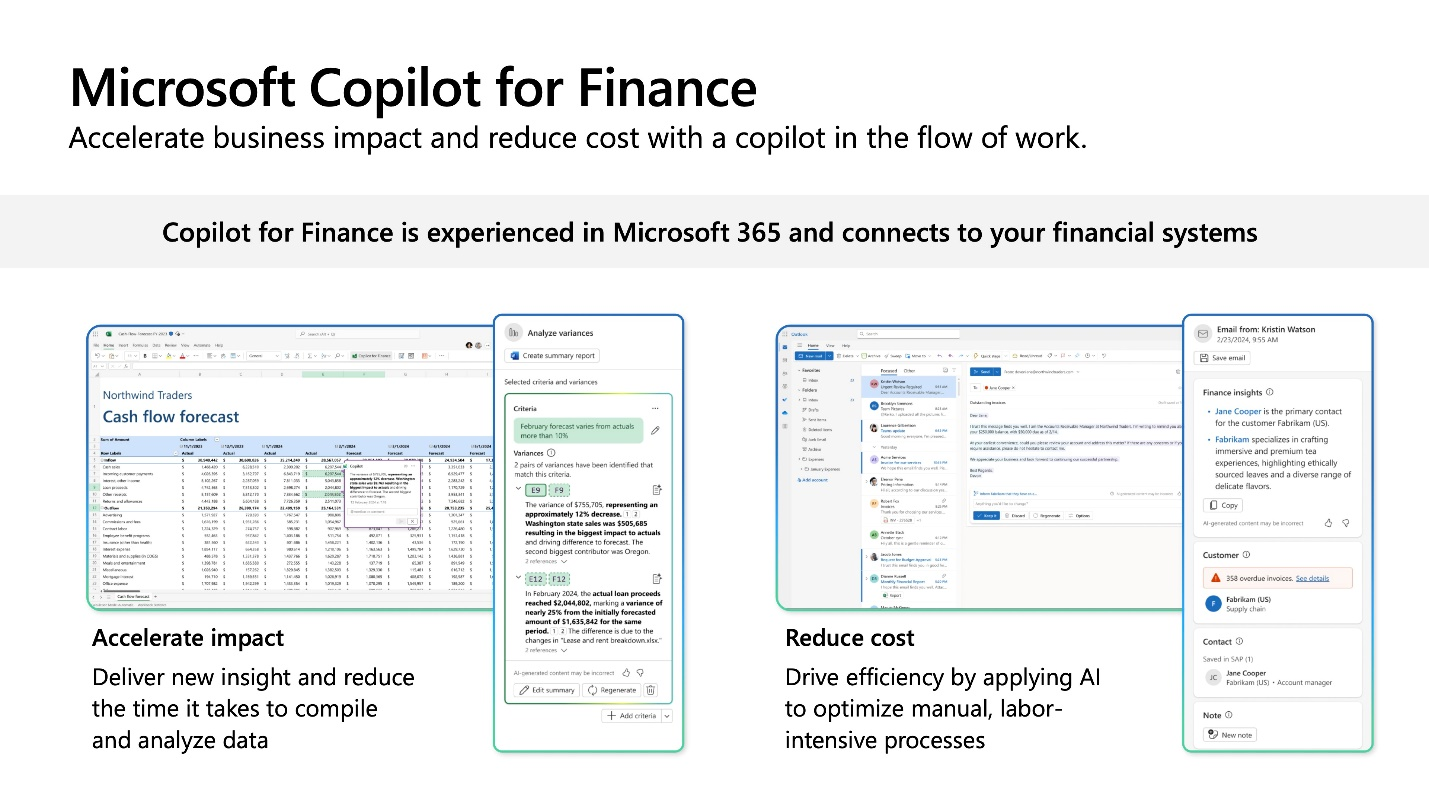
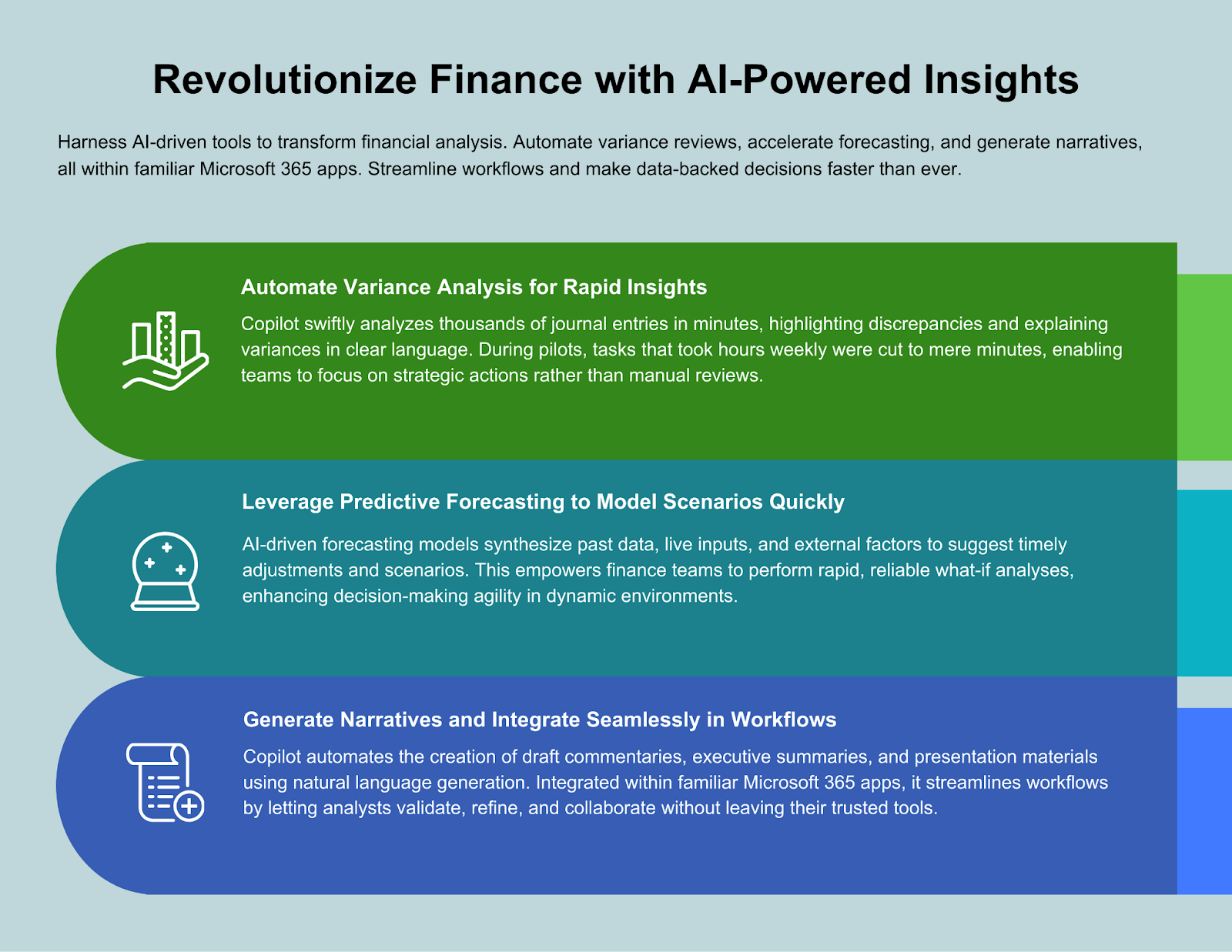
1. Automated Variance Analysis (Now Instant)
Early versions of Copilot could flag anomalies but required manual interpretation. In 2025, second-generation NLP models explain root causes in plain language and validate against unified datasets through Microsoft Fabric.
-
Impact: Variance cycle reduced from days to under an hour per business unit, unlocking faster closes and more confident forecasts.
2. Predictive Forecasting with External Data
Originally, Copilot simulated internal what-if scenarios. Now it integrates live economic indicators, supply chain signals, and competitive market data, enabling proactive budget adjustments before disruption hits.
-
Future trend: Expanding integration with ESG metrics and climate-impact forecasting for sustainability-linked financial planning.
3. Narrative Automation at Executive Grade
The first release could draft internal commentary. Today’s models generate board-ready narratives, CFO talking points, and visual data stories in Power BI, all auditable back to source transactions.
-
Impact: Reporting teams cut preparation time by 60%, with higher consistency across departments.
4. Microsoft Fabric Integration for End-to-End Visibility
New in 2025, Copilot pulls governed data across HR, supply chain, and sales into a single AI-ready pipeline. This empowers finance users to see cross-functional correlations—for instance, how workforce attrition impacts delivery timelines and revenue.
-
Future trend: Real-time KPIs presented continuously in Teams, allowing collaborative strategy sessions as events unfold.
5. Adaptive Learning Loops
The latest Copilot versions embed a feedback mechanism where finance users rate AI answers, enabling rapid retraining of models for company-specific context and jargon accuracy.
-
Future trend: Self-tuning models personalized per business unit or region.
Sector-Wide Expansion
Microsoft’s success has triggered adoption in multiple industries:
-
Retail: Proactive regional budget shifts based on demand volatility.
-
Manufacturing: Predictive cost modeling detects commodity spikes before contracts are locked.
-
Financial Services: Real-time fraud detection and anomaly flagging during close cycles.
-
Healthcare: AI-driven claim expense categorization ensuring nuanced compliance.
Future Development Trends
-
Real-Time Finance Copilots – Instant answers to “what should we do next?” via embedded AI in collaboration platforms.
-
Self-Governing AI Models – On-device AI that enforces privacy and compliance without sacrificing speed.
-
Generative Strategy Simulation – AI suggesting multiple strategic paths with quantified risk and ROI projections.
-
Conversational Finance Dashboards – Voice- or text-based queries yielding live financial insights in natural language.
-
Sustainability and Compliance AI – AI integrating carbon impact, DEI metrics, and tax optimization directly into financial strategy.
-
Federated AI Sharing Across Subsidiaries – Localized models sharing learnings without moving sensitive data.
Strategic Lessons for CFOs
-
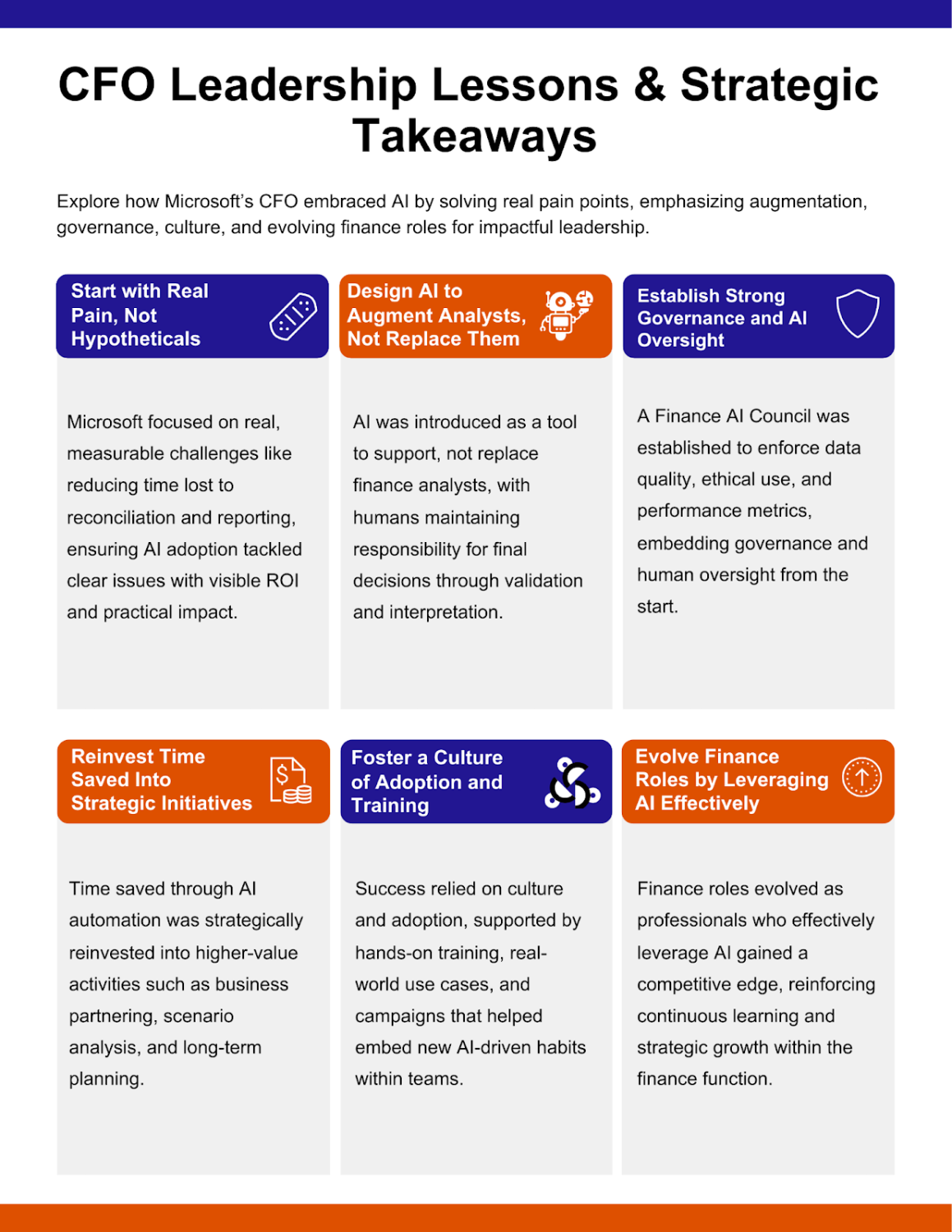
Target Pain Points First: Identify high-friction workflows and deploy AI where impact is immediate.
-
Augment, Don’t Replace: AI lifts analyst capacity rather than eliminates roles—human judgment remains the strategic cornerstone.
-
Institutionalize Governance: Microsoft’s Finance AI Council has become a template for oversight, balancing innovation and compliance.
-
Invest in Adoption Culture: Success comes from change management, training, and trust-building, not software licenses alone.
-
Redirect Effort Toward Foresight: The greatest ROI comes when freed time shifts to scenario planning and market positioning.
Microsoft’s Copilot for Finance, now deeply embedded and continuously learning, has evolved from an automation engine into a strategic foresight tool. Future iterations will eliminate the lag between market signals and executive action, ensuring finance is not simply reporting the past but architecting the future. The finance teams that embrace such capabilities will lead the next decade’s competitive landscape, blending AI intelligence with human insight to drive transformative outcomes.
Go deeper: Guide 04, Finance Tech Stack & AI, part of the CFO Guide Series: 24 one-page guides for CEOs and founders.
