
AI Has a CFO ROI Problem
You would never approve a $2 million capital request because “the team really likes it.”
That is roughly the standard AI spend is being held to right now.
A founder asked me last quarter what his company was spending on AI. He said forty thousand a year. The real number was closer to [$X], and it took two days and a credit card export to find, because it was spread across four departmental budgets, two SaaS renewals nobody had re-underwritten, a cloud line, and a consulting engagement where AI was a workstream rather than an invoice item.
That company had [X] months of runway. Nobody was hiding anything. The spend accumulated the way spend does when it arrives in pieces small enough that no single piece requires a decision.
Then his VP of Engineering asked for more, and it landed on me.
The deck was good. Adoption climbing, a testimonial from a team lead, a large number of hours saved. And I had to decide whether to underwrite a growing line item at a company with finite runway, using evidence that would not have survived five minutes of scrutiny if it had been attached to a lease, a headcount request, or a piece of capital equipment.
That is the actual problem. Not whether AI works. Not whether you’re behind.
Adoption is not ROI
Two versions of the same slide will cross your desk this year.
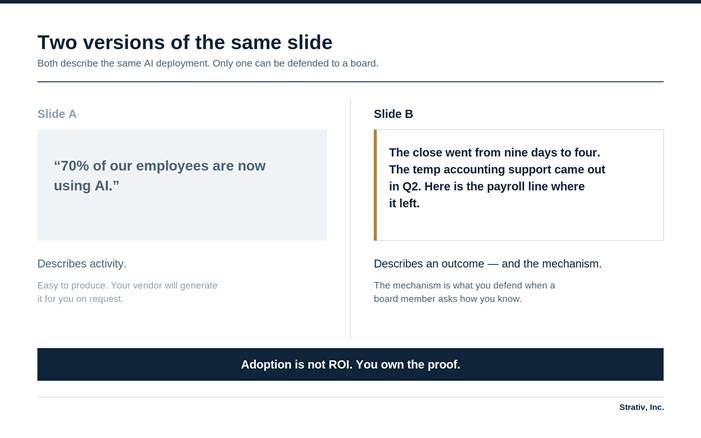
Both slides describe the same deployment. Only one shows a mechanism.
The first describes activity. The second describes an outcome and shows the mechanism connecting the two, which is the part that matters, because the mechanism is what you defend when a board member asks how you know.
Almost everything reported internally is the first slide. Number of users, number of licenses, employees trained, use cases identified. Those tell you the tool is being used. They tell you nothing about whether it earned its cost of capital. They are also the easiest metrics to produce, and your vendor will generate them for you on request. Nobody has to lie for this to go badly.
Your CIO owns the deployment. Your business unit leaders own the use cases. Your vendors own the enthusiasm. You own the proof.
In RGP’s survey of 200 U.S. finance chiefs, 48% said they were ultimately responsible for ensuring AI delivers measurable value, and 14% said they had seen a clear, measurable impact from it. Half of us are accountable for a return almost none of us can currently demonstrate.
So if you’re uneasy about what you’d say if your board asked tomorrow, you are in the majority. Staying there through another budget cycle is the part that’s a choice.
The stat in your inbox is being read wrong
Somebody has forwarded you the MIT finding: 95% of enterprise generative AI pilots produce no measurable P&L return.
Two things before you repeat it in a board meeting.
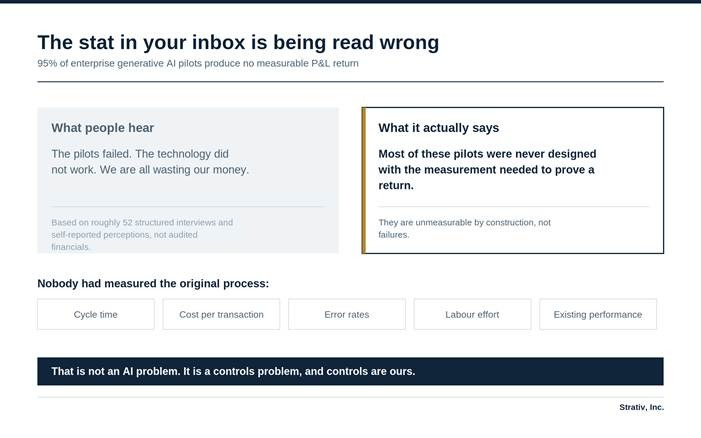
Read it again. It inverts the conversation.
Most of these programs aren’t failing. They are unmeasurable by construction. Somebody dropped a tool into a process nobody had ever timed, costed, or error-rated, and then asked finance to compute a return on it after the fact.
That’s not an AI problem. That’s a controls problem, and controls are ours.
It is the same disease that makes you miss forecast
I spend most of my time building KPI infrastructure and putting rigor into pipeline measurement, and the reason is simple. Companies miss their numbers for reasons that were visible months earlier to anyone who had instrumented the right thing.
A forecast miss almost never originates in the quarter it appears in. It originates two quarters back, when nobody was tracking stage conversion by cohort, or when the pipeline was measured in dollars rather than weighted against historical close rates, or when a definition drifted and nobody noticed that “qualified” had come to mean something different in September than it did in January. By the time the miss shows up in revenue, the information that would have predicted it is gone. You cannot reconstruct a baseline you never took.
The AI measurement problem is that same failure in newer clothes. In both cases a company is trying to answer a question about change without ever having measured the state it changed from.
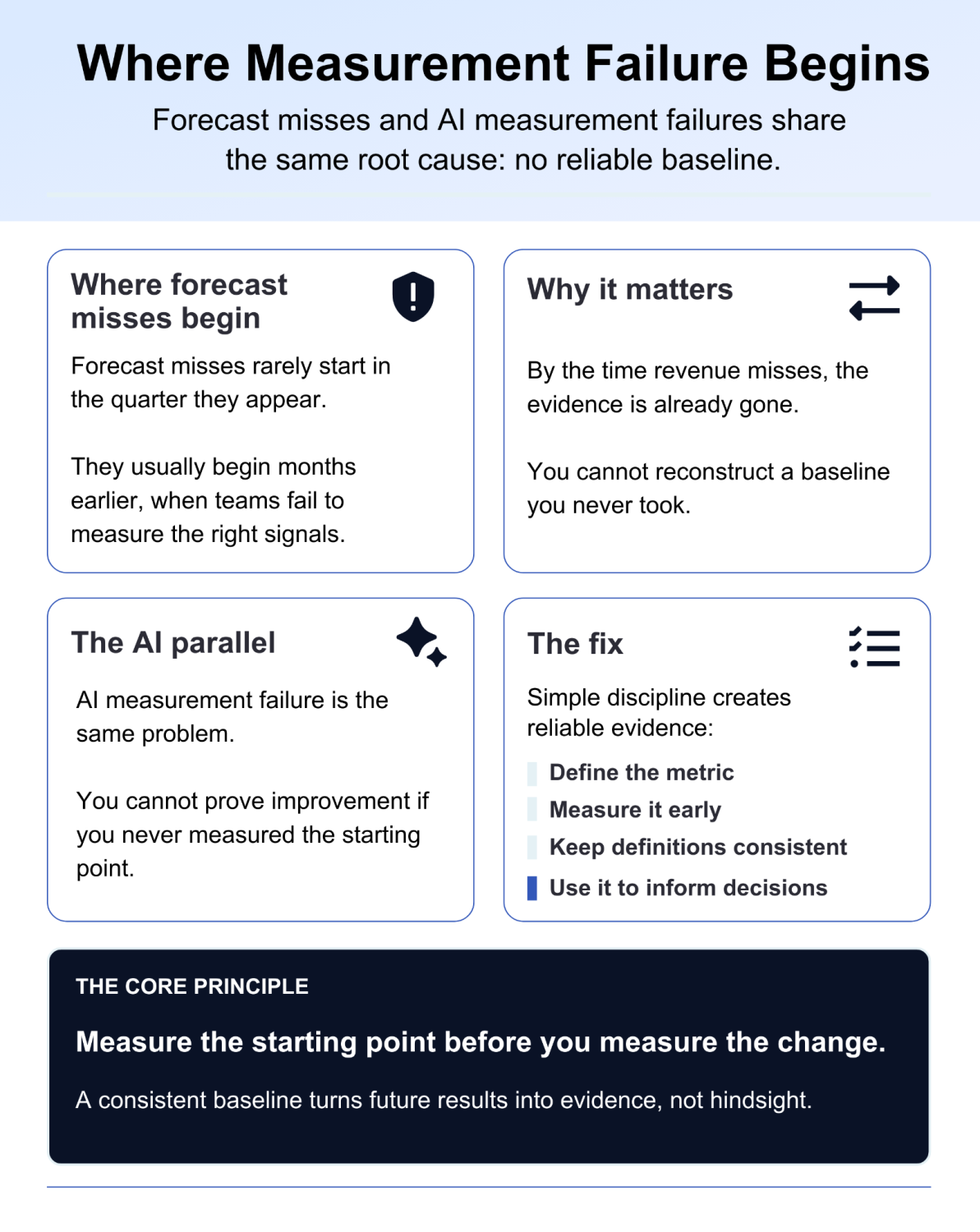
Which means the fix is one you already own. It isn’t an AI capability. It’s the ordinary discipline of defining a metric, instrumenting it before you need it, holding the definition stable, and putting it in front of the people who make the decision it’s meant to inform.
A company with that discipline can tell you what AI did for it. A company without it cannot tell you what anything did for it, and the AI question is simply the one that made the gap visible.
You don’t need a strategy. You need a gate.
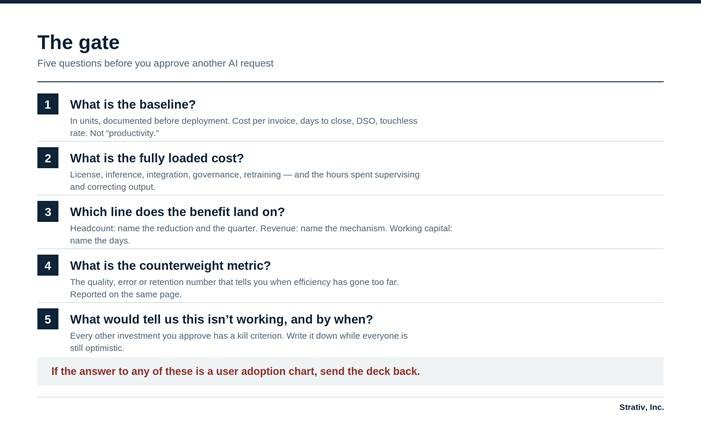
Five questions. The same standard you’d apply to a facilities lease.
Three of those deserve a note.
The baseline is the cheapest discipline available and the most frequently skipped, because it has to exist before deployment and no amount of analysis afterward will reconstruct it.
The fully loaded cost is almost never what the business case shows. If your team spends a meaningful share of the saved time correcting the tool, you didn’t capture productivity. You relocated it.
And the kill criterion has to be written while everyone is still optimistic. It becomes unwriteable later, when the vendor is a strategic partner and someone’s credibility is attached.
If the answer to any of the five is a user adoption chart, send the deck back. That isn’t obstruction.
The window is closing
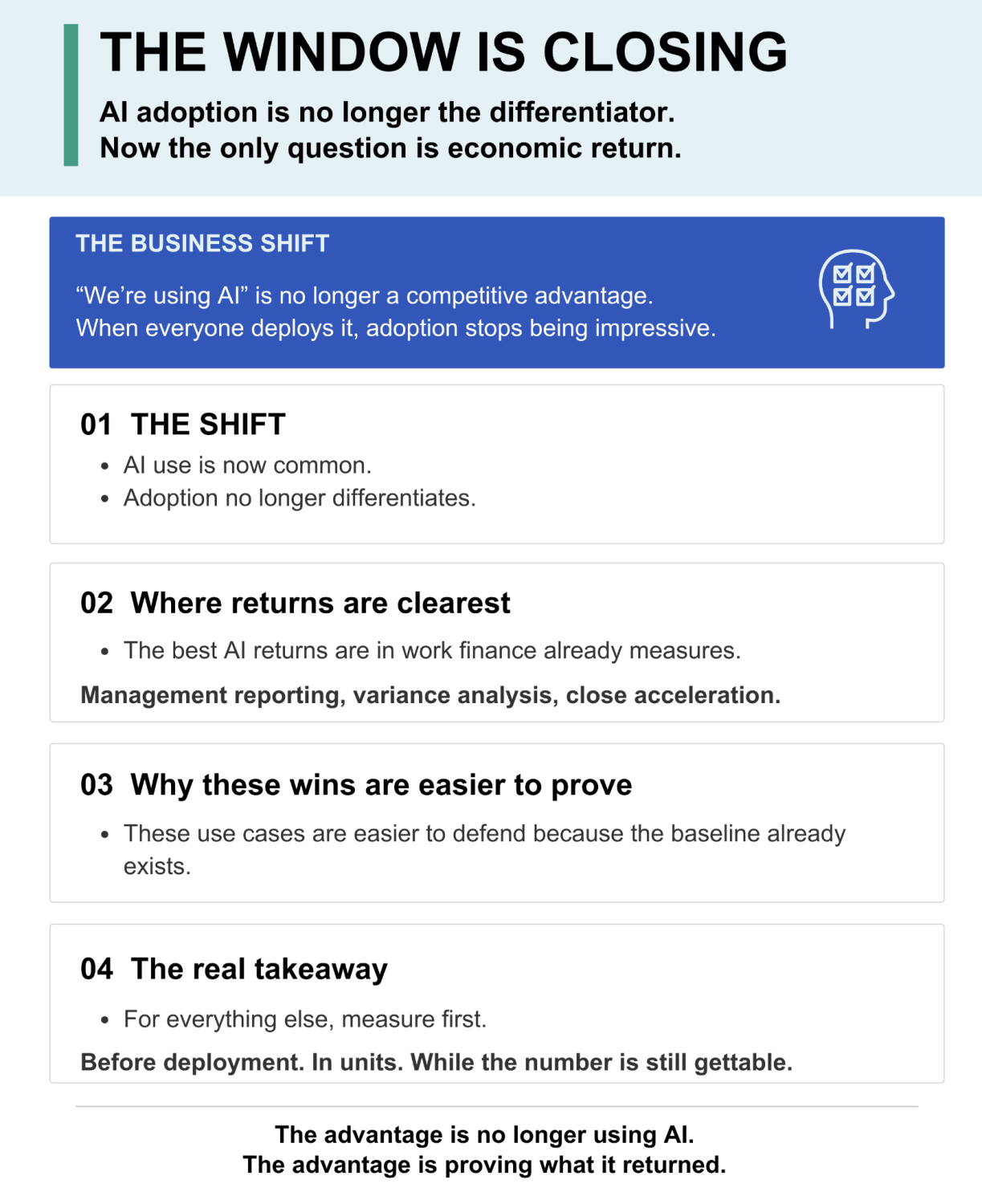
Deloitte’s Q2 2026 CFO Signals survey found 93% of large-company finance chiefs report AI in use across multiple functions. Which means “we’re using AI” no longer distinguishes anyone from anyone. Only the economics do.
None of this is an argument against the spend. The finance-function use cases in particular — management reporting, variance analysis, close acceleration — have the shortest payback and the cleanest measurement of anything on the board, because they sit in work you already own and already measure.
That’s exactly the point. The highest-confidence returns available to most companies are the ones where a baseline already exists.
Everywhere else, you have to go take it first. Before deployment. In units. While the number is still gettable.
Go deeper: Guide 05, Finance Automation & AI Implementation, part of the CFO Guide Series: 24 one-page guides for CEOs and founders.
